Songjian Wang, Tong Liu, Yi Liu, Nuonan Kou, Younuo Chen, Yuan Wang, Wenjian Sun, Shuo Wang
{"title":"Impact of hearing loss on brain signal variability in older adults under different auditory load conditions.","authors":"Songjian Wang, Tong Liu, Yi Liu, Nuonan Kou, Younuo Chen, Yuan Wang, Wenjian Sun, Shuo Wang","doi":"10.3389/fnagi.2025.1498666","DOIUrl":null,"url":null,"abstract":"<p><strong>Introduction: </strong>The moment-by-moment variability in brain signals, a newly recognized indicator, demonstrates both the adaptability of an individual's brain as a unique trait and the distribution of neural resources within that individual in response to constantly shifting task requirements. This study aimed to explore brain signal variability in older adults using oxyhemoglobin (HbO) variability derived from fNIRS during tasks with increasing signal-to-noise ratio (SNR) loads and to assess the effects of varying degrees of hearing loss on speech recognition performance and related brain signal variability patterns.</p><p><strong>Methods: </strong>Eighty-one participants were categorized into three groups: healthy controls (<i>n</i> = 30, aged 65.5 ± 3.4), mild hearing loss (<i>n</i> = 25, aged 66.0 ± 3.7), and moderate to severe hearing loss (<i>n</i> = 26, aged 67.5 ± 3.7). Speech perception was tested under quiet, 5 dB SNR, and 0 dB SNR conditions.</p><p><strong>Results: </strong>Results revealed that the brain signal variability increased with higher SNR loads in healthy older adults, indicating enhanced neural resource allocation with the SNR load. In contrast, we found that hearing loss reduced brain signal variability during speech recognition tasks, especially in noisy conditions, in the mild hearing loss and moderate to severe hearing loss groups, possibly indicating decreased neural processing efficiency. Additionally, a positive correlation between brain signal variability and speech recognition performance was observed in healthy control participants across all SNR conditions, suggesting that brain signal variability could dynamically respond to the precise level of auditory environment demands. However, this relationship was only significant at the 5 dB SNR condition in hearing loss groups.</p><p><strong>Discussion: </strong>Taken together, this study underscores the significant impact of hearing loss on brain signal variability modulation in auditory cognitive tasks and highlights the need for further research to understand the underlying neural mechanisms.</p>","PeriodicalId":12450,"journal":{"name":"Frontiers in Aging Neuroscience","volume":"17 ","pages":"1498666"},"PeriodicalIF":4.5000,"publicationDate":"2025-02-27","publicationTypes":"Journal Article","fieldsOfStudy":null,"isOpenAccess":false,"openAccessPdf":"https://www.ncbi.nlm.nih.gov/pmc/articles/PMC11903437/pdf/","citationCount":"0","resultStr":null,"platform":"Semanticscholar","paperid":null,"PeriodicalName":"Frontiers in Aging Neuroscience","FirstCategoryId":"3","ListUrlMain":"https://doi.org/10.3389/fnagi.2025.1498666","RegionNum":2,"RegionCategory":"医学","ArticlePicture":[],"TitleCN":null,"AbstractTextCN":null,"PMCID":null,"EPubDate":"2025/1/1 0:00:00","PubModel":"eCollection","JCR":"Q2","JCRName":"GERIATRICS & GERONTOLOGY","Score":null,"Total":0}
引用次数: 0
Abstract
Introduction: The moment-by-moment variability in brain signals, a newly recognized indicator, demonstrates both the adaptability of an individual's brain as a unique trait and the distribution of neural resources within that individual in response to constantly shifting task requirements. This study aimed to explore brain signal variability in older adults using oxyhemoglobin (HbO) variability derived from fNIRS during tasks with increasing signal-to-noise ratio (SNR) loads and to assess the effects of varying degrees of hearing loss on speech recognition performance and related brain signal variability patterns.
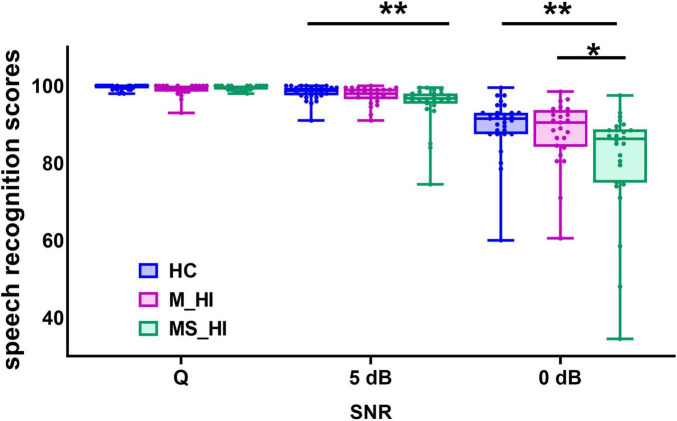
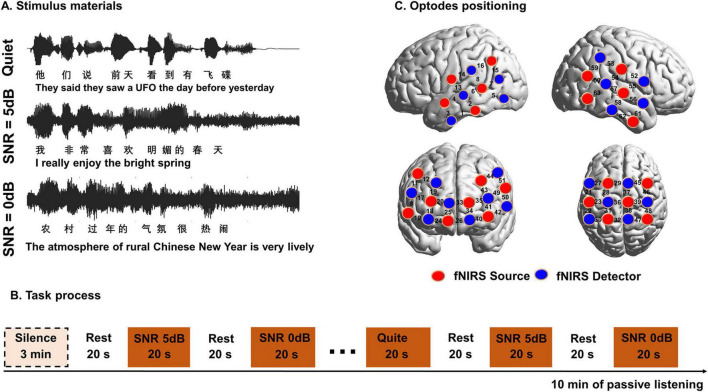
Methods: Eighty-one participants were categorized into three groups: healthy controls (n = 30, aged 65.5 ± 3.4), mild hearing loss (n = 25, aged 66.0 ± 3.7), and moderate to severe hearing loss (n = 26, aged 67.5 ± 3.7). Speech perception was tested under quiet, 5 dB SNR, and 0 dB SNR conditions.
Results: Results revealed that the brain signal variability increased with higher SNR loads in healthy older adults, indicating enhanced neural resource allocation with the SNR load. In contrast, we found that hearing loss reduced brain signal variability during speech recognition tasks, especially in noisy conditions, in the mild hearing loss and moderate to severe hearing loss groups, possibly indicating decreased neural processing efficiency. Additionally, a positive correlation between brain signal variability and speech recognition performance was observed in healthy control participants across all SNR conditions, suggesting that brain signal variability could dynamically respond to the precise level of auditory environment demands. However, this relationship was only significant at the 5 dB SNR condition in hearing loss groups.
Discussion: Taken together, this study underscores the significant impact of hearing loss on brain signal variability modulation in auditory cognitive tasks and highlights the need for further research to understand the underlying neural mechanisms.
期刊介绍:
Frontiers in Aging Neuroscience is a leading journal in its field, publishing rigorously peer-reviewed research that advances our understanding of the mechanisms of Central Nervous System aging and age-related neural diseases. Specialty Chief Editor Thomas Wisniewski at the New York University School of Medicine is supported by an outstanding Editorial Board of international researchers. This multidisciplinary open-access journal is at the forefront of disseminating and communicating scientific knowledge and impactful discoveries to researchers, academics, clinicians and the public worldwide.





 京公网安备 11010802042870号
京ICP备2023020795号-1
京公网安备 11010802042870号
京ICP备2023020795号-1

 分享
分享
 求助内容:
求助内容: 应助结果提醒方式:
 扫码关注我们
