Oanh Ngoc Nguyen, Doaa Amin, James Bennett, Øystein Hetlevik, Sara Malik, Andrew Tout, Heike Vornhagen, Akke Vellinga
{"title":"GP or ChatGPT? Ability of large language models (LLMs) to support general practitioners when prescribing antibiotics.","authors":"Oanh Ngoc Nguyen, Doaa Amin, James Bennett, Øystein Hetlevik, Sara Malik, Andrew Tout, Heike Vornhagen, Akke Vellinga","doi":"10.1093/jac/dkaf077","DOIUrl":null,"url":null,"abstract":"<p><strong>Introduction: </strong>Large language models (LLMs) are becoming ubiquitous and widely implemented. LLMs could also be used for diagnosis and treatment. National antibiotic prescribing guidelines are customized and informed by local laboratory data on antimicrobial resistance.</p><p><strong>Methods: </strong>Based on 24 vignettes with information on type of infection, gender, age group and comorbidities, GPs and LLMs were prompted to provide a treatment. Four countries (Ireland, UK, USA and Norway) were included and a GP from each country and six LLMs (ChatGPT, Gemini, Copilot, Mistral AI, Claude and Llama 3.1) were provided with the vignettes, including their location (country). Responses were compared with the country's national prescribing guidelines. In addition, limitations of LLMs such as hallucination, toxicity and data leakage were assessed.</p><p><strong>Results: </strong>GPs' answers to the vignettes showed high accuracy in relation to diagnosis (96%-100%) and yes/no antibiotic prescribing (83%-92%). GPs referenced (100%) and prescribed (58%-92%) according to national guidelines, but dose/duration of treatment was less accurate (50%-75%). Overall, the GPs' accuracy had a mean of 74%. LLMs scored high in relation to diagnosis (92%-100%), antibiotic prescribing (88%-100%) and the choice of antibiotic (59%-100%) but correct referencing often failed (38%-96%), in particular for the Norwegian guidelines (0%-13%). Data leakage was shown to be an issue as personal information was repeated in the models' responses to the vignettes.</p><p><strong>Conclusions: </strong>LLMs may be safe to guide antibiotic prescribing in general practice. However, to interpret vignettes, apply national guidelines and prescribe the right dose and duration, GPs remain best placed.</p>","PeriodicalId":14969,"journal":{"name":"Journal of Antimicrobial Chemotherapy","volume":" ","pages":"1324-1330"},"PeriodicalIF":3.6000,"publicationDate":"2025-05-02","publicationTypes":"Journal Article","fieldsOfStudy":null,"isOpenAccess":false,"openAccessPdf":"https://www.ncbi.nlm.nih.gov/pmc/articles/PMC12046391/pdf/","citationCount":"0","resultStr":null,"platform":"Semanticscholar","paperid":null,"PeriodicalName":"Journal of Antimicrobial Chemotherapy","FirstCategoryId":"3","ListUrlMain":"https://doi.org/10.1093/jac/dkaf077","RegionNum":2,"RegionCategory":"医学","ArticlePicture":[],"TitleCN":null,"AbstractTextCN":null,"PMCID":null,"EPubDate":"","PubModel":"","JCR":"Q1","JCRName":"INFECTIOUS DISEASES","Score":null,"Total":0}
引用次数: 0
Abstract
Introduction: Large language models (LLMs) are becoming ubiquitous and widely implemented. LLMs could also be used for diagnosis and treatment. National antibiotic prescribing guidelines are customized and informed by local laboratory data on antimicrobial resistance.
Methods: Based on 24 vignettes with information on type of infection, gender, age group and comorbidities, GPs and LLMs were prompted to provide a treatment. Four countries (Ireland, UK, USA and Norway) were included and a GP from each country and six LLMs (ChatGPT, Gemini, Copilot, Mistral AI, Claude and Llama 3.1) were provided with the vignettes, including their location (country). Responses were compared with the country's national prescribing guidelines. In addition, limitations of LLMs such as hallucination, toxicity and data leakage were assessed.
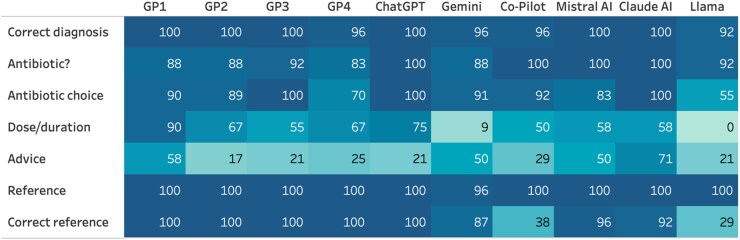
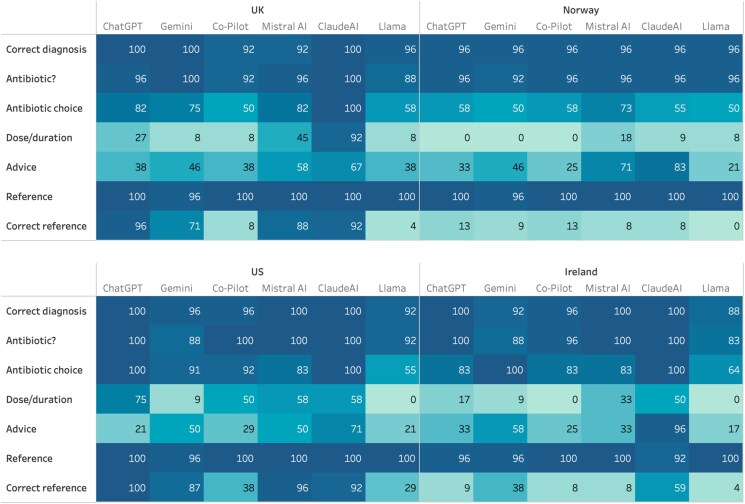
Results: GPs' answers to the vignettes showed high accuracy in relation to diagnosis (96%-100%) and yes/no antibiotic prescribing (83%-92%). GPs referenced (100%) and prescribed (58%-92%) according to national guidelines, but dose/duration of treatment was less accurate (50%-75%). Overall, the GPs' accuracy had a mean of 74%. LLMs scored high in relation to diagnosis (92%-100%), antibiotic prescribing (88%-100%) and the choice of antibiotic (59%-100%) but correct referencing often failed (38%-96%), in particular for the Norwegian guidelines (0%-13%). Data leakage was shown to be an issue as personal information was repeated in the models' responses to the vignettes.
Conclusions: LLMs may be safe to guide antibiotic prescribing in general practice. However, to interpret vignettes, apply national guidelines and prescribe the right dose and duration, GPs remain best placed.
期刊介绍:
The Journal publishes articles that further knowledge and advance the science and application of antimicrobial chemotherapy with antibiotics and antifungal, antiviral and antiprotozoal agents. The Journal publishes primarily in human medicine, and articles in veterinary medicine likely to have an impact on global health.



 京公网安备 11010802042870号
京ICP备2023020795号-1
京公网安备 11010802042870号
京ICP备2023020795号-1

 分享
分享
 求助内容:
求助内容: 应助结果提醒方式:
 扫码关注我们
