Katy Börner, Philip D. Blood, Jonathan C. Silverstein, Matthew Ruffalo, Rahul Satija, Sarah A. Teichmann, Gloria J. Pryhuber, Ravi S. Misra, Jeffrey M. Purkerson, Jean Fan, John W. Hickey, Gesmira Molla, Chuan Xu, Yun Zhang, Griffin M. Weber, Yashvardhan Jain, Danial Qaurooni, Yongxin Kong, HRA Team, Andreas Bueckle, Bruce W. Herr II
{"title":"Human BioMolecular Atlas Program (HuBMAP): 3D Human Reference Atlas construction and usage","authors":"Katy Börner, Philip D. Blood, Jonathan C. Silverstein, Matthew Ruffalo, Rahul Satija, Sarah A. Teichmann, Gloria J. Pryhuber, Ravi S. Misra, Jeffrey M. Purkerson, Jean Fan, John W. Hickey, Gesmira Molla, Chuan Xu, Yun Zhang, Griffin M. Weber, Yashvardhan Jain, Danial Qaurooni, Yongxin Kong, HRA Team, Andreas Bueckle, Bruce W. Herr II","doi":"10.1038/s41592-024-02563-5","DOIUrl":null,"url":null,"abstract":"The Human BioMolecular Atlas Program (HuBMAP) aims to construct a 3D Human Reference Atlas (HRA) of the healthy adult body. Experts from 20+ consortia collaborate to develop a Common Coordinate Framework (CCF), knowledge graphs and tools that describe the multiscale structure of the human body (from organs and tissues down to cells, genes and biomarkers) and to use the HRA to characterize changes that occur with aging, disease and other perturbations. HRA v.2.0 covers 4,499 unique anatomical structures, 1,195 cell types and 2,089 biomarkers (such as genes, proteins and lipids) from 33 ASCT+B tables and 65 3D Reference Objects linked to ontologies. New experimental data can be mapped into the HRA using (1) cell type annotation tools (for example, Azimuth), (2) validated antibody panels or (3) by registering tissue data spatially. This paper describes HRA user stories, terminology, data formats, ontology validation, unified analysis workflows, user interfaces, instructional materials, application programming interfaces, flexible hybrid cloud infrastructure and previews atlas usage applications. This Resource describes data, code and tools developed for the Human Reference Atlas and the Human BioMolecular Atlas Program for building and navigating a multiscale human atlas.","PeriodicalId":18981,"journal":{"name":"Nature Methods","volume":"22 4","pages":"845-860"},"PeriodicalIF":32.1000,"publicationDate":"2025-03-13","publicationTypes":"Journal Article","fieldsOfStudy":null,"isOpenAccess":false,"openAccessPdf":"https://www.ncbi.nlm.nih.gov/pmc/articles/PMC11978508/pdf/","citationCount":"0","resultStr":null,"platform":"Semanticscholar","paperid":null,"PeriodicalName":"Nature Methods","FirstCategoryId":"99","ListUrlMain":"https://www.nature.com/articles/s41592-024-02563-5","RegionNum":1,"RegionCategory":"生物学","ArticlePicture":[],"TitleCN":null,"AbstractTextCN":null,"PMCID":null,"EPubDate":"","PubModel":"","JCR":"Q1","JCRName":"BIOCHEMICAL RESEARCH METHODS","Score":null,"Total":0}
引用次数: 0
Abstract
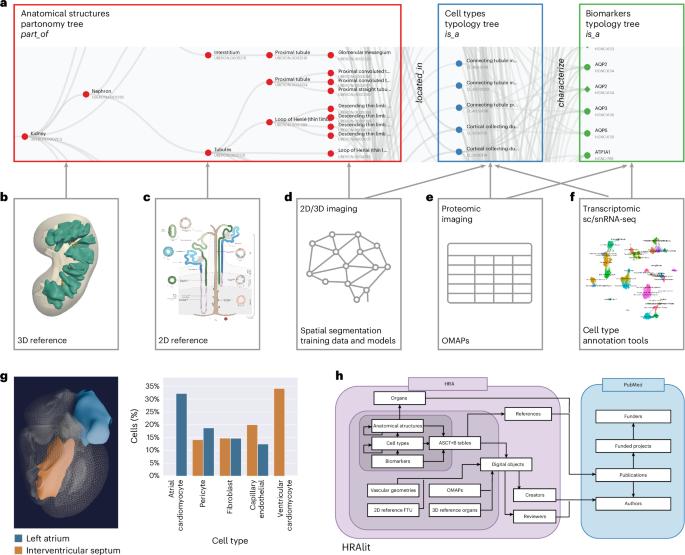
The Human BioMolecular Atlas Program (HuBMAP) aims to construct a 3D Human Reference Atlas (HRA) of the healthy adult body. Experts from 20+ consortia collaborate to develop a Common Coordinate Framework (CCF), knowledge graphs and tools that describe the multiscale structure of the human body (from organs and tissues down to cells, genes and biomarkers) and to use the HRA to characterize changes that occur with aging, disease and other perturbations. HRA v.2.0 covers 4,499 unique anatomical structures, 1,195 cell types and 2,089 biomarkers (such as genes, proteins and lipids) from 33 ASCT+B tables and 65 3D Reference Objects linked to ontologies. New experimental data can be mapped into the HRA using (1) cell type annotation tools (for example, Azimuth), (2) validated antibody panels or (3) by registering tissue data spatially. This paper describes HRA user stories, terminology, data formats, ontology validation, unified analysis workflows, user interfaces, instructional materials, application programming interfaces, flexible hybrid cloud infrastructure and previews atlas usage applications. This Resource describes data, code and tools developed for the Human Reference Atlas and the Human BioMolecular Atlas Program for building and navigating a multiscale human atlas.
期刊介绍:
Nature Methods is a monthly journal that focuses on publishing innovative methods and substantial enhancements to fundamental life sciences research techniques. Geared towards a diverse, interdisciplinary readership of researchers in academia and industry engaged in laboratory work, the journal offers new tools for research and emphasizes the immediate practical significance of the featured work. It publishes primary research papers and reviews recent technical and methodological advancements, with a particular interest in primary methods papers relevant to the biological and biomedical sciences. This includes methods rooted in chemistry with practical applications for studying biological problems.




 京公网安备 11010802042870号
京ICP备2023020795号-1
京公网安备 11010802042870号
京ICP备2023020795号-1

 分享
分享
 求助内容:
求助内容: 应助结果提醒方式:
 扫码关注我们
