Jennifer H Hwang, Neda Laiteerapong, Elbert S Huang, David D Kim
{"title":"Lifetime Health Effects and Cost-Effectiveness of Tirzepatide and Semaglutide in US Adults.","authors":"Jennifer H Hwang, Neda Laiteerapong, Elbert S Huang, David D Kim","doi":"10.1001/jamahealthforum.2024.5586","DOIUrl":null,"url":null,"abstract":"<p><strong>Importance: </strong>Newer antiobesity medications lead to greater weight loss and lower cardiometabolic risks. However, the high costs of these medications have raised policy questions about their value and coverage decisions.</p><p><strong>Objective: </strong>To compare the cost-effectiveness of 4 antiobesity medications with lifestyle modification vs lifestyle modification alone in the US.</p><p><strong>Design, setting, and participants: </strong>A lifetime cost-effectiveness analysis was conducted in 2024 using the validated Diabetes, Obesity, Cardiovascular Disease Microsimulation model for US adults. Data were included from the 2017-2020 National Health and Nutrition Examination Survey of 4823 individuals (representing 126 million eligible US adults) aged 20 to 79 years who would meet clinical trial inclusion criteria for antiobesity medications. Individual-level simulations projected long-term cardiometabolic outcomes, quality-adjusted life-years (QALYs), and health care expenditures. Probabilistic sensitivity analyses, subgroup analyses (across body mass index [BMI] categories [≥30 or ≥27 and at least 1 weight-related comorbidity], presence of comorbidities), and multiple scenario analyses (varying treatment discontinuation rates, value-based pricing benchmarks) were conducted. Future costs and QALYs were discounted at 3% annually.</p><p><strong>Interventions: </strong>Lifestyle modification with naltrexone-bupropion, phentermine-topiramate, semaglutide, or tirzepatide vs lifestyle modification alone.</p><p><strong>Main outcomes and measures: </strong>Obesity, diabetes, and cardiovascular disease cases averted, life-years and QALYs gained, costs incurred (2023 US dollars), and incremental cost-effectiveness ratios.</p><p><strong>Results: </strong>Among the 126 million eligible US adults, the mean age was 48 (SE, 0.5) years; 51% were female; and the initial mean BMI was 34.7 (SE, 0.2); and 85% had at least 1 weight-related comorbidity. Over a lifetime, tirzepatide would avert 45 609 obesity cases (95% uncertainty interval [UI], 45 092-46 126) per 100 000 individuals and semaglutide would avert 32 087 cases (95% UI, 31 292-32 882) per 100 000 individuals. Tirzepatide would reduce 20 854 incident cases of diabetes (95% UI, 19 432-22 276) per 100 000 individuals and semaglutide would reduce 19 211 cases (95% UI, 17 878-20 544) per 100 000 individuals. Tirzepatide would reduce 10 655 cardiovascular disease cases (95% UI, 10 124-11 186) per 100 000 individuals and semaglutide would reduce 8263 cases (95% UI, 7738-8788) per 100 000 individuals. Despite the largest incremental QALY gains of 0.35 for tirzepatide and 0.25 for semaglutide among all antiobesity medications, the incremental cost-effectiveness ratios were $197 023/QALY and 467 676/QALY, respectively. To reach the $100 000/QALY threshold, their prices would require additional discounts by 30.5% for tirzepatide and 81.9% for semaglutide from their current net prices. Naltrexone-bupropion was cost saving due to its lower cost and had an 89.1% probability of being cost-effective at $100 000/QALY, whereas phentermine-topiramate had a 23.5% probability of being cost-effective at $100 000/QALY. Tirzepatide and semaglutide both had a 0% probability across all QALY threshold ranges examined ($100 000-$200 000/QALY).</p><p><strong>Conclusions and relevance: </strong>This economic evaluation found that although tirzepatide and semaglutide offered substantial long-term health benefits, they were not cost-effective at current net prices. Efforts to reduce the net prices of new antiobesity medications are essential to ensure equitable access to highly effective antiobesity medications.</p>","PeriodicalId":53180,"journal":{"name":"JAMA Health Forum","volume":"6 3","pages":"e245586"},"PeriodicalIF":11.3000,"publicationDate":"2025-03-07","publicationTypes":"Journal Article","fieldsOfStudy":null,"isOpenAccess":false,"openAccessPdf":"https://www.ncbi.nlm.nih.gov/pmc/articles/PMC11909610/pdf/","citationCount":"0","resultStr":null,"platform":"Semanticscholar","paperid":null,"PeriodicalName":"JAMA Health Forum","FirstCategoryId":"1085","ListUrlMain":"https://doi.org/10.1001/jamahealthforum.2024.5586","RegionNum":0,"RegionCategory":null,"ArticlePicture":[],"TitleCN":null,"AbstractTextCN":null,"PMCID":null,"EPubDate":"","PubModel":"","JCR":"Q1","JCRName":"HEALTH CARE SCIENCES & SERVICES","Score":null,"Total":0}
引用次数: 0
Abstract
Importance: Newer antiobesity medications lead to greater weight loss and lower cardiometabolic risks. However, the high costs of these medications have raised policy questions about their value and coverage decisions.
Objective: To compare the cost-effectiveness of 4 antiobesity medications with lifestyle modification vs lifestyle modification alone in the US.
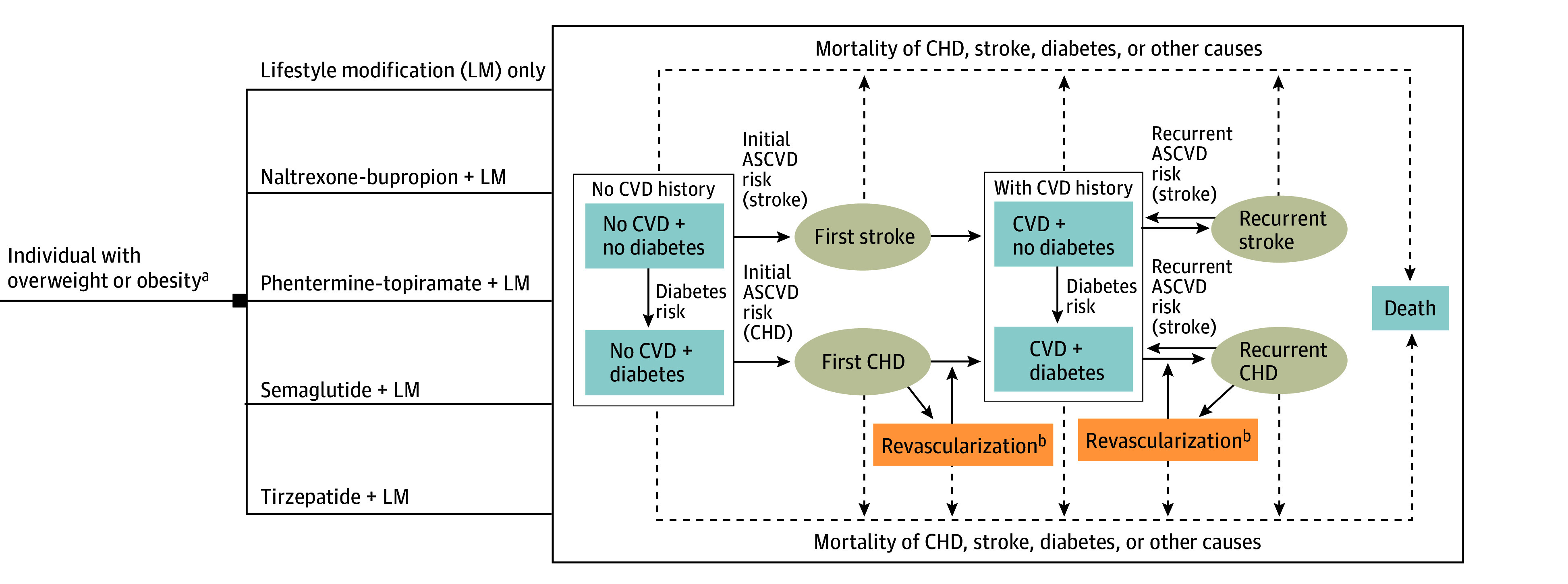
Design, setting, and participants: A lifetime cost-effectiveness analysis was conducted in 2024 using the validated Diabetes, Obesity, Cardiovascular Disease Microsimulation model for US adults. Data were included from the 2017-2020 National Health and Nutrition Examination Survey of 4823 individuals (representing 126 million eligible US adults) aged 20 to 79 years who would meet clinical trial inclusion criteria for antiobesity medications. Individual-level simulations projected long-term cardiometabolic outcomes, quality-adjusted life-years (QALYs), and health care expenditures. Probabilistic sensitivity analyses, subgroup analyses (across body mass index [BMI] categories [≥30 or ≥27 and at least 1 weight-related comorbidity], presence of comorbidities), and multiple scenario analyses (varying treatment discontinuation rates, value-based pricing benchmarks) were conducted. Future costs and QALYs were discounted at 3% annually.
Interventions: Lifestyle modification with naltrexone-bupropion, phentermine-topiramate, semaglutide, or tirzepatide vs lifestyle modification alone.
Main outcomes and measures: Obesity, diabetes, and cardiovascular disease cases averted, life-years and QALYs gained, costs incurred (2023 US dollars), and incremental cost-effectiveness ratios.
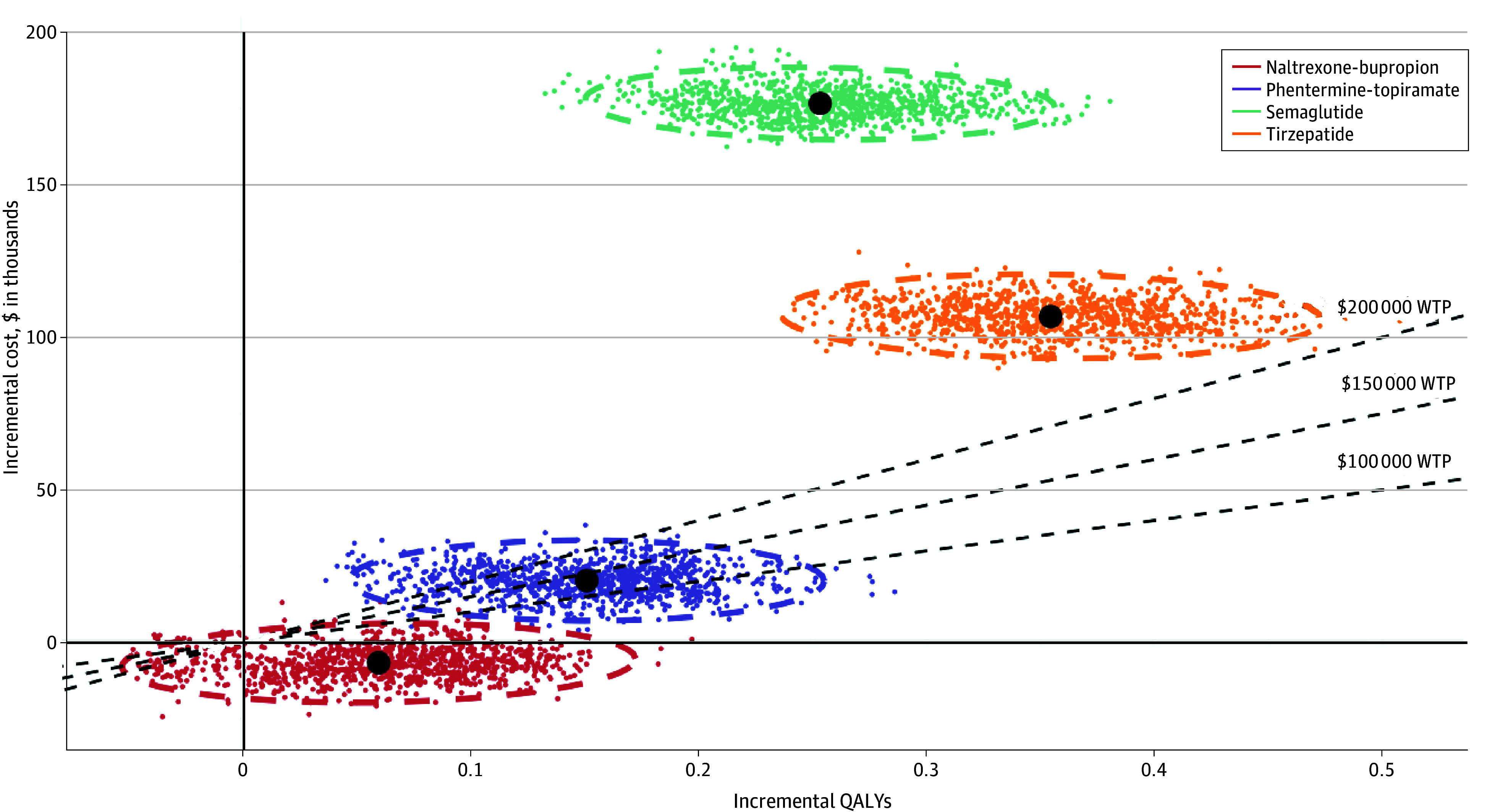
Results: Among the 126 million eligible US adults, the mean age was 48 (SE, 0.5) years; 51% were female; and the initial mean BMI was 34.7 (SE, 0.2); and 85% had at least 1 weight-related comorbidity. Over a lifetime, tirzepatide would avert 45 609 obesity cases (95% uncertainty interval [UI], 45 092-46 126) per 100 000 individuals and semaglutide would avert 32 087 cases (95% UI, 31 292-32 882) per 100 000 individuals. Tirzepatide would reduce 20 854 incident cases of diabetes (95% UI, 19 432-22 276) per 100 000 individuals and semaglutide would reduce 19 211 cases (95% UI, 17 878-20 544) per 100 000 individuals. Tirzepatide would reduce 10 655 cardiovascular disease cases (95% UI, 10 124-11 186) per 100 000 individuals and semaglutide would reduce 8263 cases (95% UI, 7738-8788) per 100 000 individuals. Despite the largest incremental QALY gains of 0.35 for tirzepatide and 0.25 for semaglutide among all antiobesity medications, the incremental cost-effectiveness ratios were $197 023/QALY and 467 676/QALY, respectively. To reach the $100 000/QALY threshold, their prices would require additional discounts by 30.5% for tirzepatide and 81.9% for semaglutide from their current net prices. Naltrexone-bupropion was cost saving due to its lower cost and had an 89.1% probability of being cost-effective at $100 000/QALY, whereas phentermine-topiramate had a 23.5% probability of being cost-effective at $100 000/QALY. Tirzepatide and semaglutide both had a 0% probability across all QALY threshold ranges examined ($100 000-$200 000/QALY).
Conclusions and relevance: This economic evaluation found that although tirzepatide and semaglutide offered substantial long-term health benefits, they were not cost-effective at current net prices. Efforts to reduce the net prices of new antiobesity medications are essential to ensure equitable access to highly effective antiobesity medications.
期刊介绍:
JAMA Health Forum is an international, peer-reviewed, online, open access journal that addresses health policy and strategies affecting medicine, health, and health care. The journal publishes original research, evidence-based reports, and opinion about national and global health policy. It covers innovative approaches to health care delivery and health care economics, access, quality, safety, equity, and reform.
In addition to publishing articles, JAMA Health Forum also features commentary from health policy leaders on the JAMA Forum. It covers news briefs on major reports released by government agencies, foundations, health policy think tanks, and other policy-focused organizations.
JAMA Health Forum is a member of the JAMA Network, which is a consortium of peer-reviewed, general medical and specialty publications. The journal presents curated health policy content from across the JAMA Network, including journals such as JAMA and JAMA Internal Medicine.



 京公网安备 11010802042870号
京ICP备2023020795号-1
京公网安备 11010802042870号
京ICP备2023020795号-1

 分享
分享
 求助内容:
求助内容: 应助结果提醒方式:
 扫码关注我们
