{"title":"INPATIENT REHABILITATION FOR A PATIENT WITH COVID-19 EXACERBATION OF PULMONARY FIBROSIS: A CASE REPORT.","authors":"Heather McKenna, Erin Y Harmon","doi":"10.2340/jrm-cc.v8.40698","DOIUrl":null,"url":null,"abstract":"<p><strong>Objective: </strong>To evaluate the benefits of inpatient rehabilitation for a patient with post-COVID-19 pulmonary fibrosis and to provide guidance for rehabilitation professionals, as many conventional therapeutic interventions are not tolerated and are poorly defined.</p><p><strong>Design: </strong>A case report.</p><p><strong>Subjects/patients: </strong>A 72-year-old man with a COVID-19-related idiopathic pulmonary fibrosis exacerbation.</p><p><strong>Results: </strong>The patient was admitted to inpatient rehabilitation with hypoxia and poor endurance for functional activities. Rehabilitation activities were focused on providing patient/family education, energy conservation, low level activities to build strength, problem solving for mobility, and discharge planning within safe medical parameters. Rehabilitation therapies were graded to meet the patient's physiologic needs and focused on patient and family training. The patient made limited functional gains and continued to have high oxygen needs but achieved his goal of returning home.</p><p><strong>Conclusion: </strong>Patients with COVID-19-related idiopathic pulmonary fibrosis exacerbations can be treated in acute rehabilitation effectively. With more patients developing post-COVID-19 pulmonary fibrosis, appropriate rehabilitation strategies are important for safe discharge planning. Prioritizing patient/family education may allow these more medically fragile patients to return home.</p>","PeriodicalId":73929,"journal":{"name":"Journal of rehabilitation medicine. Clinical communications","volume":"8 ","pages":"40698"},"PeriodicalIF":0.0000,"publicationDate":"2025-03-06","publicationTypes":"Journal Article","fieldsOfStudy":null,"isOpenAccess":false,"openAccessPdf":"https://www.ncbi.nlm.nih.gov/pmc/articles/PMC11905151/pdf/","citationCount":"0","resultStr":null,"platform":"Semanticscholar","paperid":null,"PeriodicalName":"Journal of rehabilitation medicine. Clinical communications","FirstCategoryId":"1085","ListUrlMain":"https://doi.org/10.2340/jrm-cc.v8.40698","RegionNum":0,"RegionCategory":null,"ArticlePicture":[],"TitleCN":null,"AbstractTextCN":null,"PMCID":null,"EPubDate":"2025/1/1 0:00:00","PubModel":"eCollection","JCR":"","JCRName":"","Score":null,"Total":0}
引用次数: 0
Abstract
Objective: To evaluate the benefits of inpatient rehabilitation for a patient with post-COVID-19 pulmonary fibrosis and to provide guidance for rehabilitation professionals, as many conventional therapeutic interventions are not tolerated and are poorly defined.
Design: A case report.
Subjects/patients: A 72-year-old man with a COVID-19-related idiopathic pulmonary fibrosis exacerbation.
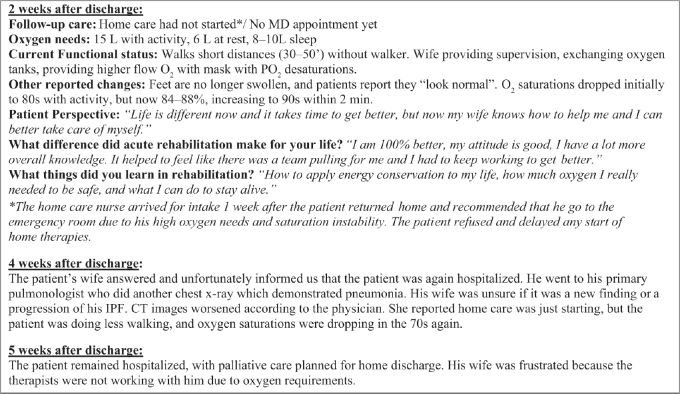
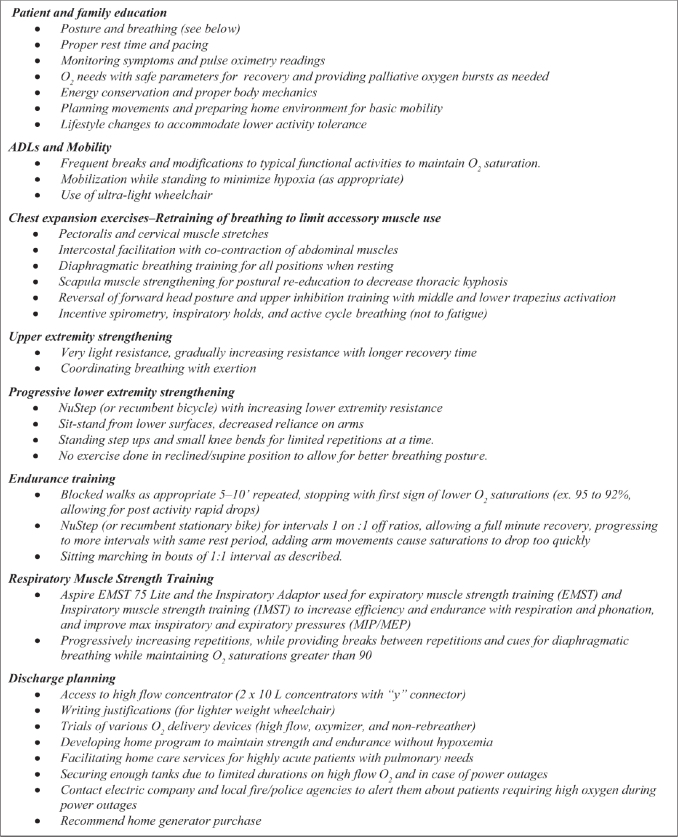
Results: The patient was admitted to inpatient rehabilitation with hypoxia and poor endurance for functional activities. Rehabilitation activities were focused on providing patient/family education, energy conservation, low level activities to build strength, problem solving for mobility, and discharge planning within safe medical parameters. Rehabilitation therapies were graded to meet the patient's physiologic needs and focused on patient and family training. The patient made limited functional gains and continued to have high oxygen needs but achieved his goal of returning home.
Conclusion: Patients with COVID-19-related idiopathic pulmonary fibrosis exacerbations can be treated in acute rehabilitation effectively. With more patients developing post-COVID-19 pulmonary fibrosis, appropriate rehabilitation strategies are important for safe discharge planning. Prioritizing patient/family education may allow these more medically fragile patients to return home.



 京公网安备 11010802042870号
京ICP备2023020795号-1
京公网安备 11010802042870号
京ICP备2023020795号-1

 分享
分享

 求助内容:
求助内容: 应助结果提醒方式:
 扫码关注我们
