Fan Wu, Yaran Wang, Yuanfeng Li, Linqi Shi, Lu Yuan, Yijin Ren, Henny C. van der Mei, Yong Liu
{"title":"Single-Atom Cu Anchored on Carbon Nitride as a Bifunctional Glucose Oxidase and Peroxidase Nanozyme for Antibacterial Therapy","authors":"Fan Wu, Yaran Wang, Yuanfeng Li, Linqi Shi, Lu Yuan, Yijin Ren, Henny C. van der Mei, Yong Liu","doi":"10.1021/acsnano.4c12348","DOIUrl":null,"url":null,"abstract":"A very promising strategy to avoid bacterial drug resistance is to replace antibiotics with artificial nanozymes, but this has not yet been translated to the clinic. Here, we construct a single-atom nanozyme using graphitic carbon nitride nanosheets modified by copper (Cu-<i>g</i>-C<sub>3</sub>N<sub>4</sub>). This Cu-<i>g</i>-C<sub>3</sub>N<sub>4</sub> nanosheet possesses both glucose oxidase-like and peroxidase-like activities responsible for reactive-oxygen-species generation by a cascade reaction to eradicate Gram-positive and Gram-negative multidrug-resistant bacteria. Cu-<i>g</i>-C<sub>3</sub>N<sub>4</sub> is introduced into polycaprolactone (PCL) by electrospinning to obtain (Cu-<i>g</i>-C<sub>3</sub>N<sub>4</sub>/PCL) nanofibers, which can be used as a dressing for bacterially infected wounds. It is demonstrated that Cu-<i>g</i>-C<sub>3</sub>N<sub>4</sub>/PCL nanofiber dressings can eradicate bacterial infections and accelerate wound healing in a mouse model with a skin wound.","PeriodicalId":21,"journal":{"name":"ACS Nano","volume":"9 1","pages":""},"PeriodicalIF":16.0000,"publicationDate":"2025-03-14","publicationTypes":"Journal Article","fieldsOfStudy":null,"isOpenAccess":false,"openAccessPdf":"","citationCount":"0","resultStr":null,"platform":"Semanticscholar","paperid":null,"PeriodicalName":"ACS Nano","FirstCategoryId":"88","ListUrlMain":"https://doi.org/10.1021/acsnano.4c12348","RegionNum":1,"RegionCategory":"材料科学","ArticlePicture":[],"TitleCN":null,"AbstractTextCN":null,"PMCID":null,"EPubDate":"","PubModel":"","JCR":"Q1","JCRName":"CHEMISTRY, MULTIDISCIPLINARY","Score":null,"Total":0}
引用次数: 0
Abstract
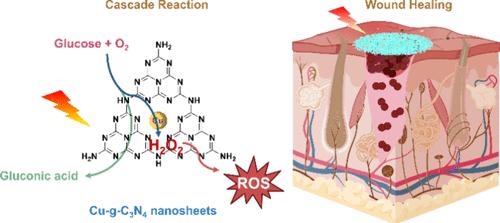
A very promising strategy to avoid bacterial drug resistance is to replace antibiotics with artificial nanozymes, but this has not yet been translated to the clinic. Here, we construct a single-atom nanozyme using graphitic carbon nitride nanosheets modified by copper (Cu-g-C3N4). This Cu-g-C3N4 nanosheet possesses both glucose oxidase-like and peroxidase-like activities responsible for reactive-oxygen-species generation by a cascade reaction to eradicate Gram-positive and Gram-negative multidrug-resistant bacteria. Cu-g-C3N4 is introduced into polycaprolactone (PCL) by electrospinning to obtain (Cu-g-C3N4/PCL) nanofibers, which can be used as a dressing for bacterially infected wounds. It is demonstrated that Cu-g-C3N4/PCL nanofiber dressings can eradicate bacterial infections and accelerate wound healing in a mouse model with a skin wound.
期刊介绍:
ACS Nano, published monthly, serves as an international forum for comprehensive articles on nanoscience and nanotechnology research at the intersections of chemistry, biology, materials science, physics, and engineering. The journal fosters communication among scientists in these communities, facilitating collaboration, new research opportunities, and advancements through discoveries. ACS Nano covers synthesis, assembly, characterization, theory, and simulation of nanostructures, nanobiotechnology, nanofabrication, methods and tools for nanoscience and nanotechnology, and self- and directed-assembly. Alongside original research articles, it offers thorough reviews, perspectives on cutting-edge research, and discussions envisioning the future of nanoscience and nanotechnology.



 京公网安备 11010802042870号
京ICP备2023020795号-1
京公网安备 11010802042870号
京ICP备2023020795号-1

 分享
分享
 求助内容:
求助内容: 应助结果提醒方式:
 扫码关注我们
