Najeebullah Khan , Shamsuddin Shahid , Kamal Ahmed , Zaher Mundher Yaseen
{"title":"Modeling spatial PM2.5 risk dynamics and projecting disease burden in Pakistan","authors":"Najeebullah Khan , Shamsuddin Shahid , Kamal Ahmed , Zaher Mundher Yaseen","doi":"10.1016/j.envpol.2025.126060","DOIUrl":null,"url":null,"abstract":"<div><div>Air pollution, especially small particulate matter (PM<sub>2</sub>.<sub>5</sub>), has emerged as a significant public health crisis in Pakistan, yet its long-term health impacts remain understudied. There is a critical lack of high-resolution spatiotemporal analysis that captures the changing exposure levels and associated mortality trends over extended periods. This study investigates this gap by addressing the spatiotemporal variations in PM<sub>2.5</sub> exposure and its associated mortality burden from 2000 to 2021. Additionally, it projects possible spatiotemporal changes in mortality for two scenarios, business-as-usual and PM<sub>2.5</sub> mitigation. The Global Exposure Mortality Model (GEMM) was applied on 0.01° resolution gridded PM<sub>2.5</sub> and population concentration data to quantify PM<sub>2.5</sub>-attributed mortality for major diseases: ischemic heart disease (IHD), cerebrovascular disease (CEV), chronic obstructive pulmonary disease (COPD), lower respiratory infection (LRI) and lung cancer (LC). The results showed escalating levels and expanded geographical spread of PM<sub>2.5</sub> and mortality in Pakistan. Population exposure estimates reveal high-risk zones with over 80 μg/m<sup>3</sup> concentrations engulfing densely inhabited areas far exceeding the WHO annual limit of 5 μg/m<sup>3</sup>. The number of PM<sub>2.5</sub> -related deaths increased from 57,100 in 2000 to 157,762 in 2021. IHD showed the highest sensitivity to PM<sub>2.5</sub>, marked by over three times higher hazard ratio at 150 μg/m<sup>3</sup> exposure. Spatial mapping revealed IHD and LRI mortality hotspots corresponding to settlers near the Indus River basin. Notably, central parts recorded over 2 μg/m<sup>3</sup> annual PM<sub>2.5</sub> increase. Future projections based on growth trajectories forecast that the uncontrolled increase in PM<sub>2.5</sub> could inflate ischemic heart disease deaths from 14,248 to 142,903 by 2030, leading to a total PM<sub>2.5</sub> -related mortality burden exceeding 290,000 deaths. However, stabilizing PM<sub>2.5</sub> levels under a mitigation scenario could significantly reduce mortality to 29,062 by 2030. This study provides critical insights into demographic vulnerabilities, high-risk zones, and future mortality trends, emphasizing the urgency for mitigation policies to safeguard millions facing existential risk.</div></div>","PeriodicalId":311,"journal":{"name":"Environmental Pollution","volume":"373 ","pages":"Article 126060"},"PeriodicalIF":7.3000,"publicationDate":"2025-05-15","publicationTypes":"Journal Article","fieldsOfStudy":null,"isOpenAccess":false,"openAccessPdf":"","citationCount":"0","resultStr":null,"platform":"Semanticscholar","paperid":null,"PeriodicalName":"Environmental Pollution","FirstCategoryId":"93","ListUrlMain":"https://www.sciencedirect.com/science/article/pii/S0269749125004336","RegionNum":2,"RegionCategory":"环境科学与生态学","ArticlePicture":[],"TitleCN":null,"AbstractTextCN":null,"PMCID":null,"EPubDate":"2025/3/14 0:00:00","PubModel":"Epub","JCR":"Q1","JCRName":"ENVIRONMENTAL SCIENCES","Score":null,"Total":0}
引用次数: 0
Abstract
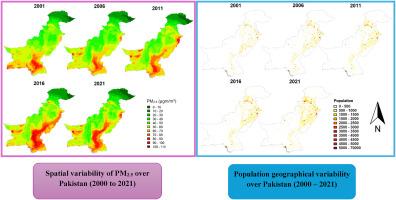
Air pollution, especially small particulate matter (PM2.5), has emerged as a significant public health crisis in Pakistan, yet its long-term health impacts remain understudied. There is a critical lack of high-resolution spatiotemporal analysis that captures the changing exposure levels and associated mortality trends over extended periods. This study investigates this gap by addressing the spatiotemporal variations in PM2.5 exposure and its associated mortality burden from 2000 to 2021. Additionally, it projects possible spatiotemporal changes in mortality for two scenarios, business-as-usual and PM2.5 mitigation. The Global Exposure Mortality Model (GEMM) was applied on 0.01° resolution gridded PM2.5 and population concentration data to quantify PM2.5-attributed mortality for major diseases: ischemic heart disease (IHD), cerebrovascular disease (CEV), chronic obstructive pulmonary disease (COPD), lower respiratory infection (LRI) and lung cancer (LC). The results showed escalating levels and expanded geographical spread of PM2.5 and mortality in Pakistan. Population exposure estimates reveal high-risk zones with over 80 μg/m3 concentrations engulfing densely inhabited areas far exceeding the WHO annual limit of 5 μg/m3. The number of PM2.5 -related deaths increased from 57,100 in 2000 to 157,762 in 2021. IHD showed the highest sensitivity to PM2.5, marked by over three times higher hazard ratio at 150 μg/m3 exposure. Spatial mapping revealed IHD and LRI mortality hotspots corresponding to settlers near the Indus River basin. Notably, central parts recorded over 2 μg/m3 annual PM2.5 increase. Future projections based on growth trajectories forecast that the uncontrolled increase in PM2.5 could inflate ischemic heart disease deaths from 14,248 to 142,903 by 2030, leading to a total PM2.5 -related mortality burden exceeding 290,000 deaths. However, stabilizing PM2.5 levels under a mitigation scenario could significantly reduce mortality to 29,062 by 2030. This study provides critical insights into demographic vulnerabilities, high-risk zones, and future mortality trends, emphasizing the urgency for mitigation policies to safeguard millions facing existential risk.
期刊介绍:
Environmental Pollution is an international peer-reviewed journal that publishes high-quality research papers and review articles covering all aspects of environmental pollution and its impacts on ecosystems and human health.
Subject areas include, but are not limited to:
• Sources and occurrences of pollutants that are clearly defined and measured in environmental compartments, food and food-related items, and human bodies;
• Interlinks between contaminant exposure and biological, ecological, and human health effects, including those of climate change;
• Contaminants of emerging concerns (including but not limited to antibiotic resistant microorganisms or genes, microplastics/nanoplastics, electronic wastes, light, and noise) and/or their biological, ecological, or human health effects;
• Laboratory and field studies on the remediation/mitigation of environmental pollution via new techniques and with clear links to biological, ecological, or human health effects;
• Modeling of pollution processes, patterns, or trends that is of clear environmental and/or human health interest;
• New techniques that measure and examine environmental occurrences, transport, behavior, and effects of pollutants within the environment or the laboratory, provided that they can be clearly used to address problems within regional or global environmental compartments.




 京公网安备 11010802042870号
京ICP备2023020795号-1
京公网安备 11010802042870号
京ICP备2023020795号-1

 分享
分享
 求助内容:
求助内容: 应助结果提醒方式:
 扫码关注我们
