Haiyan Wu, Shanguo Chen, Yu Deng, Jiahui Shen, Yifei Xu, Tao Wen, Jun Yuan, Qirong Shen, Chao Xue
{"title":"Dynamics of antibiotic resistance genes and the bacterial community after stress from a single Dazomet fumigation","authors":"Haiyan Wu, Shanguo Chen, Yu Deng, Jiahui Shen, Yifei Xu, Tao Wen, Jun Yuan, Qirong Shen, Chao Xue","doi":"10.1016/j.envpol.2025.126048","DOIUrl":null,"url":null,"abstract":"<div><div>Although chemical fumigants are widely applied in agriculture to control soil-borne diseases, their influence on soil antibiotic resistance genes (ARGs) remains poorly understood. This study employed metagenomic sequencing to investigate the dynamic response and recovery processes of soil bacterial communities and ARGs after the end of fumigation with Dazomet. The results revealed that the effects of Dazomet were both phased and recoverable. Initially, no significant shifts in bacterial community diversity were observed; however, by day 10 of recovery (Dazomet10), diversity had decreased by 3.1 %. By contrast, ARG levels surged by 17.3 % and 10.9 % on days 10 and 20 (Dazomet20), respectively, before reverting to the baseline by day 50 (Dazomet50). These patterns were corroborated by qPCR data, which showed a 90.8 % reduction in 16S rRNA gene abundance, alongside a 4.17- to 4.38-fold increase in the relative abundance of ARGs at Dazomet10 and Dazomet20. Approximately 63 % of the variation in ARGs was attributed to bacterial community composition and mobile genetic elements (MGEs). Combined with community analysis and host-tracking analysis, it was found that <em>Streptomyces</em> and <em>Nocardioides</em> were identified as key ARGs hosts. Overall, the microbial communities and resistome required at least 50 days after the end of fumigation to recover to their pre-fumigation state. This study sheds light on the dynamic interactions between bacterial communities and ARGs during recovery from Dazomet fumigation and underscores the critical need for the rational use of fumigants in agricultural practices.</div></div>","PeriodicalId":311,"journal":{"name":"Environmental Pollution","volume":"372 ","pages":"Article 126048"},"PeriodicalIF":7.3000,"publicationDate":"2025-05-01","publicationTypes":"Journal Article","fieldsOfStudy":null,"isOpenAccess":false,"openAccessPdf":"","citationCount":"0","resultStr":null,"platform":"Semanticscholar","paperid":null,"PeriodicalName":"Environmental Pollution","FirstCategoryId":"93","ListUrlMain":"https://www.sciencedirect.com/science/article/pii/S026974912500421X","RegionNum":2,"RegionCategory":"环境科学与生态学","ArticlePicture":[],"TitleCN":null,"AbstractTextCN":null,"PMCID":null,"EPubDate":"2025/3/14 0:00:00","PubModel":"Epub","JCR":"Q1","JCRName":"ENVIRONMENTAL SCIENCES","Score":null,"Total":0}
引用次数: 0
Abstract
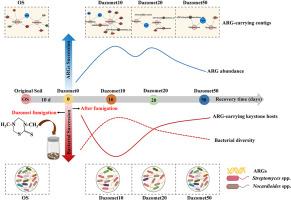
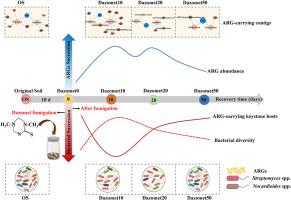
Although chemical fumigants are widely applied in agriculture to control soil-borne diseases, their influence on soil antibiotic resistance genes (ARGs) remains poorly understood. This study employed metagenomic sequencing to investigate the dynamic response and recovery processes of soil bacterial communities and ARGs after the end of fumigation with Dazomet. The results revealed that the effects of Dazomet were both phased and recoverable. Initially, no significant shifts in bacterial community diversity were observed; however, by day 10 of recovery (Dazomet10), diversity had decreased by 3.1 %. By contrast, ARG levels surged by 17.3 % and 10.9 % on days 10 and 20 (Dazomet20), respectively, before reverting to the baseline by day 50 (Dazomet50). These patterns were corroborated by qPCR data, which showed a 90.8 % reduction in 16S rRNA gene abundance, alongside a 4.17- to 4.38-fold increase in the relative abundance of ARGs at Dazomet10 and Dazomet20. Approximately 63 % of the variation in ARGs was attributed to bacterial community composition and mobile genetic elements (MGEs). Combined with community analysis and host-tracking analysis, it was found that Streptomyces and Nocardioides were identified as key ARGs hosts. Overall, the microbial communities and resistome required at least 50 days after the end of fumigation to recover to their pre-fumigation state. This study sheds light on the dynamic interactions between bacterial communities and ARGs during recovery from Dazomet fumigation and underscores the critical need for the rational use of fumigants in agricultural practices.
期刊介绍:
Environmental Pollution is an international peer-reviewed journal that publishes high-quality research papers and review articles covering all aspects of environmental pollution and its impacts on ecosystems and human health.
Subject areas include, but are not limited to:
• Sources and occurrences of pollutants that are clearly defined and measured in environmental compartments, food and food-related items, and human bodies;
• Interlinks between contaminant exposure and biological, ecological, and human health effects, including those of climate change;
• Contaminants of emerging concerns (including but not limited to antibiotic resistant microorganisms or genes, microplastics/nanoplastics, electronic wastes, light, and noise) and/or their biological, ecological, or human health effects;
• Laboratory and field studies on the remediation/mitigation of environmental pollution via new techniques and with clear links to biological, ecological, or human health effects;
• Modeling of pollution processes, patterns, or trends that is of clear environmental and/or human health interest;
• New techniques that measure and examine environmental occurrences, transport, behavior, and effects of pollutants within the environment or the laboratory, provided that they can be clearly used to address problems within regional or global environmental compartments.



 京公网安备 11010802042870号
京ICP备2023020795号-1
京公网安备 11010802042870号
京ICP备2023020795号-1

 分享
分享
 求助内容:
求助内容: 应助结果提醒方式:
 扫码关注我们
