Mingyu Ma, Linlong Zhang, Minhu Huang, Yazhuo Kuang, Hangyang Li, Huanzhou Yang, Tangqing Yao, Gang Ye, Shuyan Shao, Myung-Han Yoon, Jian Liu
{"title":"Regiochemistry and Side-Chain Engineering Enable Efficient N-Type Mixed Conducting Polymers","authors":"Mingyu Ma, Linlong Zhang, Minhu Huang, Yazhuo Kuang, Hangyang Li, Huanzhou Yang, Tangqing Yao, Gang Ye, Shuyan Shao, Myung-Han Yoon, Jian Liu","doi":"10.1002/anie.202424820","DOIUrl":null,"url":null,"abstract":"<p>Developing high-performance n-type organic mixed ionic-electronic conducting (OMIEC) polymers with simple structural motifs is still challenging. We show that high-performance, low-threshold-voltage n-type OMIEC polymers can be achieved using a simple diketopyrrolopyrrole unit flanked by thiazole groups, which is functionalized with glycolated side chains. Interestingly, the regiospecific sp<sup>2</sup>-N position in the repeating unit's thiazole governs the polymer chains' solvation and molecular packing. This specific backbone chemistry enhances conjugation efficiency, reduces trap density, and improves electrochemical doping efficiency. Moreover, systematic variation of glycolated side-chain lengths induces a sequential shift in molecular orientation—from edge-on through bimodal to face-on preferential alignment. This structural evolution achieves optimized ionic-electronic transport balance, resulting in exceptional device metrics: a geometrically normalized transconductance of 31.9 S cm<sup>−1</sup>, a figure-of-merit <i>µC</i>* of 96.3 F cm<sup>−1</sup> V<sup>−1</sup> s<sup>−1</sup>, and a threshold voltage of 0.31 V, positioning these materials among the highest-performing n-type OMIECs. An organic complementary inverter made from the optimized n-type OMIEC polymer and a reported p-type polymer exhibits a voltage gain of 198 V V<sup>−1</sup>, effectively amplifying the ECG signal and enhancing signal quality. This work establishes structure-property guidelines for designing bioelectronic n-type OMIECs.</p>","PeriodicalId":125,"journal":{"name":"Angewandte Chemie International Edition","volume":"64 21","pages":""},"PeriodicalIF":16.9000,"publicationDate":"2025-03-15","publicationTypes":"Journal Article","fieldsOfStudy":null,"isOpenAccess":false,"openAccessPdf":"","citationCount":"0","resultStr":null,"platform":"Semanticscholar","paperid":null,"PeriodicalName":"Angewandte Chemie International Edition","FirstCategoryId":"92","ListUrlMain":"https://onlinelibrary.wiley.com/doi/10.1002/anie.202424820","RegionNum":1,"RegionCategory":"化学","ArticlePicture":[],"TitleCN":null,"AbstractTextCN":null,"PMCID":null,"EPubDate":"","PubModel":"","JCR":"Q1","JCRName":"CHEMISTRY, MULTIDISCIPLINARY","Score":null,"Total":0}
引用次数: 0
Abstract
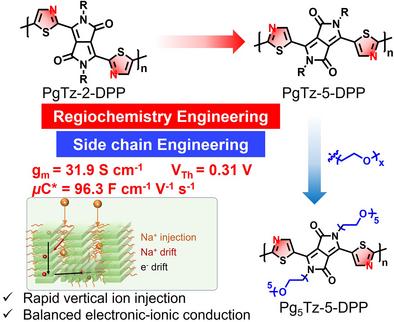
Developing high-performance n-type organic mixed ionic-electronic conducting (OMIEC) polymers with simple structural motifs is still challenging. We show that high-performance, low-threshold-voltage n-type OMIEC polymers can be achieved using a simple diketopyrrolopyrrole unit flanked by thiazole groups, which is functionalized with glycolated side chains. Interestingly, the regiospecific sp2-N position in the repeating unit's thiazole governs the polymer chains' solvation and molecular packing. This specific backbone chemistry enhances conjugation efficiency, reduces trap density, and improves electrochemical doping efficiency. Moreover, systematic variation of glycolated side-chain lengths induces a sequential shift in molecular orientation—from edge-on through bimodal to face-on preferential alignment. This structural evolution achieves optimized ionic-electronic transport balance, resulting in exceptional device metrics: a geometrically normalized transconductance of 31.9 S cm−1, a figure-of-merit µC* of 96.3 F cm−1 V−1 s−1, and a threshold voltage of 0.31 V, positioning these materials among the highest-performing n-type OMIECs. An organic complementary inverter made from the optimized n-type OMIEC polymer and a reported p-type polymer exhibits a voltage gain of 198 V V−1, effectively amplifying the ECG signal and enhancing signal quality. This work establishes structure-property guidelines for designing bioelectronic n-type OMIECs.
开发具有简单结构图案的高性能 n 型有机混合离子导电聚合物(OMIEC)仍然具有挑战性。我们的研究表明,使用一个两侧有噻唑基团的简单二酮吡咯单元,并用乙二醇化侧链对其进行官能化,就能开发出高性能、低阈值电压的 n 型 OMIEC 聚合物。有趣的是,重复单元中噻唑的特定 sp2-N 位置控制着聚合物链的溶解和分子堆积。这种特定的骨架化学性质提高了共轭效率,降低了陷阱密度,并改善了电化学掺杂效率。此外,乙二醇化侧链长度的系统性变化会诱导分子取向的连续转变--从边缘朝上到双峰再到面朝上的优先排列。这种结构演化实现了离子-电子传输平衡的优化,从而产生了卓越的器件指标:几何归一化跨导为 31.9 S cm-1,优点系数 μC* 为 96.3 F cm-1 V-1 s-1,阈值电压为 0.31 V,使这些材料跻身于性能最高的 n 型 OMIEC 之列。由优化的 n 型 OMIEC 聚合物和一种已报道的 p 型聚合物制成的有机互补逆变器显示出 198 VV-1 的电压增益,有效地放大了心电信号并提高了信号质量。这项工作为设计生物电子 n 型 OMIEC 确立了结构-性能准则。
期刊介绍:
Angewandte Chemie, a journal of the German Chemical Society (GDCh), maintains a leading position among scholarly journals in general chemistry with an impressive Impact Factor of 16.6 (2022 Journal Citation Reports, Clarivate, 2023). Published weekly in a reader-friendly format, it features new articles almost every day. Established in 1887, Angewandte Chemie is a prominent chemistry journal, offering a dynamic blend of Review-type articles, Highlights, Communications, and Research Articles on a weekly basis, making it unique in the field.




 京公网安备 11010802042870号
京ICP备2023020795号-1
京公网安备 11010802042870号
京ICP备2023020795号-1

 分享
分享
 求助内容:
求助内容: 应助结果提醒方式:
 扫码关注我们
