Anna Ebeling , Dominik Wippermann , Tristan Zimmermann , Ole Klein , Torben Kirchgeorg , Ingo Weinberg , Anna Plass , Simone Hasenbein , Daniel Pröfrock
{"title":"Coupling metal concentrations and drift simulations for tracing emissions from offshore wind farms","authors":"Anna Ebeling , Dominik Wippermann , Tristan Zimmermann , Ole Klein , Torben Kirchgeorg , Ingo Weinberg , Anna Plass , Simone Hasenbein , Daniel Pröfrock","doi":"10.1016/j.marpolbul.2025.117810","DOIUrl":null,"url":null,"abstract":"<div><div>During the last decade offshore wind energy production has become an important source of renewable energy. To ensure safe operation during the lifetime of an offshore wind turbine, the steel structures need to be protected against corrosion. This work evaluates potential metal emissions and environmental impacts from galvanic anodes used for corrosion protection of offshore wind farms (OWFs) by applying a novel multi-tracer approach. A total of 235 surface water samples from different German North Sea OWFs were taken between 2016 and 2022 and analyzed for their concentration of 32 metals via online preconcentration/matrix removal ICP-MS/MS. The concentrations were assessed for temporal and spatial trends with an emphasis on the previously proposed OWF tracers Al, Cd, Pb, Zn, Ga and In. By comparing patterns of In concentrations and Gd anomalies together with modelled drift trajectories of water masses, a differentiation of riverine and OWF-induced metal load was achieved.</div><div>Results suggest that elevated In concentrations may be linked to OWF corrosion protection systems. Other metal concentrations remained within natural variability. This study demonstrates that the applied tracer approach is effective in identifying OWF-induced metal emissions. Furthermore, it highlights the necessity for long-term monitoring of these tracers to further investigate this emerging source of contamination.</div></div>","PeriodicalId":18215,"journal":{"name":"Marine pollution bulletin","volume":"214 ","pages":"Article 117810"},"PeriodicalIF":4.9000,"publicationDate":"2025-03-14","publicationTypes":"Journal Article","fieldsOfStudy":null,"isOpenAccess":false,"openAccessPdf":"","citationCount":"0","resultStr":null,"platform":"Semanticscholar","paperid":null,"PeriodicalName":"Marine pollution bulletin","FirstCategoryId":"93","ListUrlMain":"https://www.sciencedirect.com/science/article/pii/S0025326X25002851","RegionNum":3,"RegionCategory":"环境科学与生态学","ArticlePicture":[],"TitleCN":null,"AbstractTextCN":null,"PMCID":null,"EPubDate":"","PubModel":"","JCR":"Q1","JCRName":"ENVIRONMENTAL SCIENCES","Score":null,"Total":0}
引用次数: 0
Abstract
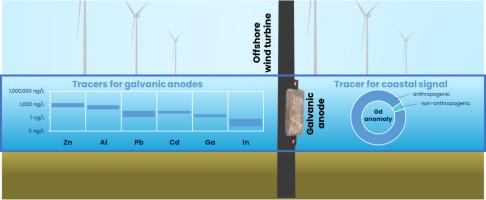
During the last decade offshore wind energy production has become an important source of renewable energy. To ensure safe operation during the lifetime of an offshore wind turbine, the steel structures need to be protected against corrosion. This work evaluates potential metal emissions and environmental impacts from galvanic anodes used for corrosion protection of offshore wind farms (OWFs) by applying a novel multi-tracer approach. A total of 235 surface water samples from different German North Sea OWFs were taken between 2016 and 2022 and analyzed for their concentration of 32 metals via online preconcentration/matrix removal ICP-MS/MS. The concentrations were assessed for temporal and spatial trends with an emphasis on the previously proposed OWF tracers Al, Cd, Pb, Zn, Ga and In. By comparing patterns of In concentrations and Gd anomalies together with modelled drift trajectories of water masses, a differentiation of riverine and OWF-induced metal load was achieved.
Results suggest that elevated In concentrations may be linked to OWF corrosion protection systems. Other metal concentrations remained within natural variability. This study demonstrates that the applied tracer approach is effective in identifying OWF-induced metal emissions. Furthermore, it highlights the necessity for long-term monitoring of these tracers to further investigate this emerging source of contamination.
期刊介绍:
Marine Pollution Bulletin is concerned with the rational use of maritime and marine resources in estuaries, the seas and oceans, as well as with documenting marine pollution and introducing new forms of measurement and analysis. A wide range of topics are discussed as news, comment, reviews and research reports, not only on effluent disposal and pollution control, but also on the management, economic aspects and protection of the marine environment in general.



 京公网安备 11010802042870号
京ICP备2023020795号-1
京公网安备 11010802042870号
京ICP备2023020795号-1

 分享
分享
 求助内容:
求助内容: 应助结果提醒方式:
 扫码关注我们
