{"title":"Operational decisions of wind–photovoltaic–storage hybrid power systems using improved dung beetle optimizer","authors":"Yi Niu , Ming Meng , Xinxin Li , Tingting Pang","doi":"10.1016/j.est.2025.116225","DOIUrl":null,"url":null,"abstract":"<div><div>Developing wind–photovoltaic–storage hybrid power system (WPS-HPS) is crucial for many countries seeking to advance their energy transition. However, the intricacies of both internal production processes and external market conditions often leads to suboptimal operational decisions, resulting in missed profit opportunities and abandoned renewable energies. To address this problem, this study builds an operational decision model aimed at maximizing profits while minimizing the renewable energy curtailment rate. Different from most studies that only consider one single market, the model constructed in this study comprehensively involves day-ahead–auxiliary service (DAAS) joint market, and is more suitable for the actual situations. As this model is essentially a complex nondeterministic polynomial problem, it cannot be solved directly through conventional programming methods. Consequently, this study proposes a hybrid metaheuristic non-dominated sorting dung beetle optimizer (HMNSDBO) to solve the above operational decision problem. Based on Dung Beetle Optimizer (DBO), the proposed HMNSDBO algorithm combines 6 improvement strategies. This effectively alleviates the problem of low initial population quality, premature convergence, and the tendency to fall into local optimum. Compared with DBO and other 4 popular algorithms, the search capability, optimization accuracy, and convergence speed of HMNSDBO are improved by 7.88 %, 16.1 %, and 6.95 %, respectively. When participating in DAAS joint market, compared with participating solely in day-ahead market or auxiliary service market, the proposed HMNSDBO enable WPS-HPS to achieve a profit increase of 21.68 % or 107.40 %, respectively, and a renewable energy curtailment rate decrease by 4.11 % or 73.98 %, respectively.</div></div>","PeriodicalId":15942,"journal":{"name":"Journal of energy storage","volume":"117 ","pages":"Article 116225"},"PeriodicalIF":8.9000,"publicationDate":"2025-03-15","publicationTypes":"Journal Article","fieldsOfStudy":null,"isOpenAccess":false,"openAccessPdf":"","citationCount":"0","resultStr":null,"platform":"Semanticscholar","paperid":null,"PeriodicalName":"Journal of energy storage","FirstCategoryId":"5","ListUrlMain":"https://www.sciencedirect.com/science/article/pii/S2352152X25009387","RegionNum":2,"RegionCategory":"工程技术","ArticlePicture":[],"TitleCN":null,"AbstractTextCN":null,"PMCID":null,"EPubDate":"","PubModel":"","JCR":"Q1","JCRName":"ENERGY & FUELS","Score":null,"Total":0}
引用次数: 0
Abstract
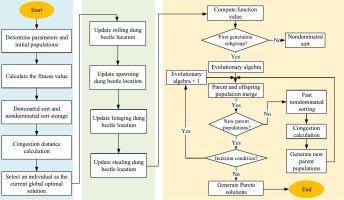
Developing wind–photovoltaic–storage hybrid power system (WPS-HPS) is crucial for many countries seeking to advance their energy transition. However, the intricacies of both internal production processes and external market conditions often leads to suboptimal operational decisions, resulting in missed profit opportunities and abandoned renewable energies. To address this problem, this study builds an operational decision model aimed at maximizing profits while minimizing the renewable energy curtailment rate. Different from most studies that only consider one single market, the model constructed in this study comprehensively involves day-ahead–auxiliary service (DAAS) joint market, and is more suitable for the actual situations. As this model is essentially a complex nondeterministic polynomial problem, it cannot be solved directly through conventional programming methods. Consequently, this study proposes a hybrid metaheuristic non-dominated sorting dung beetle optimizer (HMNSDBO) to solve the above operational decision problem. Based on Dung Beetle Optimizer (DBO), the proposed HMNSDBO algorithm combines 6 improvement strategies. This effectively alleviates the problem of low initial population quality, premature convergence, and the tendency to fall into local optimum. Compared with DBO and other 4 popular algorithms, the search capability, optimization accuracy, and convergence speed of HMNSDBO are improved by 7.88 %, 16.1 %, and 6.95 %, respectively. When participating in DAAS joint market, compared with participating solely in day-ahead market or auxiliary service market, the proposed HMNSDBO enable WPS-HPS to achieve a profit increase of 21.68 % or 107.40 %, respectively, and a renewable energy curtailment rate decrease by 4.11 % or 73.98 %, respectively.
期刊介绍:
Journal of energy storage focusses on all aspects of energy storage, in particular systems integration, electric grid integration, modelling and analysis, novel energy storage technologies, sizing and management strategies, business models for operation of storage systems and energy storage developments worldwide.




 京公网安备 11010802042870号
京ICP备2023020795号-1
京公网安备 11010802042870号
京ICP备2023020795号-1

 分享
分享
 求助内容:
求助内容: 应助结果提醒方式:
 扫码关注我们
