A comparison of binding interaction of angelicin and psoralen to bromelain a cysteine protease: Steady-state fluorescence, circular dichroism and molecular docking study
{"title":"A comparison of binding interaction of angelicin and psoralen to bromelain a cysteine protease: Steady-state fluorescence, circular dichroism and molecular docking study","authors":"Sourav Pakrashy , Prakash K. Mandal , Sandip Paul , Sourav Misra , Jishu Mandal , Malay Dolai , Anjoy Majhi","doi":"10.1016/j.saa.2025.125964","DOIUrl":null,"url":null,"abstract":"<div><div>Furocoumarins are photo-active arising in several medicinal plants when they are subjected to stress devising varied medicinal applications. Angelicin and psoralen are the two main active components of <em>Psoralea corylifolia L.</em>, an herbal-medicinal plant used from early times to treat numerous skin-related disorders. It is extensively dispersed in the therapeutics in Indian and Chinese herbal mode treatment. Here we synthesized two isomeric furocoumarins angelicin and psoralen and investigated their interaction with a cysteine protease proteolytic enzyme bromelain, using different spectroscopic techniques like steady state fluorescence and circular dichroism to understand the binding affinity of the two furocoumarins with bromelain. Bromelain is a well-known phytotherapeutic ingredient displaying widespread medicinal applications. The binding constants and the number of binding sites for the interactions of angelicin and psoralen with bromelain were evaluated using the steady state fluorescence data at 298 K. An in-silico investigation was executed by docking the two isomeric furocoumarins angelicin and psoralen with bromelain which revealed that both bind with the same energy but at different sites, which also alters a little more in the case of psoralen than angelicin the secondary structure of bromelain as evidenced in Circular dichroism spectra. DFT study revealed the stability of both moieties. In conclusion, this study shed light on the effective application of bromelain complexed with angelicin and psoralen, for developing functional foods and also can be considered an effective carrier for angelicin and psoralen.</div></div>","PeriodicalId":433,"journal":{"name":"Spectrochimica Acta Part A: Molecular and Biomolecular Spectroscopy","volume":"336 ","pages":"Article 125964"},"PeriodicalIF":4.6000,"publicationDate":"2025-08-05","publicationTypes":"Journal Article","fieldsOfStudy":null,"isOpenAccess":false,"openAccessPdf":"","citationCount":"0","resultStr":null,"platform":"Semanticscholar","paperid":null,"PeriodicalName":"Spectrochimica Acta Part A: Molecular and Biomolecular Spectroscopy","FirstCategoryId":"92","ListUrlMain":"https://www.sciencedirect.com/science/article/pii/S1386142525002707","RegionNum":2,"RegionCategory":"化学","ArticlePicture":[],"TitleCN":null,"AbstractTextCN":null,"PMCID":null,"EPubDate":"2025/3/6 0:00:00","PubModel":"Epub","JCR":"Q1","JCRName":"SPECTROSCOPY","Score":null,"Total":0}
引用次数: 0
Abstract
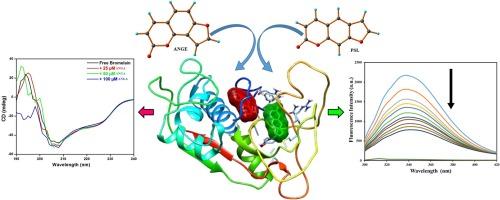
Furocoumarins are photo-active arising in several medicinal plants when they are subjected to stress devising varied medicinal applications. Angelicin and psoralen are the two main active components of Psoralea corylifolia L., an herbal-medicinal plant used from early times to treat numerous skin-related disorders. It is extensively dispersed in the therapeutics in Indian and Chinese herbal mode treatment. Here we synthesized two isomeric furocoumarins angelicin and psoralen and investigated their interaction with a cysteine protease proteolytic enzyme bromelain, using different spectroscopic techniques like steady state fluorescence and circular dichroism to understand the binding affinity of the two furocoumarins with bromelain. Bromelain is a well-known phytotherapeutic ingredient displaying widespread medicinal applications. The binding constants and the number of binding sites for the interactions of angelicin and psoralen with bromelain were evaluated using the steady state fluorescence data at 298 K. An in-silico investigation was executed by docking the two isomeric furocoumarins angelicin and psoralen with bromelain which revealed that both bind with the same energy but at different sites, which also alters a little more in the case of psoralen than angelicin the secondary structure of bromelain as evidenced in Circular dichroism spectra. DFT study revealed the stability of both moieties. In conclusion, this study shed light on the effective application of bromelain complexed with angelicin and psoralen, for developing functional foods and also can be considered an effective carrier for angelicin and psoralen.
期刊介绍:
Spectrochimica Acta, Part A: Molecular and Biomolecular Spectroscopy (SAA) is an interdisciplinary journal which spans from basic to applied aspects of optical spectroscopy in chemistry, medicine, biology, and materials science.
The journal publishes original scientific papers that feature high-quality spectroscopic data and analysis. From the broad range of optical spectroscopies, the emphasis is on electronic, vibrational or rotational spectra of molecules, rather than on spectroscopy based on magnetic moments.
Criteria for publication in SAA are novelty, uniqueness, and outstanding quality. Routine applications of spectroscopic techniques and computational methods are not appropriate.
Topics of particular interest of Spectrochimica Acta Part A include, but are not limited to:
Spectroscopy and dynamics of bioanalytical, biomedical, environmental, and atmospheric sciences,
Novel experimental techniques or instrumentation for molecular spectroscopy,
Novel theoretical and computational methods,
Novel applications in photochemistry and photobiology,
Novel interpretational approaches as well as advances in data analysis based on electronic or vibrational spectroscopy.



 京公网安备 11010802042870号
京ICP备2023020795号-1
京公网安备 11010802042870号
京ICP备2023020795号-1

 分享
分享
 求助内容:
求助内容: 应助结果提醒方式:
 扫码关注我们
