{"title":"Phase composition control of biphasic tritium breeding ceramics","authors":"Chadha Henchiri , Shu-Rui Shang , Shou-xi Gu , Fatma Argoubi , Qiang Qi , Hai-shan Zhou","doi":"10.1016/j.matchemphys.2025.130665","DOIUrl":null,"url":null,"abstract":"<div><div>This work introduces strategies for obtaining a convenient candidate for tritium breeder materials. Li<sub>4+x</sub>Si<sub>1-x</sub>Cr<sub>x</sub>O<sub>4</sub> (x = 0 and 0.1) has been successfully prepared using the sol-gel method. X-Ray diffraction, SEM, TEM, X-Ray Photoelectron Spectra (XPS), Raman spectra, Electronic Paramagnetic Resonance (EPR) and Electrochemical Impedance Spectroscopy (EIS) were undertaken. X-Ray diffraction revealed that this compound crystallizes in the monoclinic structure with <strong>P 1 21/m 1</strong> space group. A secondary phase Li<sub>2</sub>CO<sub>3</sub> was detected by means of the High score software. The difference of XRD intensity demonstrated that the chromium substitution on silicon position into lithium orthosilicate is possible. The porosity values of compound demonstrate that it is sufficient for the generation a tritium breeder. Using TEM, the particle size increases from 20.04 nm to 31.67 nm for x = 0 and 0.1 respectively. This increase has been accounted for in terms of the fact that the Cr<sup>3+</sup> ions influence the morphology. XPS and Raman spectra indicated the presence of valence state of Cr<sub>2</sub>O<sub>3</sub>. The resonance g = 1.97 of Li<sub>4.1</sub>Cr<sub>0.1</sub>Si<sub>0.9</sub>O<sub>4</sub> is assigned to the exchange coupled Cr<sup>3+</sup>-Cr<sup>3+</sup> pairs. At room-temperature, Electrochemical impedance spectroscopy (EIS) was conducted in order to control the lithium diffusion coefficient (D<sub>Li</sub>) as well as the Warburg coefficient (W). The increase of W from 86.761 Ω<sup>0.5</sup>–87.328 Ω<sup>0.5</sup> and the growth of the lithium diffusion coefficient D<sub>Li</sub> from 2.4710<sup>−8</sup> cm<sup>2</sup>s<sup>−1</sup> to 8.4810<sup>−8</sup> cm<sup>2</sup>s<sup>−1</sup> for x = 0 and 0.1, respectively, have been assigned to chromium (Cr) which can enhance the ionic conductivity. The latter is ascribed to the rise of porosity which in turn triggers the enhancement of the electrochemical kinetics.</div></div>","PeriodicalId":18227,"journal":{"name":"Materials Chemistry and Physics","volume":"339 ","pages":"Article 130665"},"PeriodicalIF":4.7000,"publicationDate":"2025-07-15","publicationTypes":"Journal Article","fieldsOfStudy":null,"isOpenAccess":false,"openAccessPdf":"","citationCount":"0","resultStr":null,"platform":"Semanticscholar","paperid":null,"PeriodicalName":"Materials Chemistry and Physics","FirstCategoryId":"88","ListUrlMain":"https://www.sciencedirect.com/science/article/pii/S0254058425003116","RegionNum":3,"RegionCategory":"材料科学","ArticlePicture":[],"TitleCN":null,"AbstractTextCN":null,"PMCID":null,"EPubDate":"2025/3/6 0:00:00","PubModel":"Epub","JCR":"Q2","JCRName":"MATERIALS SCIENCE, MULTIDISCIPLINARY","Score":null,"Total":0}
引用次数: 0
Abstract
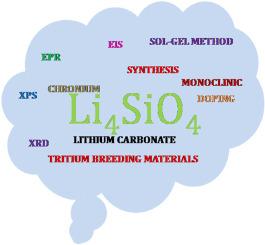
This work introduces strategies for obtaining a convenient candidate for tritium breeder materials. Li4+xSi1-xCrxO4 (x = 0 and 0.1) has been successfully prepared using the sol-gel method. X-Ray diffraction, SEM, TEM, X-Ray Photoelectron Spectra (XPS), Raman spectra, Electronic Paramagnetic Resonance (EPR) and Electrochemical Impedance Spectroscopy (EIS) were undertaken. X-Ray diffraction revealed that this compound crystallizes in the monoclinic structure with P 1 21/m 1 space group. A secondary phase Li2CO3 was detected by means of the High score software. The difference of XRD intensity demonstrated that the chromium substitution on silicon position into lithium orthosilicate is possible. The porosity values of compound demonstrate that it is sufficient for the generation a tritium breeder. Using TEM, the particle size increases from 20.04 nm to 31.67 nm for x = 0 and 0.1 respectively. This increase has been accounted for in terms of the fact that the Cr3+ ions influence the morphology. XPS and Raman spectra indicated the presence of valence state of Cr2O3. The resonance g = 1.97 of Li4.1Cr0.1Si0.9O4 is assigned to the exchange coupled Cr3+-Cr3+ pairs. At room-temperature, Electrochemical impedance spectroscopy (EIS) was conducted in order to control the lithium diffusion coefficient (DLi) as well as the Warburg coefficient (W). The increase of W from 86.761 Ω0.5–87.328 Ω0.5 and the growth of the lithium diffusion coefficient DLi from 2.4710−8 cm2s−1 to 8.4810−8 cm2s−1 for x = 0 and 0.1, respectively, have been assigned to chromium (Cr) which can enhance the ionic conductivity. The latter is ascribed to the rise of porosity which in turn triggers the enhancement of the electrochemical kinetics.
期刊介绍:
Materials Chemistry and Physics is devoted to short communications, full-length research papers and feature articles on interrelationships among structure, properties, processing and performance of materials. The Editors welcome manuscripts on thin films, surface and interface science, materials degradation and reliability, metallurgy, semiconductors and optoelectronic materials, fine ceramics, magnetics, superconductors, specialty polymers, nano-materials and composite materials.



 京公网安备 11010802042870号
京ICP备2023020795号-1
京公网安备 11010802042870号
京ICP备2023020795号-1

 分享
分享
 求助内容:
求助内容: 应助结果提醒方式:
 扫码关注我们
