{"title":"Dose-dependent developmental fluoride exposure leads to neurotoxicity and impairs excitatory synapse development","authors":"Wenjin Qiu, Xiaoyu Wang, Shuling Zhang, Zhenting Zhang, Kaiju Zhang, Zhijuan Shao, Yubo Liu, Ruting Wei, Liangzhao Chu, Peng Luo","doi":"10.1007/s00204-025-04003-5","DOIUrl":null,"url":null,"abstract":"<div><p>Developmental fluoride exposure has been implicated in cognitive deficits and neurotoxicity, yet the mechanisms underlying these effects remain unclear. Here, we investigated the dose- and time-dependent impacts of sodium fluoride (NaF) on neuronal morphology, viability, oxidative stress, and synaptic function using both in vitro and in vivo mouse models. Cultured primary embryonic mouse cortical neurons were exposed to varying concentrations of NaF (0–200 μg/ml). Acute exposure led to neuronal swelling at higher concentrations (≥ 50 μg/ml), while prolonged exposure reduced neuronal viability. Notably, NaF dose-dependently elevated reactive oxygen species (ROS) production, implicating oxidative stress as a key mechanism of fluoride-induced neurotoxicity. Synaptic development was also impaired, as evidenced by reduced density and co-localization of excitatory synapse markers with prolonged 2 μg/ml NaF exposure. To extend these in vitro findings, pregnant mice were exposed to 50 mg/L NaF in drinking water, and offspring brain functions were evaluated postnatally. Whole-cell patch-clamp recordings in layer V pyramidal neurons in the prefrontal cortex revealed reduced frequency and amplitude of miniature excitatory post-synaptic currents (mEPSCs), indicating impaired synaptic function. Morphological analysis showed decreased dendritic spine density and head diameter. These findings suggest that fluoride exposure during critical period of brain development disrupts synaptic integrity and function through excitatory synapse impairments.</p></div>","PeriodicalId":8329,"journal":{"name":"Archives of Toxicology","volume":"99 6","pages":"2327 - 2338"},"PeriodicalIF":6.9000,"publicationDate":"2025-03-14","publicationTypes":"Journal Article","fieldsOfStudy":null,"isOpenAccess":false,"openAccessPdf":"","citationCount":"0","resultStr":null,"platform":"Semanticscholar","paperid":null,"PeriodicalName":"Archives of Toxicology","FirstCategoryId":"3","ListUrlMain":"https://link.springer.com/article/10.1007/s00204-025-04003-5","RegionNum":2,"RegionCategory":"医学","ArticlePicture":[],"TitleCN":null,"AbstractTextCN":null,"PMCID":null,"EPubDate":"","PubModel":"","JCR":"Q1","JCRName":"TOXICOLOGY","Score":null,"Total":0}
引用次数: 0
Abstract
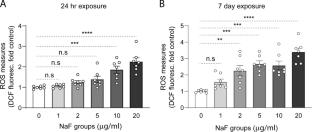
Developmental fluoride exposure has been implicated in cognitive deficits and neurotoxicity, yet the mechanisms underlying these effects remain unclear. Here, we investigated the dose- and time-dependent impacts of sodium fluoride (NaF) on neuronal morphology, viability, oxidative stress, and synaptic function using both in vitro and in vivo mouse models. Cultured primary embryonic mouse cortical neurons were exposed to varying concentrations of NaF (0–200 μg/ml). Acute exposure led to neuronal swelling at higher concentrations (≥ 50 μg/ml), while prolonged exposure reduced neuronal viability. Notably, NaF dose-dependently elevated reactive oxygen species (ROS) production, implicating oxidative stress as a key mechanism of fluoride-induced neurotoxicity. Synaptic development was also impaired, as evidenced by reduced density and co-localization of excitatory synapse markers with prolonged 2 μg/ml NaF exposure. To extend these in vitro findings, pregnant mice were exposed to 50 mg/L NaF in drinking water, and offspring brain functions were evaluated postnatally. Whole-cell patch-clamp recordings in layer V pyramidal neurons in the prefrontal cortex revealed reduced frequency and amplitude of miniature excitatory post-synaptic currents (mEPSCs), indicating impaired synaptic function. Morphological analysis showed decreased dendritic spine density and head diameter. These findings suggest that fluoride exposure during critical period of brain development disrupts synaptic integrity and function through excitatory synapse impairments.
期刊介绍:
Archives of Toxicology provides up-to-date information on the latest advances in toxicology. The journal places particular emphasis on studies relating to defined effects of chemicals and mechanisms of toxicity, including toxic activities at the molecular level, in humans and experimental animals. Coverage includes new insights into analysis and toxicokinetics and into forensic toxicology. Review articles of general interest to toxicologists are an additional important feature of the journal.




 京公网安备 11010802042870号
京ICP备2023020795号-1
京公网安备 11010802042870号
京ICP备2023020795号-1

 分享
分享
 求助内容:
求助内容: 应助结果提醒方式:
 扫码关注我们
