Li Pan MD, PhD , Ze Yu MD , Wen-Xuan Xiang MD , Shi-Ran Sun MD , Jing-Xian Li MD, PhD , Yi-Ke Deng MD, PhD , Meng-Chen Wang , Ji-Xin Zhong MD, PhD , Kun Huang PhD , Pei-Song Gao MD, PhD , Li-Ping Zhu PhD , Yin Yao MD, PhD , Zheng Liu MD, PhD
{"title":"Cigarette smoke–induced epithelial cell ferroptosis promotes neutrophilic inflammation in patients with nasal polyps","authors":"Li Pan MD, PhD , Ze Yu MD , Wen-Xuan Xiang MD , Shi-Ran Sun MD , Jing-Xian Li MD, PhD , Yi-Ke Deng MD, PhD , Meng-Chen Wang , Ji-Xin Zhong MD, PhD , Kun Huang PhD , Pei-Song Gao MD, PhD , Li-Ping Zhu PhD , Yin Yao MD, PhD , Zheng Liu MD, PhD","doi":"10.1016/j.jaci.2025.02.034","DOIUrl":null,"url":null,"abstract":"<div><h3>Background</h3><div>Regulation of epithelial cell death has emerged as a key mechanism maintaining immune homeostasis in the airway. However, the mechanisms governing epithelial cell survival in nasal polyps (NPs) remain poorly understood.</div></div><div><h3>Objective</h3><div>We sought to investigate the ferroptosis of nasal epithelial cells and its implications in the pathogenesis of NPs.</div></div><div><h3>Methods</h3><div>The cell death, lipid peroxidation, and ferrous iron levels in nasal epithelial cells were determined by flow cytometry. Biomarkers and signaling pathways associated with ferroptosis were evaluated by quantitative RT-PCR, single-cell and bulk RNA sequencing, immunofluorescence staining, and Western blotting. Human nasal epithelial cells (HNECs) and human bronchial epithelial cells (16HBE) were stimulated with different agents. Mitochondrial ultrastructure in HNECs was visualized by transmission electron microscopy. Cytokine levels were quantified using ELISA. A cigarette smoke extract (CSE)-induced mouse model was established and treated with deferoxamine.</div></div><div><h3>Results</h3><div>Nasal epithelial cells from both eosinophilic and noneosinophilic NPs showed intensified lipid peroxidation and altered mitochondrial morphology, resembling the features of ferroptosis. Ferroptosis triggered CXCL8 production in 16HBE cells and HNECs through the activation of mitogen-activated protein kinase pathway. CSE exposure elevated ferrous iron levels by upregulating transferrin receptor 1, leading to ferroptosis and subsequent CXCL8 production in HNECs. Deferoxamine treatment inhibited nasal epithelial cell ferroptosis, CXCL8 levels, and neutrophil numbers in a CSE-induced mice model. Smoking burden was correlated with CXCL8 levels and neutrophil infiltration in patients with NPs. An analysis of 494,176 UK Biobank participants revealed smoking as a risk factor for NPs (odds ratio, 1.346; 95% CI, 1.245-1.456; <em>P</em> < .001).</div></div><div><h3>Conclusions</h3><div>Smoking-induced ferroptosis promotes CXCL8 production in nasal epithelial cells and thus potentially exacerbates neutrophilic inflammation in NPs.</div></div>","PeriodicalId":14936,"journal":{"name":"Journal of Allergy and Clinical Immunology","volume":"155 6","pages":"Pages 1882-1897"},"PeriodicalIF":11.2000,"publicationDate":"2025-06-01","publicationTypes":"Journal Article","fieldsOfStudy":null,"isOpenAccess":false,"openAccessPdf":"","citationCount":"0","resultStr":null,"platform":"Semanticscholar","paperid":null,"PeriodicalName":"Journal of Allergy and Clinical Immunology","FirstCategoryId":"3","ListUrlMain":"https://www.sciencedirect.com/science/article/pii/S0091674925002660","RegionNum":1,"RegionCategory":"医学","ArticlePicture":[],"TitleCN":null,"AbstractTextCN":null,"PMCID":null,"EPubDate":"","PubModel":"","JCR":"Q1","JCRName":"ALLERGY","Score":null,"Total":0}
引用次数: 0
Abstract
Background
Regulation of epithelial cell death has emerged as a key mechanism maintaining immune homeostasis in the airway. However, the mechanisms governing epithelial cell survival in nasal polyps (NPs) remain poorly understood.
Objective
We sought to investigate the ferroptosis of nasal epithelial cells and its implications in the pathogenesis of NPs.
Methods
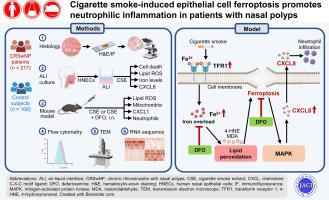
The cell death, lipid peroxidation, and ferrous iron levels in nasal epithelial cells were determined by flow cytometry. Biomarkers and signaling pathways associated with ferroptosis were evaluated by quantitative RT-PCR, single-cell and bulk RNA sequencing, immunofluorescence staining, and Western blotting. Human nasal epithelial cells (HNECs) and human bronchial epithelial cells (16HBE) were stimulated with different agents. Mitochondrial ultrastructure in HNECs was visualized by transmission electron microscopy. Cytokine levels were quantified using ELISA. A cigarette smoke extract (CSE)-induced mouse model was established and treated with deferoxamine.
Results
Nasal epithelial cells from both eosinophilic and noneosinophilic NPs showed intensified lipid peroxidation and altered mitochondrial morphology, resembling the features of ferroptosis. Ferroptosis triggered CXCL8 production in 16HBE cells and HNECs through the activation of mitogen-activated protein kinase pathway. CSE exposure elevated ferrous iron levels by upregulating transferrin receptor 1, leading to ferroptosis and subsequent CXCL8 production in HNECs. Deferoxamine treatment inhibited nasal epithelial cell ferroptosis, CXCL8 levels, and neutrophil numbers in a CSE-induced mice model. Smoking burden was correlated with CXCL8 levels and neutrophil infiltration in patients with NPs. An analysis of 494,176 UK Biobank participants revealed smoking as a risk factor for NPs (odds ratio, 1.346; 95% CI, 1.245-1.456; P < .001).
Conclusions
Smoking-induced ferroptosis promotes CXCL8 production in nasal epithelial cells and thus potentially exacerbates neutrophilic inflammation in NPs.
期刊介绍:
The Journal of Allergy and Clinical Immunology is a prestigious publication that features groundbreaking research in the fields of Allergy, Asthma, and Immunology. This influential journal publishes high-impact research papers that explore various topics, including asthma, food allergy, allergic rhinitis, atopic dermatitis, primary immune deficiencies, occupational and environmental allergy, and other allergic and immunologic diseases. The articles not only report on clinical trials and mechanistic studies but also provide insights into novel therapies, underlying mechanisms, and important discoveries that contribute to our understanding of these diseases. By sharing this valuable information, the journal aims to enhance the diagnosis and management of patients in the future.



 京公网安备 11010802042870号
京ICP备2023020795号-1
京公网安备 11010802042870号
京ICP备2023020795号-1

 分享
分享
 求助内容:
求助内容: 应助结果提醒方式:
 扫码关注我们
