{"title":"Understanding human amygdala function with artificial neural networks.","authors":"Grace Jang, Philip A Kragel","doi":"10.1523/JNEUROSCI.1436-24.2025","DOIUrl":null,"url":null,"abstract":"<p><p>The amygdala is a cluster of subcortical nuclei that receives diverse sensory inputs and projects to the cortex, midbrain, and other subcortical structures. Numerous accounts of amygdalar contributions to social and emotional behavior have been offered, yet an overarching description of amygdala function remains elusive. Here we adopt a computationally explicit framework that aims to develop a model of amygdala function based on the types of sensory inputs it receives, rather than individual constructs such as threat, arousal, or valence. Characterizing human fMRI signal acquired as male and female participants viewed a full-length film, we developed encoding models that predict both patterns of amygdala activity and self-reported valence evoked by naturalistic images. We use deep image synthesis to generate artificial stimuli that distinctly engage encoding models of amygdala subregions that systematically differ from one another in terms of their low-level visual properties. These findings characterize how the amygdala compresses high-dimensional sensory inputs into low-dimensional representations relevant for behavior.<b>Significance Statement</b> The amygdala is a cluster of subcortical nuclei critical for motivation, emotion, and social behavior. Characterizing the contribution of the amygdala to behavior has been challenging due to its structural complexity, broad connectivity, and functional heterogeneity. Here we use a combination of human neuroimaging and computational modeling to investigate how visual inputs relate to low-dimensional representations encoded in the amygdala. We find that the amygdala encodes an array of visual features, which systematically vary across specific nuclei and relate to the affective properties of the sensory environment.</p>","PeriodicalId":50114,"journal":{"name":"Journal of Neuroscience","volume":" ","pages":""},"PeriodicalIF":4.0000,"publicationDate":"2025-03-14","publicationTypes":"Journal Article","fieldsOfStudy":null,"isOpenAccess":false,"openAccessPdf":"https://www.ncbi.nlm.nih.gov/pmc/articles/PMC12044042/pdf/","citationCount":"0","resultStr":null,"platform":"Semanticscholar","paperid":null,"PeriodicalName":"Journal of Neuroscience","FirstCategoryId":"3","ListUrlMain":"https://doi.org/10.1523/JNEUROSCI.1436-24.2025","RegionNum":2,"RegionCategory":"医学","ArticlePicture":[],"TitleCN":null,"AbstractTextCN":null,"PMCID":null,"EPubDate":"","PubModel":"","JCR":"Q1","JCRName":"NEUROSCIENCES","Score":null,"Total":0}
引用次数: 0
Abstract
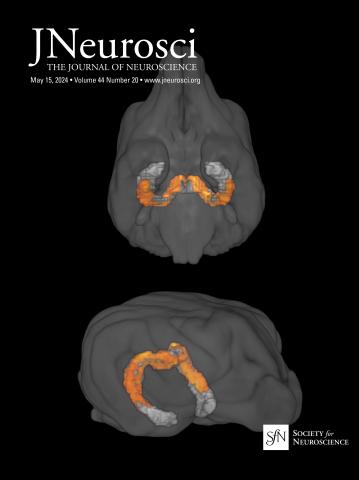
The amygdala is a cluster of subcortical nuclei that receives diverse sensory inputs and projects to the cortex, midbrain, and other subcortical structures. Numerous accounts of amygdalar contributions to social and emotional behavior have been offered, yet an overarching description of amygdala function remains elusive. Here we adopt a computationally explicit framework that aims to develop a model of amygdala function based on the types of sensory inputs it receives, rather than individual constructs such as threat, arousal, or valence. Characterizing human fMRI signal acquired as male and female participants viewed a full-length film, we developed encoding models that predict both patterns of amygdala activity and self-reported valence evoked by naturalistic images. We use deep image synthesis to generate artificial stimuli that distinctly engage encoding models of amygdala subregions that systematically differ from one another in terms of their low-level visual properties. These findings characterize how the amygdala compresses high-dimensional sensory inputs into low-dimensional representations relevant for behavior.Significance Statement The amygdala is a cluster of subcortical nuclei critical for motivation, emotion, and social behavior. Characterizing the contribution of the amygdala to behavior has been challenging due to its structural complexity, broad connectivity, and functional heterogeneity. Here we use a combination of human neuroimaging and computational modeling to investigate how visual inputs relate to low-dimensional representations encoded in the amygdala. We find that the amygdala encodes an array of visual features, which systematically vary across specific nuclei and relate to the affective properties of the sensory environment.
期刊介绍:
JNeurosci (ISSN 0270-6474) is an official journal of the Society for Neuroscience. It is published weekly by the Society, fifty weeks a year, one volume a year. JNeurosci publishes papers on a broad range of topics of general interest to those working on the nervous system. Authors now have an Open Choice option for their published articles



 京公网安备 11010802042870号
京ICP备2023020795号-1
京公网安备 11010802042870号
京ICP备2023020795号-1

 分享
分享
 求助内容:
求助内容: 应助结果提醒方式:
 扫码关注我们
