Periprocedural and Long-Term Outcomes of Carotid Stent Placement in Patients with Very Severe Carotid Artery Stenosis versus Carotid Near Occlusion with Full Collapse: A Propensity Score Matching Analysis
Zhenyu Zhou MD , Xiao Tang MD , Hanfei Tang MD , Tonglei Han MD , Fen Yu MD , Zhenyu Shi MD , Minhui Li MD , Jiaqi Zhu MD , Bin Gao MD , Yi Si MD , Changpo Lin MD , Weiguo Fu MD , Daqiao Guo MD
{"title":"Periprocedural and Long-Term Outcomes of Carotid Stent Placement in Patients with Very Severe Carotid Artery Stenosis versus Carotid Near Occlusion with Full Collapse: A Propensity Score Matching Analysis","authors":"Zhenyu Zhou MD , Xiao Tang MD , Hanfei Tang MD , Tonglei Han MD , Fen Yu MD , Zhenyu Shi MD , Minhui Li MD , Jiaqi Zhu MD , Bin Gao MD , Yi Si MD , Changpo Lin MD , Weiguo Fu MD , Daqiao Guo MD","doi":"10.1016/j.jvir.2025.03.005","DOIUrl":null,"url":null,"abstract":"<div><h3>Purpose</h3><div>To compare the periprocedural and 5-year outcomes between patients with very severe stenosis (80%–99% stenosis) and those with carotid near occlusion (CNO) with full collapse.</div></div><div><h3>Materials and Methods</h3><div>Data from patients with very severe stenosis and CNO with full collapse who underwent carotid artery stent (CAS) placement at a single center were retrospectively analyzed from January 2018 to December 2021. Unmatched and propensity score-matched (PSM) comparisons of periprocedural adverse events and 5-year follow-up rates for in-stent restenosis, ipsilateral ischemic stroke, myocardial infarction, and mortality were conducted between the 2 groups.</div></div><div><h3>Results</h3><div>A total of 555 patients (481 patients in the very severe stenosis group and 74 in the CNO with full collapse group) were included. PSM resulted in 61 patients from the CNO group being matched with 183 from the severe stenosis control group. The periprocedural adverse events did not differ significantly between the 2 groups after PSM. The 5-year follow-up results demonstrated no significant differences in outcomes between the 2 groups. Kaplan–Meier curves showed that the 5-year rate of freedom from stroke was 89% (CNO group) versus 92% (control group; <em>P</em> = .500). The 5-year rate of freedom from in-stent restenosis was 89% (CNO group) versus 91% (control group; <em>P</em> = .630), while that from death, myocardial infarction, and stroke incidence was 84% (CNO group) versus 87% (control group; <em>P</em> = .430).</div></div><div><h3>Conclusions</h3><div>CNO with full collapse showed long-term outcomes comparable with those of very severe carotid stenosis following CAS placement.</div></div>","PeriodicalId":49962,"journal":{"name":"Journal of Vascular and Interventional Radiology","volume":"36 7","pages":"Pages 1186-1195.e1"},"PeriodicalIF":2.6000,"publicationDate":"2025-07-01","publicationTypes":"Journal Article","fieldsOfStudy":null,"isOpenAccess":false,"openAccessPdf":"","citationCount":"0","resultStr":null,"platform":"Semanticscholar","paperid":null,"PeriodicalName":"Journal of Vascular and Interventional Radiology","FirstCategoryId":"3","ListUrlMain":"https://www.sciencedirect.com/science/article/pii/S1051044325002337","RegionNum":3,"RegionCategory":"医学","ArticlePicture":[],"TitleCN":null,"AbstractTextCN":null,"PMCID":null,"EPubDate":"2025/3/12 0:00:00","PubModel":"Epub","JCR":"Q2","JCRName":"PERIPHERAL VASCULAR DISEASE","Score":null,"Total":0}
引用次数: 0
Abstract
Purpose
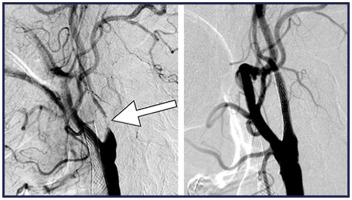
To compare the periprocedural and 5-year outcomes between patients with very severe stenosis (80%–99% stenosis) and those with carotid near occlusion (CNO) with full collapse.
Materials and Methods
Data from patients with very severe stenosis and CNO with full collapse who underwent carotid artery stent (CAS) placement at a single center were retrospectively analyzed from January 2018 to December 2021. Unmatched and propensity score-matched (PSM) comparisons of periprocedural adverse events and 5-year follow-up rates for in-stent restenosis, ipsilateral ischemic stroke, myocardial infarction, and mortality were conducted between the 2 groups.
Results
A total of 555 patients (481 patients in the very severe stenosis group and 74 in the CNO with full collapse group) were included. PSM resulted in 61 patients from the CNO group being matched with 183 from the severe stenosis control group. The periprocedural adverse events did not differ significantly between the 2 groups after PSM. The 5-year follow-up results demonstrated no significant differences in outcomes between the 2 groups. Kaplan–Meier curves showed that the 5-year rate of freedom from stroke was 89% (CNO group) versus 92% (control group; P = .500). The 5-year rate of freedom from in-stent restenosis was 89% (CNO group) versus 91% (control group; P = .630), while that from death, myocardial infarction, and stroke incidence was 84% (CNO group) versus 87% (control group; P = .430).
Conclusions
CNO with full collapse showed long-term outcomes comparable with those of very severe carotid stenosis following CAS placement.
期刊介绍:
JVIR, published continuously since 1990, is an international, monthly peer-reviewed interventional radiology journal. As the official journal of the Society of Interventional Radiology, JVIR is the peer-reviewed journal of choice for interventional radiologists, radiologists, cardiologists, vascular surgeons, neurosurgeons, and other clinicians who seek current and reliable information on every aspect of vascular and interventional radiology. Each issue of JVIR covers critical and cutting-edge medical minimally invasive, clinical, basic research, radiological, pathological, and socioeconomic issues of importance to the field.



 京公网安备 11010802042870号
京ICP备2023020795号-1
京公网安备 11010802042870号
京ICP备2023020795号-1

 分享
分享

 求助内容:
求助内容: 应助结果提醒方式:
 扫码关注我们
