Peipei Qi , Qingsheng Li , Jiao Wang , Xiaorong Ren , Zhenzhen Liu , Zhiwei Wang , Shanshan Di , Huiyu Zhao , Chenghui Zhang , Xinquan Wang
{"title":"Dissipation dynamics of methomyl, phoxim, and pymetrozine during mulberry (Morus alba L.) leaves harvest, tea processing and brewing","authors":"Peipei Qi , Qingsheng Li , Jiao Wang , Xiaorong Ren , Zhenzhen Liu , Zhiwei Wang , Shanshan Di , Huiyu Zhao , Chenghui Zhang , Xinquan Wang","doi":"10.1016/j.foodchem.2025.143899","DOIUrl":null,"url":null,"abstract":"<div><div>Mulberry leaf tea is known for its health benefits; however, concerns remain about pesticide residues during harvest, processing, and brewing. The dissipation dynamics of methomyl, phoxim, and pymetrozine were systematically investigated in this study. In fresh leaves, their half-lives ranged from 1.1 to 2.3 days, with dissipation rates of 64.6–87.8 % within three days. During tea processing, dissipation rates in black and green tea ranged from 46.3 % to 78.9 %, influenced by the initial pesticide levels and processing conditions. The dissipation of pesticides was significantly influenced by drying and spreading/withering. During brewing, pesticide leaching was closely related to water solubility, with 33.8–76.9 % of methomyl and pymetrozine transferring to the infusion, compared to just 0.32–3.2 % for the less water-soluble phoxim. Overall, at least 85 % of the pesticides dissipated across harvest, processing, and brewing, suggesting negligible health risks based on risk quotient assessment.</div></div>","PeriodicalId":318,"journal":{"name":"Food Chemistry","volume":"480 ","pages":"Article 143899"},"PeriodicalIF":9.8000,"publicationDate":"2025-07-15","publicationTypes":"Journal Article","fieldsOfStudy":null,"isOpenAccess":false,"openAccessPdf":"","citationCount":"0","resultStr":null,"platform":"Semanticscholar","paperid":null,"PeriodicalName":"Food Chemistry","FirstCategoryId":"97","ListUrlMain":"https://www.sciencedirect.com/science/article/pii/S0308814625011501","RegionNum":1,"RegionCategory":"农林科学","ArticlePicture":[],"TitleCN":null,"AbstractTextCN":null,"PMCID":null,"EPubDate":"2025/3/16 0:00:00","PubModel":"Epub","JCR":"Q1","JCRName":"CHEMISTRY, APPLIED","Score":null,"Total":0}
引用次数: 0
Abstract
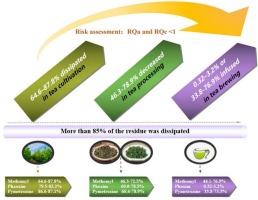
Mulberry leaf tea is known for its health benefits; however, concerns remain about pesticide residues during harvest, processing, and brewing. The dissipation dynamics of methomyl, phoxim, and pymetrozine were systematically investigated in this study. In fresh leaves, their half-lives ranged from 1.1 to 2.3 days, with dissipation rates of 64.6–87.8 % within three days. During tea processing, dissipation rates in black and green tea ranged from 46.3 % to 78.9 %, influenced by the initial pesticide levels and processing conditions. The dissipation of pesticides was significantly influenced by drying and spreading/withering. During brewing, pesticide leaching was closely related to water solubility, with 33.8–76.9 % of methomyl and pymetrozine transferring to the infusion, compared to just 0.32–3.2 % for the less water-soluble phoxim. Overall, at least 85 % of the pesticides dissipated across harvest, processing, and brewing, suggesting negligible health risks based on risk quotient assessment.
期刊介绍:
Food Chemistry publishes original research papers dealing with the advancement of the chemistry and biochemistry of foods or the analytical methods/ approach used. All papers should focus on the novelty of the research carried out.






 京公网安备 11010802042870号
京ICP备2023020795号-1
京公网安备 11010802042870号
京ICP备2023020795号-1

 分享
分享
 求助内容:
求助内容: 应助结果提醒方式:
 扫码关注我们
