Structural, electronic, and Li-ion adsorption properties of PolyPyGY explored by first-principles and machine learning simulations: A new multi-ringed 2D carbon allotrope
K.A.L. Lima , D.A. da Silva , G.D. Amvame Nze , F.L. Lopes de Mendonça , M.L. Pereira Jr , L.A. Ribeiro Jr
{"title":"Structural, electronic, and Li-ion adsorption properties of PolyPyGY explored by first-principles and machine learning simulations: A new multi-ringed 2D carbon allotrope","authors":"K.A.L. Lima , D.A. da Silva , G.D. Amvame Nze , F.L. Lopes de Mendonça , M.L. Pereira Jr , L.A. Ribeiro Jr","doi":"10.1016/j.est.2025.116099","DOIUrl":null,"url":null,"abstract":"<div><div>Two-dimensional (2D) carbon materials have been intensively investigated because of their distinctive structural framework and electronic behaviors as alternatives in energy conversion and storage applications. This study proposes a novel 2D carbon allotrope, Polymerized Pyracyclene Graphyne (PolyPyGY), characterized by a multi-ringed structure with 4-, 5-, 6-, 8-, and 16-membered rings comprising a porous structure. Using first-principles calculations and machine-learning techniques, we explore its structural, electronic, mechanical, optical, and lithium-ion storing properties. The vibrational properties assessed through the density functional perturbation theory framework confirm its structural stability. Moreover, ab initio molecular dynamics simulations at 1000 K demonstrate its thermal resilience, with no bond breaking or reconfiguration observed. The electronic band structure reveals a metallic nature, and the material exhibits anisotropic elastic properties, with Young’s modulus varying between 421 and 664 GPa, suggesting good mechanical stability. Furthermore, lithium diffusion studies indicate low energy barriers (0.05-0.9 eV), max lithium-ion storage capacity of 2231.41 mAh/g, and a high diffusion coefficient (<span><math><mo>></mo></math></span> 6 × 10<sup>−6</sup> cm<sup>2</sup>/s), along with a stable open circuit voltage of 2.5 V. These results highlight PolyPyGY’s potential as a highly effective and durable anode material for lithium-ion batteries, featuring rapid Li-ion diffusion, stable intercalation, and consistent performance during charge and discharge cycles.</div></div>","PeriodicalId":15942,"journal":{"name":"Journal of energy storage","volume":"117 ","pages":"Article 116099"},"PeriodicalIF":8.9000,"publicationDate":"2025-05-01","publicationTypes":"Journal Article","fieldsOfStudy":null,"isOpenAccess":false,"openAccessPdf":"","citationCount":"0","resultStr":null,"platform":"Semanticscholar","paperid":null,"PeriodicalName":"Journal of energy storage","FirstCategoryId":"5","ListUrlMain":"https://www.sciencedirect.com/science/article/pii/S2352152X25008126","RegionNum":2,"RegionCategory":"工程技术","ArticlePicture":[],"TitleCN":null,"AbstractTextCN":null,"PMCID":null,"EPubDate":"2025/3/15 0:00:00","PubModel":"Epub","JCR":"Q1","JCRName":"ENERGY & FUELS","Score":null,"Total":0}
引用次数: 0
Abstract
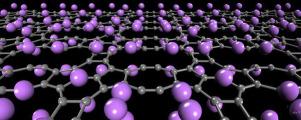
Two-dimensional (2D) carbon materials have been intensively investigated because of their distinctive structural framework and electronic behaviors as alternatives in energy conversion and storage applications. This study proposes a novel 2D carbon allotrope, Polymerized Pyracyclene Graphyne (PolyPyGY), characterized by a multi-ringed structure with 4-, 5-, 6-, 8-, and 16-membered rings comprising a porous structure. Using first-principles calculations and machine-learning techniques, we explore its structural, electronic, mechanical, optical, and lithium-ion storing properties. The vibrational properties assessed through the density functional perturbation theory framework confirm its structural stability. Moreover, ab initio molecular dynamics simulations at 1000 K demonstrate its thermal resilience, with no bond breaking or reconfiguration observed. The electronic band structure reveals a metallic nature, and the material exhibits anisotropic elastic properties, with Young’s modulus varying between 421 and 664 GPa, suggesting good mechanical stability. Furthermore, lithium diffusion studies indicate low energy barriers (0.05-0.9 eV), max lithium-ion storage capacity of 2231.41 mAh/g, and a high diffusion coefficient ( 6 × 10⁻⁶ cm2/s), along with a stable open circuit voltage of 2.5 V. These results highlight PolyPyGY’s potential as a highly effective and durable anode material for lithium-ion batteries, featuring rapid Li-ion diffusion, stable intercalation, and consistent performance during charge and discharge cycles.
期刊介绍:
Journal of energy storage focusses on all aspects of energy storage, in particular systems integration, electric grid integration, modelling and analysis, novel energy storage technologies, sizing and management strategies, business models for operation of storage systems and energy storage developments worldwide.




 京公网安备 11010802042870号
京ICP备2023020795号-1
京公网安备 11010802042870号
京ICP备2023020795号-1

 分享
分享
 求助内容:
求助内容: 应助结果提醒方式:
 扫码关注我们
