{"title":"Unveiling the Catalytic Activity of Nickel(II) Complexes of Pentadentate Ligands in Aromatic Oxidations","authors":"Anjana Rajeev, Sethuraman Muthuramalingam, Visvesvarar Pitchai Murugan, Miquel Costas, Prabha Vadivelu, Muniyandi Sankaralingam","doi":"10.1002/cctc.202401645","DOIUrl":null,"url":null,"abstract":"<p>Selective oxidation of aromatic substrates to phenols is a challenging goal in synthetic chemistry. Herein, we investigate the catalytic activity of nickel(II) complexes of the type [Ni(L)(CH<sub>3</sub>CN)](X)<sub>2</sub> (<b>1</b>–<b>4</b>); (X = ClO<sub>4</sub><sup>−</sup>, BPh<sub>4</sub><sup>−</sup>, L = N4Py, BnTPEN, and BnImDPEN) supported by pentadentate ligands in the hydroxylation of aromatic substrates to corresponding phenols using H<sub>2</sub>O<sub>2</sub>. In benzene oxidation, complex <b>2</b> showed a phenol yield of 28% and a turnover number of 560 with 99% selectivity. Also, preferential oxidation of aromatic C─H bonds over aliphatic C─H bonds was noted during the oxidation of substituted benzenes. The kinetic isotope effect value (1.01) supported the involvement of nickel-bound oxygen species in the catalytic cycle rather than hydroxyl radicals. The key source of oxygen in the formed phenol was found to be H<sub>2</sub>O<sub>2</sub> based on the isotope-labelling experiments using H<sub>2</sub><sup>18</sup>O<sub>2</sub> and H<sub>2</sub><sup>18</sup>O. Although the formation of {[(BnTPEN)Ni(OOH)]<sup>+</sup> + NCCH<sub>3</sub>}<sup>+</sup> intermediate was identified upon reacting complex <b>2</b> with H<sub>2</sub>O<sub>2</sub>, this species did not directly react with benzene to form phenol. Further, DFT studies suggested that the species [(L)Ni<sup>II</sup>(O<sup>•</sup>)]<sup>+</sup> derived from O─O homolysis of nickel(II) hydroperoxo intermediate reacts with benzene to produce phenol and the presence of a nickel-based oxidant is the reason behind the excellent selectivity.</p>","PeriodicalId":141,"journal":{"name":"ChemCatChem","volume":"17 6","pages":""},"PeriodicalIF":3.9000,"publicationDate":"2025-01-26","publicationTypes":"Journal Article","fieldsOfStudy":null,"isOpenAccess":false,"openAccessPdf":"","citationCount":"0","resultStr":null,"platform":"Semanticscholar","paperid":null,"PeriodicalName":"ChemCatChem","FirstCategoryId":"92","ListUrlMain":"https://chemistry-europe.onlinelibrary.wiley.com/doi/10.1002/cctc.202401645","RegionNum":3,"RegionCategory":"化学","ArticlePicture":[],"TitleCN":null,"AbstractTextCN":null,"PMCID":null,"EPubDate":"","PubModel":"","JCR":"Q2","JCRName":"CHEMISTRY, PHYSICAL","Score":null,"Total":0}
引用次数: 0
Abstract
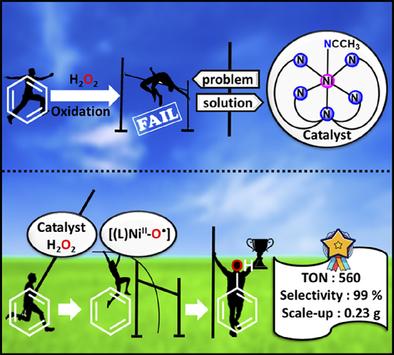
Selective oxidation of aromatic substrates to phenols is a challenging goal in synthetic chemistry. Herein, we investigate the catalytic activity of nickel(II) complexes of the type [Ni(L)(CH3CN)](X)2 (1–4); (X = ClO4−, BPh4−, L = N4Py, BnTPEN, and BnImDPEN) supported by pentadentate ligands in the hydroxylation of aromatic substrates to corresponding phenols using H2O2. In benzene oxidation, complex 2 showed a phenol yield of 28% and a turnover number of 560 with 99% selectivity. Also, preferential oxidation of aromatic C─H bonds over aliphatic C─H bonds was noted during the oxidation of substituted benzenes. The kinetic isotope effect value (1.01) supported the involvement of nickel-bound oxygen species in the catalytic cycle rather than hydroxyl radicals. The key source of oxygen in the formed phenol was found to be H2O2 based on the isotope-labelling experiments using H218O2 and H218O. Although the formation of {[(BnTPEN)Ni(OOH)]+ + NCCH3}+ intermediate was identified upon reacting complex 2 with H2O2, this species did not directly react with benzene to form phenol. Further, DFT studies suggested that the species [(L)NiII(O•)]+ derived from O─O homolysis of nickel(II) hydroperoxo intermediate reacts with benzene to produce phenol and the presence of a nickel-based oxidant is the reason behind the excellent selectivity.
期刊介绍:
With an impact factor of 4.495 (2018), ChemCatChem is one of the premier journals in the field of catalysis. The journal provides primary research papers and critical secondary information on heterogeneous, homogeneous and bio- and nanocatalysis. The journal is well placed to strengthen cross-communication within between these communities. Its authors and readers come from academia, the chemical industry, and government laboratories across the world. It is published on behalf of Chemistry Europe, an association of 16 European chemical societies, and is supported by the German Catalysis Society.






 京公网安备 11010802042870号
京ICP备2023020795号-1
京公网安备 11010802042870号
京ICP备2023020795号-1

 分享
分享
 求助内容:
求助内容: 应助结果提醒方式:
 扫码关注我们
