Julio C. S. Terra, Jackson DeWolfe, Jesus A. Valdez, Audrey Moores
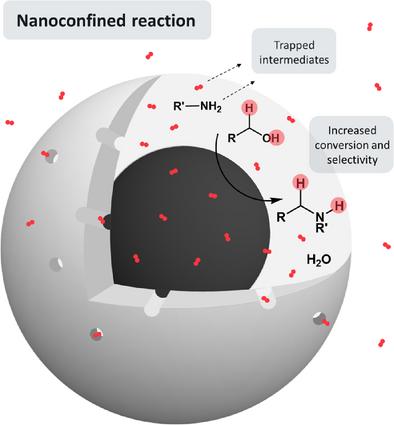
{"title":"Trapping Hydrogen: Confined Catalysis for Improved Alcohol Amination Selectivity","authors":"Julio C. S. Terra, Jackson DeWolfe, Jesus A. Valdez, Audrey Moores","doi":"10.1002/cctc.202401941","DOIUrl":null,"url":null,"abstract":"<p>Confined chemistry is a powerful tool in catalysis. In this study, we report hierarchical structures with controlled morphology able to trap labile intermediates and improve a catalytic cascade reaction. We used alcohol amination via hydrogen borrowing as model, a process that gives substituted amines from alcohols and does not require the addition of hydrogen to reduce the imines or the use of coupling agents. A common problem however in those systems is the loss of the borrowed hydrogen atoms, leading to stagnation of the product at the imine stage. To this end, we encapsulated Al<sub>2</sub>O<sub>3</sub>/Ru(OH)<sub>x</sub> nanocatalysts inside mesoporous silica in a yolk-shell architecture and were able to trap the hydrogens to increase the amine yield from 12% to 82%, with a three-fold increase in selectivity without the need of any additive. We found the presence of mesopores in the silica shells to be essential to enable access to the catalytic sites and the yolk-shell gap size to be the key parameter influencing the reactivity of the catalytic system. To the best of our knowledge, this is the first report of a confined hydrogen borrowing reaction, an approach that can be extended to the other types of cascade reactions that produce labile intermediates.</p>","PeriodicalId":141,"journal":{"name":"ChemCatChem","volume":"17 6","pages":""},"PeriodicalIF":3.9000,"publicationDate":"2025-03-05","publicationTypes":"Journal Article","fieldsOfStudy":null,"isOpenAccess":false,"openAccessPdf":"","citationCount":"0","resultStr":null,"platform":"Semanticscholar","paperid":null,"PeriodicalName":"ChemCatChem","FirstCategoryId":"92","ListUrlMain":"https://chemistry-europe.onlinelibrary.wiley.com/doi/10.1002/cctc.202401941","RegionNum":3,"RegionCategory":"化学","ArticlePicture":[],"TitleCN":null,"AbstractTextCN":null,"PMCID":null,"EPubDate":"","PubModel":"","JCR":"Q2","JCRName":"CHEMISTRY, PHYSICAL","Score":null,"Total":0}
引用次数: 0
Abstract
Confined chemistry is a powerful tool in catalysis. In this study, we report hierarchical structures with controlled morphology able to trap labile intermediates and improve a catalytic cascade reaction. We used alcohol amination via hydrogen borrowing as model, a process that gives substituted amines from alcohols and does not require the addition of hydrogen to reduce the imines or the use of coupling agents. A common problem however in those systems is the loss of the borrowed hydrogen atoms, leading to stagnation of the product at the imine stage. To this end, we encapsulated Al2O3/Ru(OH)x nanocatalysts inside mesoporous silica in a yolk-shell architecture and were able to trap the hydrogens to increase the amine yield from 12% to 82%, with a three-fold increase in selectivity without the need of any additive. We found the presence of mesopores in the silica shells to be essential to enable access to the catalytic sites and the yolk-shell gap size to be the key parameter influencing the reactivity of the catalytic system. To the best of our knowledge, this is the first report of a confined hydrogen borrowing reaction, an approach that can be extended to the other types of cascade reactions that produce labile intermediates.
期刊介绍:
With an impact factor of 4.495 (2018), ChemCatChem is one of the premier journals in the field of catalysis. The journal provides primary research papers and critical secondary information on heterogeneous, homogeneous and bio- and nanocatalysis. The journal is well placed to strengthen cross-communication within between these communities. Its authors and readers come from academia, the chemical industry, and government laboratories across the world. It is published on behalf of Chemistry Europe, an association of 16 European chemical societies, and is supported by the German Catalysis Society.






 京公网安备 11010802042870号
京ICP备2023020795号-1
京公网安备 11010802042870号
京ICP备2023020795号-1

 分享
分享
 求助内容:
求助内容: 应助结果提醒方式:
 扫码关注我们
