Enhanced Electrocatalytic Oxidation of 5-Hydroxymethylfurfural to 2,5-Furandicarboxylic Acid via N-Hydroxyphthalimide-Integrated Porphyrin(Co) Covalent Organic Frameworks
Ying Yin, Lei Fang, Guocai Wu, Hui Xu, Prof. Liangchun Li
{"title":"Enhanced Electrocatalytic Oxidation of 5-Hydroxymethylfurfural to 2,5-Furandicarboxylic Acid via N-Hydroxyphthalimide-Integrated Porphyrin(Co) Covalent Organic Frameworks","authors":"Ying Yin, Lei Fang, Guocai Wu, Hui Xu, Prof. Liangchun Li","doi":"10.1002/cctc.202401674","DOIUrl":null,"url":null,"abstract":"<p>The depletion of fossil fuel reserves, coupled with the mounting environmental concerns, highlights the urgent need to develop sustainable methods for chemical synthesis from renewable resources. One promising avenue is the electrocatalytic oxidation of 5-hydroxymethylfurfural (HMF) to 2,5-furandicarboxylic acid (FDCA), utilizing non-precious metal catalysts. Herein, we designed and synthesized covalent organic frameworks (COFs) as electrocatalysts, engineered through the integration of <i>N</i>-hydroxyphthalimide (NHPI) linkers with porphyrin building blocks. Electrochemical studies revealed that the Co-Por-COF-NHPI with metallic porphyrin(Co) surpassed the nonmetallic Por-COF-NHPI in conversion, selectivity, and recyclable stability by virtue of the lower onset potentials, higher current densities, and diminished charge transfer resistance. The Co-Por-COF-NHPI achieved remarkable HMF conversion of 95.5% and selectivity to FDCA of 95.6%, attributable to the synergistic effect of porphyrin(Co) and oxidative organocatalytic NHPI sites. Continuous cycling tests further verified its outstanding stability and durability, underscoring the potential of Co-Por-COF-NHPI as an efficient and sustainable catalyst for biomass conversion.</p>","PeriodicalId":141,"journal":{"name":"ChemCatChem","volume":"17 6","pages":""},"PeriodicalIF":3.9000,"publicationDate":"2025-01-22","publicationTypes":"Journal Article","fieldsOfStudy":null,"isOpenAccess":false,"openAccessPdf":"","citationCount":"0","resultStr":null,"platform":"Semanticscholar","paperid":null,"PeriodicalName":"ChemCatChem","FirstCategoryId":"92","ListUrlMain":"https://chemistry-europe.onlinelibrary.wiley.com/doi/10.1002/cctc.202401674","RegionNum":3,"RegionCategory":"化学","ArticlePicture":[],"TitleCN":null,"AbstractTextCN":null,"PMCID":null,"EPubDate":"","PubModel":"","JCR":"Q2","JCRName":"CHEMISTRY, PHYSICAL","Score":null,"Total":0}
引用次数: 0
Abstract
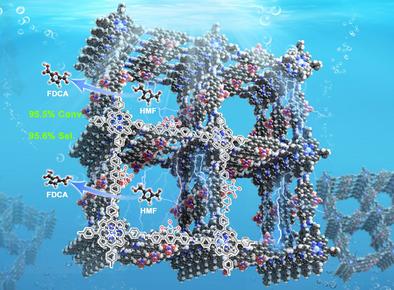
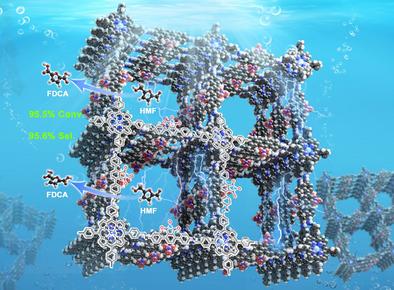
The depletion of fossil fuel reserves, coupled with the mounting environmental concerns, highlights the urgent need to develop sustainable methods for chemical synthesis from renewable resources. One promising avenue is the electrocatalytic oxidation of 5-hydroxymethylfurfural (HMF) to 2,5-furandicarboxylic acid (FDCA), utilizing non-precious metal catalysts. Herein, we designed and synthesized covalent organic frameworks (COFs) as electrocatalysts, engineered through the integration of N-hydroxyphthalimide (NHPI) linkers with porphyrin building blocks. Electrochemical studies revealed that the Co-Por-COF-NHPI with metallic porphyrin(Co) surpassed the nonmetallic Por-COF-NHPI in conversion, selectivity, and recyclable stability by virtue of the lower onset potentials, higher current densities, and diminished charge transfer resistance. The Co-Por-COF-NHPI achieved remarkable HMF conversion of 95.5% and selectivity to FDCA of 95.6%, attributable to the synergistic effect of porphyrin(Co) and oxidative organocatalytic NHPI sites. Continuous cycling tests further verified its outstanding stability and durability, underscoring the potential of Co-Por-COF-NHPI as an efficient and sustainable catalyst for biomass conversion.
期刊介绍:
With an impact factor of 4.495 (2018), ChemCatChem is one of the premier journals in the field of catalysis. The journal provides primary research papers and critical secondary information on heterogeneous, homogeneous and bio- and nanocatalysis. The journal is well placed to strengthen cross-communication within between these communities. Its authors and readers come from academia, the chemical industry, and government laboratories across the world. It is published on behalf of Chemistry Europe, an association of 16 European chemical societies, and is supported by the German Catalysis Society.






 京公网安备 11010802042870号
京ICP备2023020795号-1
京公网安备 11010802042870号
京ICP备2023020795号-1

 分享
分享
 求助内容:
求助内容: 应助结果提醒方式:
 扫码关注我们
