Altered serum glutathione disulfide levels in acute relapsed schizophrenia are associated with clinical symptoms and response to electroconvulsive therapy.
{"title":"Altered serum glutathione disulfide levels in acute relapsed schizophrenia are associated with clinical symptoms and response to electroconvulsive therapy.","authors":"Li Xu, Ping Yu, Haidong Yang, Chengbing Huang, Wenxi Sun, Xiaobin Zhang, Xiaowei Tang","doi":"10.1186/s12888-025-06691-w","DOIUrl":null,"url":null,"abstract":"<p><strong>Background: </strong>The pathophysiological mechanisms of schizophrenia are complex and not fully elucidated. This study aimed to investigate changes to total glutathione (T-GSH), glutathione disulfide (GSSG), reduced glutathione (GSH), and the GSH/GSSG ratio before and after electroconvulsive therapy (ECT) for patients with acute relapse of schizophrenia and associations with clinical symptoms.</p><p><strong>Methods: </strong>The study cohort included 110 patients with acute relapse of schizophrenia and 55 healthy controls. All patients received 8-10 sessions of ECT. Clinical symptoms were assessed using the Positive and Negative Syndrome Scale (PANSS).</p><p><strong>Results: </strong>As compared to the healthy controls, schizophrenia patients had decreased baseline GSSG levels (t = -2.115, p = 0.036) and elevated GSH/GSSG ratios (t = 2.141, p = 0.034). Baseline GSSG levels were negatively correlated with both PANSS total scores (beta = -0.369, t = -4.108, p < 0.001) and positive symptom scores (beta = -0.332, t = -3.730, p < 0.001), while changes to GSSG levels were positively correlated with improvements in PANSS total scores (r = 0.392, p < 0.001) and positive symptom scores (r = 0.293, p = 0.005) after ECT treatment. In treatment responders, GSSG levels were significantly increased (t = -2.817, p = 0.006) and GSH/GSSG ratios were decreased (t = 4.474, p < 0.001), as compared to before ECT, with baseline T-GSH (B = 0.734, OR = 2.083, 95%CI:1.287-3.372, p = 0.003), GSSG (B = -2.720, OR = 0.066, 95%CI:0.011-0.390, p = 0.003), and GSH/GSSG ratio (B = -1.013, OR = 0.363, 95%CI:0.142-0.930, p = 0.035) predictive of clinical improvement.</p><p><strong>Conclusion: </strong>Patients with schizophrenia exhibit significant redox imbalance, and GSSG levels may serve as a potential biomarker to evaluate and predict ECT outcomes.</p>","PeriodicalId":9029,"journal":{"name":"BMC Psychiatry","volume":"25 1","pages":"242"},"PeriodicalIF":3.4000,"publicationDate":"2025-03-14","publicationTypes":"Journal Article","fieldsOfStudy":null,"isOpenAccess":false,"openAccessPdf":"https://www.ncbi.nlm.nih.gov/pmc/articles/PMC11907840/pdf/","citationCount":"0","resultStr":null,"platform":"Semanticscholar","paperid":null,"PeriodicalName":"BMC Psychiatry","FirstCategoryId":"3","ListUrlMain":"https://doi.org/10.1186/s12888-025-06691-w","RegionNum":2,"RegionCategory":"医学","ArticlePicture":[],"TitleCN":null,"AbstractTextCN":null,"PMCID":null,"EPubDate":"","PubModel":"","JCR":"Q2","JCRName":"PSYCHIATRY","Score":null,"Total":0}
引用次数: 0
Abstract
Background: The pathophysiological mechanisms of schizophrenia are complex and not fully elucidated. This study aimed to investigate changes to total glutathione (T-GSH), glutathione disulfide (GSSG), reduced glutathione (GSH), and the GSH/GSSG ratio before and after electroconvulsive therapy (ECT) for patients with acute relapse of schizophrenia and associations with clinical symptoms.
Methods: The study cohort included 110 patients with acute relapse of schizophrenia and 55 healthy controls. All patients received 8-10 sessions of ECT. Clinical symptoms were assessed using the Positive and Negative Syndrome Scale (PANSS).
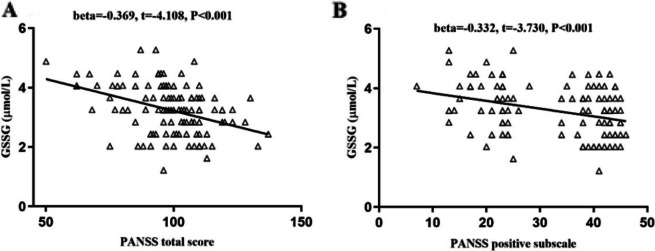
Results: As compared to the healthy controls, schizophrenia patients had decreased baseline GSSG levels (t = -2.115, p = 0.036) and elevated GSH/GSSG ratios (t = 2.141, p = 0.034). Baseline GSSG levels were negatively correlated with both PANSS total scores (beta = -0.369, t = -4.108, p < 0.001) and positive symptom scores (beta = -0.332, t = -3.730, p < 0.001), while changes to GSSG levels were positively correlated with improvements in PANSS total scores (r = 0.392, p < 0.001) and positive symptom scores (r = 0.293, p = 0.005) after ECT treatment. In treatment responders, GSSG levels were significantly increased (t = -2.817, p = 0.006) and GSH/GSSG ratios were decreased (t = 4.474, p < 0.001), as compared to before ECT, with baseline T-GSH (B = 0.734, OR = 2.083, 95%CI:1.287-3.372, p = 0.003), GSSG (B = -2.720, OR = 0.066, 95%CI:0.011-0.390, p = 0.003), and GSH/GSSG ratio (B = -1.013, OR = 0.363, 95%CI:0.142-0.930, p = 0.035) predictive of clinical improvement.
Conclusion: Patients with schizophrenia exhibit significant redox imbalance, and GSSG levels may serve as a potential biomarker to evaluate and predict ECT outcomes.
期刊介绍:
BMC Psychiatry is an open access, peer-reviewed journal that considers articles on all aspects of the prevention, diagnosis and management of psychiatric disorders, as well as related molecular genetics, pathophysiology, and epidemiology.





 京公网安备 11010802042870号
京ICP备2023020795号-1
京公网安备 11010802042870号
京ICP备2023020795号-1

 分享
分享
 求助内容:
求助内容: 应助结果提醒方式:
 扫码关注我们
