Rose P Kaptchuk, Aastha Kant, Surendra S Shekhawat, Jiban Baishya, Archit Sinha, Ashwini Kedar, Saisha Khanna, Allison M McFall, Sunil S Solomon, Shruti H Mehta, Gregory M Lucas
{"title":"Social support and HIV management among people who inject drugs: in-depth interviews in Delhi, India.","authors":"Rose P Kaptchuk, Aastha Kant, Surendra S Shekhawat, Jiban Baishya, Archit Sinha, Ashwini Kedar, Saisha Khanna, Allison M McFall, Sunil S Solomon, Shruti H Mehta, Gregory M Lucas","doi":"10.1186/s12954-025-01185-0","DOIUrl":null,"url":null,"abstract":"<p><strong>Background: </strong>People who inject drugs (PWID) experience a higher burden of HIV compared to general populations. Social support has been shown to improve disease management and combat stigma for PWID yet remains unexplored among PWID in low- and middle-income countries.</p><p><strong>Methods: </strong>We conducted qualitative in-depth interviews to understand social ties and health management among PWID living with HIV in Delhi, India. The research was nested in a factorial randomized controlled trial comparing same-day treatment and community-based care with standard-of-care. Interviews were conducted in Hindi in a private room, audio recorded, transcribed in English, and analyzed inductively using Dedoose.</p><p><strong>Results: </strong>We conducted 22 interviews (30 min-two hours) with PWID living with HIV in Delhi (all men, ages 21-38 years). 10 slept in houses, 11 on public streets, and one in a shelter. Participants often experienced isolation in their lives but identified avenues of positive social support from healthcare staff, families, peers (friends or injecting partners), and authority figures/public contacts. Healthcare staff provided information and respectful encouragement to manage health. Outreach workers provided support to remind and accompany participants to clinic visits. Family members offered financial support, medicine reminders, and trust. Authority figures/public contacts included employers, shopkeepers, and vendors who provided a safe place to sleep or store belongings, which proved crucial to consistently store and take pills. In some cases, specific social connections created barriers to health by enabling injecting drug use and carrying out harmful behaviors such as physical attacks, disrespect, and theft.</p><p><strong>Conclusion: </strong>Social connections can offer PWID positive emotional and logistical support to access health services and help them persevere through societal and structural stigmas. However, in some cases they may also contribute negatively to health management challenges. As a harm reduction strategy, public health services can work with PWID to consider untapped opportunities to build positive support and resilience through social ties, as well as how to contend with social connections harmful to health management.</p>","PeriodicalId":12922,"journal":{"name":"Harm Reduction Journal","volume":"22 1","pages":"32"},"PeriodicalIF":4.0000,"publicationDate":"2025-03-14","publicationTypes":"Journal Article","fieldsOfStudy":null,"isOpenAccess":false,"openAccessPdf":"https://www.ncbi.nlm.nih.gov/pmc/articles/PMC11909935/pdf/","citationCount":"0","resultStr":null,"platform":"Semanticscholar","paperid":null,"PeriodicalName":"Harm Reduction Journal","FirstCategoryId":"90","ListUrlMain":"https://doi.org/10.1186/s12954-025-01185-0","RegionNum":2,"RegionCategory":"社会学","ArticlePicture":[],"TitleCN":null,"AbstractTextCN":null,"PMCID":null,"EPubDate":"","PubModel":"","JCR":"Q1","JCRName":"SUBSTANCE ABUSE","Score":null,"Total":0}
引用次数: 0
Abstract
Background: People who inject drugs (PWID) experience a higher burden of HIV compared to general populations. Social support has been shown to improve disease management and combat stigma for PWID yet remains unexplored among PWID in low- and middle-income countries.
Methods: We conducted qualitative in-depth interviews to understand social ties and health management among PWID living with HIV in Delhi, India. The research was nested in a factorial randomized controlled trial comparing same-day treatment and community-based care with standard-of-care. Interviews were conducted in Hindi in a private room, audio recorded, transcribed in English, and analyzed inductively using Dedoose.
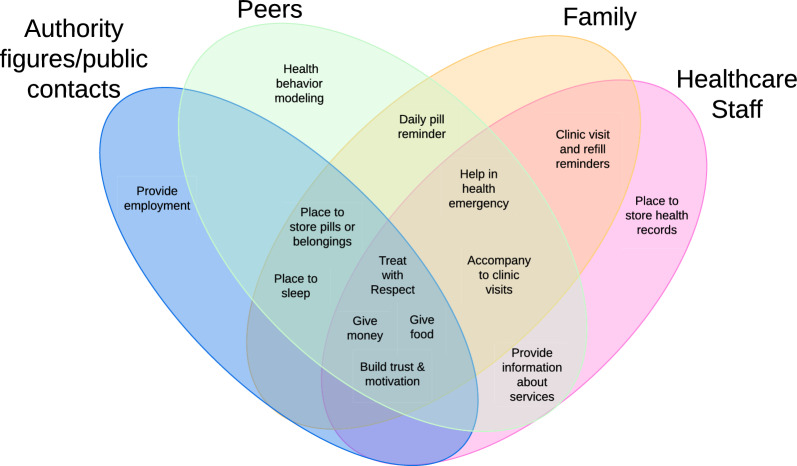
Results: We conducted 22 interviews (30 min-two hours) with PWID living with HIV in Delhi (all men, ages 21-38 years). 10 slept in houses, 11 on public streets, and one in a shelter. Participants often experienced isolation in their lives but identified avenues of positive social support from healthcare staff, families, peers (friends or injecting partners), and authority figures/public contacts. Healthcare staff provided information and respectful encouragement to manage health. Outreach workers provided support to remind and accompany participants to clinic visits. Family members offered financial support, medicine reminders, and trust. Authority figures/public contacts included employers, shopkeepers, and vendors who provided a safe place to sleep or store belongings, which proved crucial to consistently store and take pills. In some cases, specific social connections created barriers to health by enabling injecting drug use and carrying out harmful behaviors such as physical attacks, disrespect, and theft.
Conclusion: Social connections can offer PWID positive emotional and logistical support to access health services and help them persevere through societal and structural stigmas. However, in some cases they may also contribute negatively to health management challenges. As a harm reduction strategy, public health services can work with PWID to consider untapped opportunities to build positive support and resilience through social ties, as well as how to contend with social connections harmful to health management.
期刊介绍:
Harm Reduction Journal is an Open Access, peer-reviewed, online journal whose focus is on the prevalent patterns of psychoactive drug use, the public policies meant to control them, and the search for effective methods of reducing the adverse medical, public health, and social consequences associated with both drugs and drug policies. We define "harm reduction" as "policies and programs which aim to reduce the health, social, and economic costs of legal and illegal psychoactive drug use without necessarily reducing drug consumption". We are especially interested in studies of the evolving patterns of drug use around the world, their implications for the spread of HIV/AIDS and other blood-borne pathogens.



 京公网安备 11010802042870号
京ICP备2023020795号-1
京公网安备 11010802042870号
京ICP备2023020795号-1

 分享
分享
 求助内容:
求助内容: 应助结果提醒方式:
 扫码关注我们
