Sam Y. Son MD , Sara Velayati MD , Ken Zhao MD , Brett Marinelli MD , Ruben Geevarghese MBBS , Vlasios S. Sotirchos MD , Anne Covey MD , James J. Harding MD , Michael I. D’Angelica MD , William R. Jarnagin MD , Alice Wei MD , Hooman Yarmohammadi MD
{"title":"Outcomes of Transarterial Hepatic Embolization versus Yttrium-90 Radioembolization for Treatment of Patients with Hepatocellular Carcinoma >7 cm","authors":"Sam Y. Son MD , Sara Velayati MD , Ken Zhao MD , Brett Marinelli MD , Ruben Geevarghese MBBS , Vlasios S. Sotirchos MD , Anne Covey MD , James J. Harding MD , Michael I. D’Angelica MD , William R. Jarnagin MD , Alice Wei MD , Hooman Yarmohammadi MD","doi":"10.1016/j.jvir.2025.03.006","DOIUrl":null,"url":null,"abstract":"<div><h3>Purpose</h3><div>To assess and compare the safety, effectiveness, and outcomes of transarterial hepatic embolization (TAE) and transarterial radioembolization (TARE) for the treatment of patients with unresectable hepatocellular carcinoma (HCC) >7 cm.</div></div><div><h3>Materials and Methods</h3><div>Treatment-naive patients with HCC >7 cm who were treated with TAE or TARE between January 2013 and December 2023 were reviewed in this retrospective study. Nearest neighbor 2:1 propensity score matching was utilized for direct comparison. Radiological treatment response was assessed using the modified Response Evaluation Criteria in Solid Tumours (mRECIST). Kaplan-Meier survival curves were used to estimate progression-free survival (PFS) and overall survival (OS). Log-rank tests were performed to compare survival curves.</div></div><div><h3>Results</h3><div>A total of 125 patients with HCC >7 cm were treated with TAE (n = 103) or TARE (n = 22). After propensity score matching, 44 patients who underwent TAE and 22 patients who were treated with TARE were compared. The mean tumor sizes were 10.4 cm (SD ± 2.6) in the TAE group and 10.7 cm (SD ± 2.7) in the TARE group (<em>P</em> > .695). TAE and TARE exhibited comparable adverse event (AE) rates (Grade 1 AE in 22 [50%] of 44 in TAE and 6 [27%] of 22 in TARE, <em>P</em> = .999; 1 Grade 2 AE [4.5%] in TAE). Median OS durations were 15.2 and 23.6 months in the TAE and TARE groups, respectively (<em>P</em> = .252). Median local PFS (4.7 vs 21.6 months, <em>P</em> < .001) and PFS (3.6 vs 10.0 months, <em>P</em> = .002) were significantly longer after TARE. TAE and TARE had similar objective response rates (TAE, 88.6% vs TARE, 77.3%; <em>P</em> = .364). Systemic therapy after TAE or TARE was a significant positive prognostic factor associated with freedom from disease progression and survival (PFS hazard ratio [HR], 0.58 [<em>P</em> = .047]; OS HR, 0.33 [<em>P</em> < .001]).</div></div><div><h3>Conclusions</h3><div>TAE and TARE are both safe transarterial therapies for patients with HCC >7 cm. TARE is associated with a longer time to progression and longer OS.</div></div>","PeriodicalId":49962,"journal":{"name":"Journal of Vascular and Interventional Radiology","volume":"36 7","pages":"Pages 1160-1170"},"PeriodicalIF":2.6000,"publicationDate":"2025-03-13","publicationTypes":"Journal Article","fieldsOfStudy":null,"isOpenAccess":false,"openAccessPdf":"","citationCount":"0","resultStr":null,"platform":"Semanticscholar","paperid":null,"PeriodicalName":"Journal of Vascular and Interventional Radiology","FirstCategoryId":"3","ListUrlMain":"https://www.sciencedirect.com/science/article/pii/S105104432500243X","RegionNum":3,"RegionCategory":"医学","ArticlePicture":[],"TitleCN":null,"AbstractTextCN":null,"PMCID":null,"EPubDate":"","PubModel":"","JCR":"Q2","JCRName":"PERIPHERAL VASCULAR DISEASE","Score":null,"Total":0}
引用次数: 0
Abstract
Purpose
To assess and compare the safety, effectiveness, and outcomes of transarterial hepatic embolization (TAE) and transarterial radioembolization (TARE) for the treatment of patients with unresectable hepatocellular carcinoma (HCC) >7 cm.
Materials and Methods
Treatment-naive patients with HCC >7 cm who were treated with TAE or TARE between January 2013 and December 2023 were reviewed in this retrospective study. Nearest neighbor 2:1 propensity score matching was utilized for direct comparison. Radiological treatment response was assessed using the modified Response Evaluation Criteria in Solid Tumours (mRECIST). Kaplan-Meier survival curves were used to estimate progression-free survival (PFS) and overall survival (OS). Log-rank tests were performed to compare survival curves.
Results
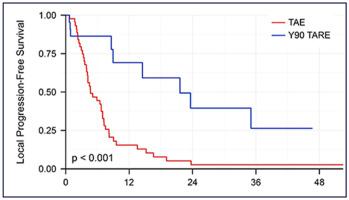
A total of 125 patients with HCC >7 cm were treated with TAE (n = 103) or TARE (n = 22). After propensity score matching, 44 patients who underwent TAE and 22 patients who were treated with TARE were compared. The mean tumor sizes were 10.4 cm (SD ± 2.6) in the TAE group and 10.7 cm (SD ± 2.7) in the TARE group (P > .695). TAE and TARE exhibited comparable adverse event (AE) rates (Grade 1 AE in 22 [50%] of 44 in TAE and 6 [27%] of 22 in TARE, P = .999; 1 Grade 2 AE [4.5%] in TAE). Median OS durations were 15.2 and 23.6 months in the TAE and TARE groups, respectively (P = .252). Median local PFS (4.7 vs 21.6 months, P < .001) and PFS (3.6 vs 10.0 months, P = .002) were significantly longer after TARE. TAE and TARE had similar objective response rates (TAE, 88.6% vs TARE, 77.3%; P = .364). Systemic therapy after TAE or TARE was a significant positive prognostic factor associated with freedom from disease progression and survival (PFS hazard ratio [HR], 0.58 [P = .047]; OS HR, 0.33 [P < .001]).
Conclusions
TAE and TARE are both safe transarterial therapies for patients with HCC >7 cm. TARE is associated with a longer time to progression and longer OS.
期刊介绍:
JVIR, published continuously since 1990, is an international, monthly peer-reviewed interventional radiology journal. As the official journal of the Society of Interventional Radiology, JVIR is the peer-reviewed journal of choice for interventional radiologists, radiologists, cardiologists, vascular surgeons, neurosurgeons, and other clinicians who seek current and reliable information on every aspect of vascular and interventional radiology. Each issue of JVIR covers critical and cutting-edge medical minimally invasive, clinical, basic research, radiological, pathological, and socioeconomic issues of importance to the field.



 京公网安备 11010802042870号
京ICP备2023020795号-1
京公网安备 11010802042870号
京ICP备2023020795号-1

 分享
分享

 求助内容:
求助内容: 应助结果提醒方式:
 扫码关注我们
