{"title":"Rotaxane Mediated Covalent Organic Framework Membranes for Efficient Desalination","authors":"Liang Ren, Hong Wu, Jian Han, Jianxin Chen","doi":"10.1002/adfm.202425244","DOIUrl":null,"url":null,"abstract":"<p>Covalent organic framework (COF) membranes with adjustable and periodic channels show great potential in desalination. However, low crystallinity and inherent large pore size of COF membranes seriously hinder effective interception for salt. Herein, a rotaxane-mediated interfacial polymerization (RMIP) strategy is proposed via incorporating pseudorotaxane linkers (macrocyclic molecule and diamine host-guest complexes) into the reaction, obtaining rotaxane-based COF (RCOF) membranes with high crystallinity and sub-nanochannels. The pseudorotaxanes slow down the diffusion of diamines in the liquid phase, which regulates the Schiff base reaction rate at the oil-water interface and balances polymerization-crystallization process, facilitating crystalline, tight, and defect-free COF membrane formation. Moreover, formed rotaxanes increase interlayer steric hindrance and induce RCOF subunits with ABC stacking, narrowing pore size of membranes. During pervaporation, the optimal RCOF membrane shows permeation flux of 180.2 kg m<sup>−2</sup> h<sup>−1</sup> and outstanding NaCl rejection of 99.9%. Meanwhile, it exhibits stable desalination and antifouling ability in long-term operation. This study provides a new method for accurate construction of COF membranes and is of great significance for efficient separation.</p>","PeriodicalId":112,"journal":{"name":"Advanced Functional Materials","volume":"35 33","pages":""},"PeriodicalIF":19.0000,"publicationDate":"2025-03-17","publicationTypes":"Journal Article","fieldsOfStudy":null,"isOpenAccess":false,"openAccessPdf":"","citationCount":"0","resultStr":null,"platform":"Semanticscholar","paperid":null,"PeriodicalName":"Advanced Functional Materials","FirstCategoryId":"88","ListUrlMain":"https://advanced.onlinelibrary.wiley.com/doi/10.1002/adfm.202425244","RegionNum":1,"RegionCategory":"材料科学","ArticlePicture":[],"TitleCN":null,"AbstractTextCN":null,"PMCID":null,"EPubDate":"","PubModel":"","JCR":"Q1","JCRName":"CHEMISTRY, MULTIDISCIPLINARY","Score":null,"Total":0}
引用次数: 0
Abstract
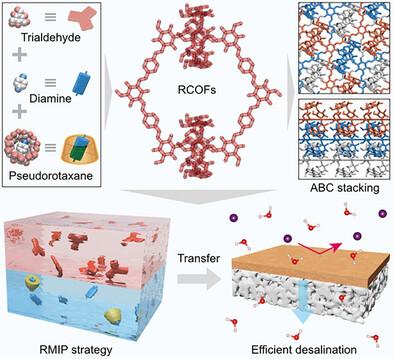
Covalent organic framework (COF) membranes with adjustable and periodic channels show great potential in desalination. However, low crystallinity and inherent large pore size of COF membranes seriously hinder effective interception for salt. Herein, a rotaxane-mediated interfacial polymerization (RMIP) strategy is proposed via incorporating pseudorotaxane linkers (macrocyclic molecule and diamine host-guest complexes) into the reaction, obtaining rotaxane-based COF (RCOF) membranes with high crystallinity and sub-nanochannels. The pseudorotaxanes slow down the diffusion of diamines in the liquid phase, which regulates the Schiff base reaction rate at the oil-water interface and balances polymerization-crystallization process, facilitating crystalline, tight, and defect-free COF membrane formation. Moreover, formed rotaxanes increase interlayer steric hindrance and induce RCOF subunits with ABC stacking, narrowing pore size of membranes. During pervaporation, the optimal RCOF membrane shows permeation flux of 180.2 kg m−2 h−1 and outstanding NaCl rejection of 99.9%. Meanwhile, it exhibits stable desalination and antifouling ability in long-term operation. This study provides a new method for accurate construction of COF membranes and is of great significance for efficient separation.
具有可调节和周期性通道的共价有机框架膜在海水淡化中显示出巨大的潜力。然而,COF膜的低结晶度和固有的大孔径严重阻碍了对盐的有效拦截。本文提出了一种轮烷介导的界面聚合(RMIP)策略,通过将假轮烷连接剂(大环分子和二胺主客体配合物)加入到反应中,获得了具有高结晶度和亚纳米通道的轮烷基COF (RCOF)膜。伪环紫杉烷减缓了二胺在液相中的扩散,从而调节了油水界面的席夫碱反应速率,平衡了聚合结晶过程,促进了结晶性、致密性和无缺陷的COF膜的形成。此外,形成的轮烷增加了层间空间位阻,并诱导RCOF亚基与ABC堆积,缩小了膜的孔径。在渗透汽化过程中,最佳的rof膜的渗透通量为180.2 kg m−2 h−1,NaCl截留率为99.9%。同时在长期运行中表现出稳定的脱盐和防污能力。本研究为COF膜的精确构建提供了一种新的方法,对高效分离具有重要意义。
期刊介绍:
Firmly established as a top-tier materials science journal, Advanced Functional Materials reports breakthrough research in all aspects of materials science, including nanotechnology, chemistry, physics, and biology every week.
Advanced Functional Materials is known for its rapid and fair peer review, quality content, and high impact, making it the first choice of the international materials science community.






 京公网安备 11010802042870号
京ICP备2023020795号-1
京公网安备 11010802042870号
京ICP备2023020795号-1

 分享
分享
 求助内容:
求助内容: 应助结果提醒方式:
 扫码关注我们
