{"title":"A Perspective on Pathways Toward Commercial Sodium-Ion Batteries","authors":"Zehao Cui, Chen Liu, Arumugam Manthiram","doi":"10.1002/adma.202420463","DOIUrl":null,"url":null,"abstract":"<p>Lithium-ion batteries (LIBs) have been widely adopted in the automotive industry, with an annual global production exceeding 1000 GWh. Despite their success, the escalating demand for LIBs has created concerns on supply chain issues related to key elements, such as lithium, cobalt, and nickel. Sodium-ion batteries (SIBs) are emerging as a promising alternative due to the high abundance and low cost of sodium and other raw materials. Nevertheless, the commercialization of SIBs, particularly for grid storage and automotive applications, faces significant hurdles. This perspective article aims to identify the critical challenges in making SIBs viable from both chemical and techno-economic perspectives. First, a brief comparison of the materials chemistry, working mechanisms, and cost between mainstream LIB systems and prospective SIB systems is provided. The intrinsic challenges of SIBs regarding storage stability, capacity utilization, cycle stability, calendar life, and safe operation of cathode, electrolyte, and anode materials are discussed. Furthermore, issues related to the scalability of material production, materials engineering feasibility, and energy-dense electrode design and fabrication are illustrated. Finally, promising pathways are listed and discussed toward achieving high-energy-density, stable, cost-effective SIBs.</p>","PeriodicalId":114,"journal":{"name":"Advanced Materials","volume":"37 46","pages":""},"PeriodicalIF":26.8000,"publicationDate":"2025-03-17","publicationTypes":"Journal Article","fieldsOfStudy":null,"isOpenAccess":false,"openAccessPdf":"https://advanced.onlinelibrary.wiley.com/doi/epdf/10.1002/adma.202420463","citationCount":"0","resultStr":null,"platform":"Semanticscholar","paperid":null,"PeriodicalName":"Advanced Materials","FirstCategoryId":"88","ListUrlMain":"https://advanced.onlinelibrary.wiley.com/doi/10.1002/adma.202420463","RegionNum":1,"RegionCategory":"材料科学","ArticlePicture":[],"TitleCN":null,"AbstractTextCN":null,"PMCID":null,"EPubDate":"","PubModel":"","JCR":"Q1","JCRName":"CHEMISTRY, MULTIDISCIPLINARY","Score":null,"Total":0}
引用次数: 0
Abstract
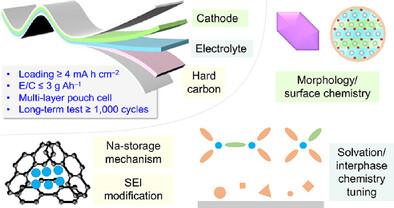
Lithium-ion batteries (LIBs) have been widely adopted in the automotive industry, with an annual global production exceeding 1000 GWh. Despite their success, the escalating demand for LIBs has created concerns on supply chain issues related to key elements, such as lithium, cobalt, and nickel. Sodium-ion batteries (SIBs) are emerging as a promising alternative due to the high abundance and low cost of sodium and other raw materials. Nevertheless, the commercialization of SIBs, particularly for grid storage and automotive applications, faces significant hurdles. This perspective article aims to identify the critical challenges in making SIBs viable from both chemical and techno-economic perspectives. First, a brief comparison of the materials chemistry, working mechanisms, and cost between mainstream LIB systems and prospective SIB systems is provided. The intrinsic challenges of SIBs regarding storage stability, capacity utilization, cycle stability, calendar life, and safe operation of cathode, electrolyte, and anode materials are discussed. Furthermore, issues related to the scalability of material production, materials engineering feasibility, and energy-dense electrode design and fabrication are illustrated. Finally, promising pathways are listed and discussed toward achieving high-energy-density, stable, cost-effective SIBs.
期刊介绍:
Advanced Materials, one of the world's most prestigious journals and the foundation of the Advanced portfolio, is the home of choice for best-in-class materials science for more than 30 years. Following this fast-growing and interdisciplinary field, we are considering and publishing the most important discoveries on any and all materials from materials scientists, chemists, physicists, engineers as well as health and life scientists and bringing you the latest results and trends in modern materials-related research every week.




 京公网安备 11010802042870号
京ICP备2023020795号-1
京公网安备 11010802042870号
京ICP备2023020795号-1

 分享
分享
 求助内容:
求助内容: 应助结果提醒方式:
 扫码关注我们
