Lin Zhang, Jie Xu, Laiping Li, Haoran Fei, Qi Wu, Haoxiang Yu, Lei Yan, Jie Shu, Liyuan Zhang
{"title":"Construction of KF-Rich Solid Electrolyte Interfaces Based on the Electrodeposition Behavior of FEC Additives for Protecting K-Metal Anodes","authors":"Lin Zhang, Jie Xu, Laiping Li, Haoran Fei, Qi Wu, Haoxiang Yu, Lei Yan, Jie Shu, Liyuan Zhang","doi":"10.1002/aenm.202500434","DOIUrl":null,"url":null,"abstract":"<p>Potassium metal (K) electrodes have attracted much attention as one of the most promising anode materials in potassium metal batteries. Nevertheless, dendrite growth and unstable solid electrolyte interface (SEI) have seriously hindered the practical application of potassium-metal anodes. Therefore, to address the aforementioned issue, a brand-new method is proposed: electrodeposition to construct a KF-rich artificial SEI layer, which can improve the stability and cycle time of the K metal anode. The homogeneous KF-rich SEI layer is formed via an in situ reaction between fresh K metal and the electrolyte additive fluoroethylene carbonate (FEC) during electrodeposition. This exerts tremendous effects on protecting the electrode and inhibiting the growth of dendrites. With the uniform and robust SEI layer, the potassium-metal symmetric battery has been stably cycled for more than 1400 h in a conventional carbonate electrolyte (0.8 <span>m</span> KPF<sub>6</sub>-based electrolyte (EC:DEC = 1:1, v/v)). In addition, K||Prussian blue (PPB) batteries with this conventional carbonate electrolyte can be operated for more than 200 cycles with an average Coulombic efficiency of 99.4%. This study sheds light on the construction mechanism of the KF-rich artificial SEI layer on K-metal anodes.</p>","PeriodicalId":111,"journal":{"name":"Advanced Energy Materials","volume":"15 26","pages":""},"PeriodicalIF":26.0000,"publicationDate":"2025-03-17","publicationTypes":"Journal Article","fieldsOfStudy":null,"isOpenAccess":false,"openAccessPdf":"","citationCount":"0","resultStr":null,"platform":"Semanticscholar","paperid":null,"PeriodicalName":"Advanced Energy Materials","FirstCategoryId":"88","ListUrlMain":"https://advanced.onlinelibrary.wiley.com/doi/10.1002/aenm.202500434","RegionNum":1,"RegionCategory":"材料科学","ArticlePicture":[],"TitleCN":null,"AbstractTextCN":null,"PMCID":null,"EPubDate":"","PubModel":"","JCR":"Q1","JCRName":"CHEMISTRY, PHYSICAL","Score":null,"Total":0}
引用次数: 0
Abstract
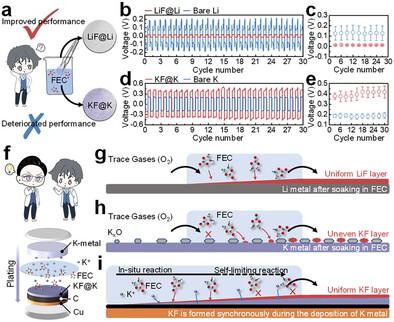
Potassium metal (K) electrodes have attracted much attention as one of the most promising anode materials in potassium metal batteries. Nevertheless, dendrite growth and unstable solid electrolyte interface (SEI) have seriously hindered the practical application of potassium-metal anodes. Therefore, to address the aforementioned issue, a brand-new method is proposed: electrodeposition to construct a KF-rich artificial SEI layer, which can improve the stability and cycle time of the K metal anode. The homogeneous KF-rich SEI layer is formed via an in situ reaction between fresh K metal and the electrolyte additive fluoroethylene carbonate (FEC) during electrodeposition. This exerts tremendous effects on protecting the electrode and inhibiting the growth of dendrites. With the uniform and robust SEI layer, the potassium-metal symmetric battery has been stably cycled for more than 1400 h in a conventional carbonate electrolyte (0.8 m KPF6-based electrolyte (EC:DEC = 1:1, v/v)). In addition, K||Prussian blue (PPB) batteries with this conventional carbonate electrolyte can be operated for more than 200 cycles with an average Coulombic efficiency of 99.4%. This study sheds light on the construction mechanism of the KF-rich artificial SEI layer on K-metal anodes.
期刊介绍:
Established in 2011, Advanced Energy Materials is an international, interdisciplinary, English-language journal that focuses on materials used in energy harvesting, conversion, and storage. It is regarded as a top-quality journal alongside Advanced Materials, Advanced Functional Materials, and Small.
With a 2022 Impact Factor of 27.8, Advanced Energy Materials is considered a prime source for the best energy-related research. The journal covers a wide range of topics in energy-related research, including organic and inorganic photovoltaics, batteries and supercapacitors, fuel cells, hydrogen generation and storage, thermoelectrics, water splitting and photocatalysis, solar fuels and thermosolar power, magnetocalorics, and piezoelectronics.
The readership of Advanced Energy Materials includes materials scientists, chemists, physicists, and engineers in both academia and industry. The journal is indexed in various databases and collections, such as Advanced Technologies & Aerospace Database, FIZ Karlsruhe, INSPEC (IET), Science Citation Index Expanded, Technology Collection, and Web of Science, among others.





 京公网安备 11010802042870号
京ICP备2023020795号-1
京公网安备 11010802042870号
京ICP备2023020795号-1

 分享
分享
 求助内容:
求助内容: 应助结果提醒方式:
 扫码关注我们
