AIE-based dual-ratiometric chemosensor for detection of sulfur dioxide derivatives and viscosity and its application in food samples and biological imaging
Na Tang , Ruian Sun , Kangshuo Xu , Haichang Ding , Yuling Zeng , Yuan Ji , Gang Liu , Shouzhi Pu
{"title":"AIE-based dual-ratiometric chemosensor for detection of sulfur dioxide derivatives and viscosity and its application in food samples and biological imaging","authors":"Na Tang , Ruian Sun , Kangshuo Xu , Haichang Ding , Yuling Zeng , Yuan Ji , Gang Liu , Shouzhi Pu","doi":"10.1016/j.aca.2025.343949","DOIUrl":null,"url":null,"abstract":"<div><h3>Background</h3><div>SO<sub>2</sub> is an important gas molecular messenger that participates in many physiological activities and helps maintaining the redox homeostasis in biological system. Especially, SO<sub>2</sub> can effectively regulate oxidative stress and improve mitochondrial morphology. Abnormal mitochondrial viscosity can lead to a variety of diseases. Therefore, it is of great importance to detect SO<sub>2</sub> derivatives and cell viscosity in biological systems.</div></div><div><h3>Results</h3><div>Here, two mitochondria-targeted and dual-ratiometric chemosensors (<strong>TPE-1</strong> and <strong>TPE-2</strong>) based on tetraphenylethene were constructed, which could be used to simultaneously detect SO<sub>2</sub> derivatives and cell viscosity. Notably, <strong>TPE-2</strong> as the preferable due to its superior discernibility to HSO<sub>3</sub><sup>−</sup> than that of <strong>TPE-1</strong>. Moreover, <strong>TPE-2</strong> featured rapid response, high sensitivity, excellent selectivity, and low cytotoxicity under physiological conditions which means that <strong>TPE-2</strong> is more suitable for practical application than <strong>TPE-1</strong>. The response mechanism of <strong>TPE-2</strong> for HSO<sub>3</sub><sup>−</sup> was confirmed by the theoretical calculation and mass spectral analysis. Meanwhile, <strong>TPE-2</strong> showed enhanced fluorescence intensity the increased viscosity environment due to it was subjected to structural rotation. In addition, the practical application for detecting HSO<sub>3</sub><sup>−</sup> in real water samples was successfully carried out with good recovery, the test strips loaded <strong>TPE-2</strong> was prepared and the detection of HSO<sub>3</sub><sup>−</sup> in food samples was realized by a convenient smartphone analysis. Importantly, <strong>TPE-2</strong> had good mitochondrial targeting ability and had successfully imaged HSO<sub>3</sub><sup>−</sup> and viscosity in HeLa cells and zebrafish.</div></div><div><h3>Significance</h3><div>This study provides an effective and potential tool for detecting HSO<sub>3</sub><sup>−</sup> and viscosity in mitochondria and in vivo, the rational design strategy in this work holds potential to inspire the development of more powerful dual-response chemosensor for other biological factors.</div></div>","PeriodicalId":240,"journal":{"name":"Analytica Chimica Acta","volume":"1353 ","pages":"Article 343949"},"PeriodicalIF":6.0000,"publicationDate":"2025-03-17","publicationTypes":"Journal Article","fieldsOfStudy":null,"isOpenAccess":false,"openAccessPdf":"","citationCount":"0","resultStr":null,"platform":"Semanticscholar","paperid":null,"PeriodicalName":"Analytica Chimica Acta","FirstCategoryId":"92","ListUrlMain":"https://www.sciencedirect.com/science/article/pii/S0003267025003435","RegionNum":2,"RegionCategory":"化学","ArticlePicture":[],"TitleCN":null,"AbstractTextCN":null,"PMCID":null,"EPubDate":"","PubModel":"","JCR":"Q1","JCRName":"CHEMISTRY, ANALYTICAL","Score":null,"Total":0}
引用次数: 0
Abstract
Background
SO2 is an important gas molecular messenger that participates in many physiological activities and helps maintaining the redox homeostasis in biological system. Especially, SO2 can effectively regulate oxidative stress and improve mitochondrial morphology. Abnormal mitochondrial viscosity can lead to a variety of diseases. Therefore, it is of great importance to detect SO2 derivatives and cell viscosity in biological systems.
Results
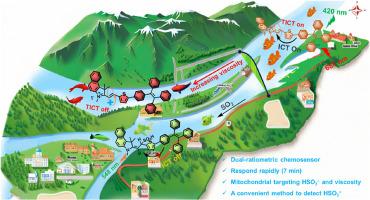
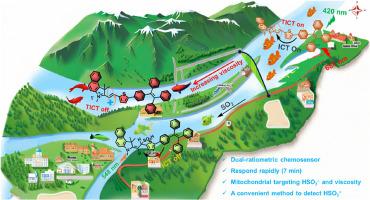
Here, two mitochondria-targeted and dual-ratiometric chemosensors (TPE-1 and TPE-2) based on tetraphenylethene were constructed, which could be used to simultaneously detect SO2 derivatives and cell viscosity. Notably, TPE-2 as the preferable due to its superior discernibility to HSO3− than that of TPE-1. Moreover, TPE-2 featured rapid response, high sensitivity, excellent selectivity, and low cytotoxicity under physiological conditions which means that TPE-2 is more suitable for practical application than TPE-1. The response mechanism of TPE-2 for HSO3− was confirmed by the theoretical calculation and mass spectral analysis. Meanwhile, TPE-2 showed enhanced fluorescence intensity the increased viscosity environment due to it was subjected to structural rotation. In addition, the practical application for detecting HSO3− in real water samples was successfully carried out with good recovery, the test strips loaded TPE-2 was prepared and the detection of HSO3− in food samples was realized by a convenient smartphone analysis. Importantly, TPE-2 had good mitochondrial targeting ability and had successfully imaged HSO3− and viscosity in HeLa cells and zebrafish.
Significance
This study provides an effective and potential tool for detecting HSO3− and viscosity in mitochondria and in vivo, the rational design strategy in this work holds potential to inspire the development of more powerful dual-response chemosensor for other biological factors.
期刊介绍:
Analytica Chimica Acta has an open access mirror journal Analytica Chimica Acta: X, sharing the same aims and scope, editorial team, submission system and rigorous peer review.
Analytica Chimica Acta provides a forum for the rapid publication of original research, and critical, comprehensive reviews dealing with all aspects of fundamental and applied modern analytical chemistry. The journal welcomes the submission of research papers which report studies concerning the development of new and significant analytical methodologies. In determining the suitability of submitted articles for publication, particular scrutiny will be placed on the degree of novelty and impact of the research and the extent to which it adds to the existing body of knowledge in analytical chemistry.



 京公网安备 11010802042870号
京ICP备2023020795号-1
京公网安备 11010802042870号
京ICP备2023020795号-1

 分享
分享
 求助内容:
求助内容: 应助结果提醒方式:
 扫码关注我们
