{"title":"Soil pollution with jet-fuel by the Russian aerospace transportation","authors":"I.N. Semenkov, T.V. Koroleva, S.A. Lednev","doi":"10.1016/j.scitotenv.2025.179131","DOIUrl":null,"url":null,"abstract":"<div><div>Aviation and space transportation effect the ecosystems since the beginning and middle of 20<sup>th</sup> century, respectively. However soil pollution with jet fuel is virtually unexplored. In this article, we summarized the levels of soil pollution near the airfields (in Central Russia) and in the falling sites of the Soyuz launch vehicle debris (in Central and Northern Kazakhstan) with petroleum hydrocarbons via the concentration of jet fuel and/or total petroleum hydrocarbons. At the long-term used airfields in the central regions of Russia, the level of contamination is acceptable: we did not find any jet fuel (its concentration was below 0.1 g/kg – the lowest detected level) in all 47 soil samples collected at the impact zones of 7 airfields. At propellant spills with an area of no >7.1 m<sup>2</sup> from the regular falling sites of the Soyuz launch vehicle first stages, the content of jet fuel and total petroleum hydrocarbons reached 128 (<em>n</em> = 36; 11 falling sites) and 57 g/kg (<em>n</em> = 2249; 230 falling sites), respectively. Four months after the jet fuel spill at Ostafyevo airfield, there was 190 g/kg of jet fuel in the impact zone. One day after the accident, up to 1.6 g/kg of total petroleum hydrocarbons were found at the site where the Soyuz launch vehicle second stage fell. Ecosystems can get rid of jet fuel pollution in a few years. For Aridisols in Kazakhstan, 0.26 g/kg total petroleum hydrocarbons is proposed as a trigger value. Fluorimetry gives lower results for total petroleum hydrocarbons than chromatography-mass spectrometry. This is probably because of different sample preparation and extraction.</div></div>","PeriodicalId":422,"journal":{"name":"Science of the Total Environment","volume":"972 ","pages":"Article 179131"},"PeriodicalIF":8.0000,"publicationDate":"2025-04-01","publicationTypes":"Journal Article","fieldsOfStudy":null,"isOpenAccess":false,"openAccessPdf":"","citationCount":"0","resultStr":null,"platform":"Semanticscholar","paperid":null,"PeriodicalName":"Science of the Total Environment","FirstCategoryId":"93","ListUrlMain":"https://www.sciencedirect.com/science/article/pii/S0048969725007661","RegionNum":1,"RegionCategory":"环境科学与生态学","ArticlePicture":[],"TitleCN":null,"AbstractTextCN":null,"PMCID":null,"EPubDate":"2025/3/17 0:00:00","PubModel":"Epub","JCR":"Q1","JCRName":"ENVIRONMENTAL SCIENCES","Score":null,"Total":0}
引用次数: 0
Abstract
Aviation and space transportation effect the ecosystems since the beginning and middle of 20th century, respectively. However soil pollution with jet fuel is virtually unexplored. In this article, we summarized the levels of soil pollution near the airfields (in Central Russia) and in the falling sites of the Soyuz launch vehicle debris (in Central and Northern Kazakhstan) with petroleum hydrocarbons via the concentration of jet fuel and/or total petroleum hydrocarbons. At the long-term used airfields in the central regions of Russia, the level of contamination is acceptable: we did not find any jet fuel (its concentration was below 0.1 g/kg – the lowest detected level) in all 47 soil samples collected at the impact zones of 7 airfields. At propellant spills with an area of no >7.1 m2 from the regular falling sites of the Soyuz launch vehicle first stages, the content of jet fuel and total petroleum hydrocarbons reached 128 (n = 36; 11 falling sites) and 57 g/kg (n = 2249; 230 falling sites), respectively. Four months after the jet fuel spill at Ostafyevo airfield, there was 190 g/kg of jet fuel in the impact zone. One day after the accident, up to 1.6 g/kg of total petroleum hydrocarbons were found at the site where the Soyuz launch vehicle second stage fell. Ecosystems can get rid of jet fuel pollution in a few years. For Aridisols in Kazakhstan, 0.26 g/kg total petroleum hydrocarbons is proposed as a trigger value. Fluorimetry gives lower results for total petroleum hydrocarbons than chromatography-mass spectrometry. This is probably because of different sample preparation and extraction.
期刊介绍:
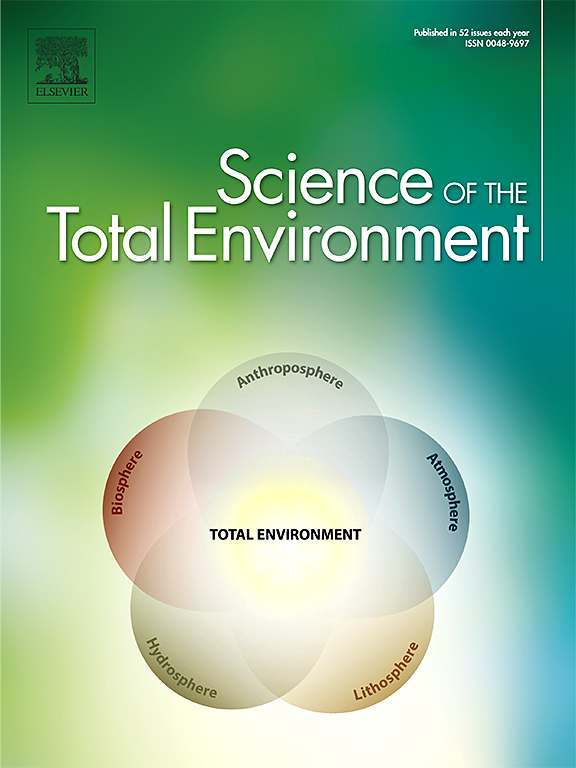
The Science of the Total Environment is an international journal dedicated to scientific research on the environment and its interaction with humanity. It covers a wide range of disciplines and seeks to publish innovative, hypothesis-driven, and impactful research that explores the entire environment, including the atmosphere, lithosphere, hydrosphere, biosphere, and anthroposphere.
The journal's updated Aims & Scope emphasizes the importance of interdisciplinary environmental research with broad impact. Priority is given to studies that advance fundamental understanding and explore the interconnectedness of multiple environmental spheres. Field studies are preferred, while laboratory experiments must demonstrate significant methodological advancements or mechanistic insights with direct relevance to the environment.




 京公网安备 11010802042870号
京ICP备2023020795号-1
京公网安备 11010802042870号
京ICP备2023020795号-1

 分享
分享
 求助内容:
求助内容: 应助结果提醒方式:
 扫码关注我们
