Chengwei Zhang , Yudong Zou , Guojian Cheng , David Liu , Runyu Yang , Aibing Yu
{"title":"Quantify the edge effect of HPGR mills with DEM modelling","authors":"Chengwei Zhang , Yudong Zou , Guojian Cheng , David Liu , Runyu Yang , Aibing Yu","doi":"10.1016/j.partic.2025.02.013","DOIUrl":null,"url":null,"abstract":"<div><div>High pressure grinding rolls (HPGR) mills are an energy efficient comminution device widely used in the cement and mineral processing industries. Uneven roll wear and particle breakage near edges causes significant variation in grinding pressure along the axial direction. This study aimed to quantify the edge effect on mill performance through discrete element method (DEM) modelling. The DEM model, coupled with a multi-body dynamics (MBD) model for the motion of the floating roll and a particle fracture model, was calibrated and validated by the experimental data from a lab-scale HPGR mill. The simulations showed that the edge effect had the most significant impact on particle-particle compressive force and product size (characterised by the median particle size <em>d</em><sub>50</sub>), followed by particle-roll force, and the least on throughput. Increasing roll length amplified the edge effect, causing larger variations in throughput, particle-roll force, and product size, while increasing roll size mitigated the edge effect, resulting in a more uniform product sizes and particle-wall interaction. On the other hand, varying grinding pressure had a minimal impact on the edge effect. A unified equation was proposed to quantify changes from parabolic to trapezoidal profiles. The proposed unified equation offers a new approach to predict changes in the wear and particle size profiles.</div></div>","PeriodicalId":401,"journal":{"name":"Particuology","volume":"99 ","pages":"Pages 60-68"},"PeriodicalIF":4.3000,"publicationDate":"2025-04-01","publicationTypes":"Journal Article","fieldsOfStudy":null,"isOpenAccess":false,"openAccessPdf":"","citationCount":"0","resultStr":null,"platform":"Semanticscholar","paperid":null,"PeriodicalName":"Particuology","FirstCategoryId":"88","ListUrlMain":"https://www.sciencedirect.com/science/article/pii/S1674200125000495","RegionNum":2,"RegionCategory":"材料科学","ArticlePicture":[],"TitleCN":null,"AbstractTextCN":null,"PMCID":null,"EPubDate":"2025/3/5 0:00:00","PubModel":"Epub","JCR":"Q2","JCRName":"ENGINEERING, CHEMICAL","Score":null,"Total":0}
引用次数: 0
Abstract
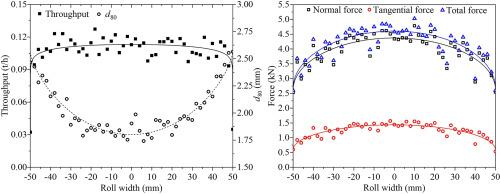
High pressure grinding rolls (HPGR) mills are an energy efficient comminution device widely used in the cement and mineral processing industries. Uneven roll wear and particle breakage near edges causes significant variation in grinding pressure along the axial direction. This study aimed to quantify the edge effect on mill performance through discrete element method (DEM) modelling. The DEM model, coupled with a multi-body dynamics (MBD) model for the motion of the floating roll and a particle fracture model, was calibrated and validated by the experimental data from a lab-scale HPGR mill. The simulations showed that the edge effect had the most significant impact on particle-particle compressive force and product size (characterised by the median particle size d50), followed by particle-roll force, and the least on throughput. Increasing roll length amplified the edge effect, causing larger variations in throughput, particle-roll force, and product size, while increasing roll size mitigated the edge effect, resulting in a more uniform product sizes and particle-wall interaction. On the other hand, varying grinding pressure had a minimal impact on the edge effect. A unified equation was proposed to quantify changes from parabolic to trapezoidal profiles. The proposed unified equation offers a new approach to predict changes in the wear and particle size profiles.
期刊介绍:
The word ‘particuology’ was coined to parallel the discipline for the science and technology of particles.
Particuology is an interdisciplinary journal that publishes frontier research articles and critical reviews on the discovery, formulation and engineering of particulate materials, processes and systems. It especially welcomes contributions utilising advanced theoretical, modelling and measurement methods to enable the discovery and creation of new particulate materials, and the manufacturing of functional particulate-based products, such as sensors.
Papers are handled by Thematic Editors who oversee contributions from specific subject fields. These fields are classified into: Particle Synthesis and Modification; Particle Characterization and Measurement; Granular Systems and Bulk Solids Technology; Fluidization and Particle-Fluid Systems; Aerosols; and Applications of Particle Technology.
Key topics concerning the creation and processing of particulates include:
-Modelling and simulation of particle formation, collective behaviour of particles and systems for particle production over a broad spectrum of length scales
-Mining of experimental data for particle synthesis and surface properties to facilitate the creation of new materials and processes
-Particle design and preparation including controlled response and sensing functionalities in formation, delivery systems and biological systems, etc.
-Experimental and computational methods for visualization and analysis of particulate system.
These topics are broadly relevant to the production of materials, pharmaceuticals and food, and to the conversion of energy resources to fuels and protection of the environment.



 京公网安备 11010802042870号
京ICP备2023020795号-1
京公网安备 11010802042870号
京ICP备2023020795号-1

 分享
分享
 求助内容:
求助内容: 应助结果提醒方式:
 扫码关注我们
