William Osterholz, Steve Culman, Cathy Herms, Douglas Doohan
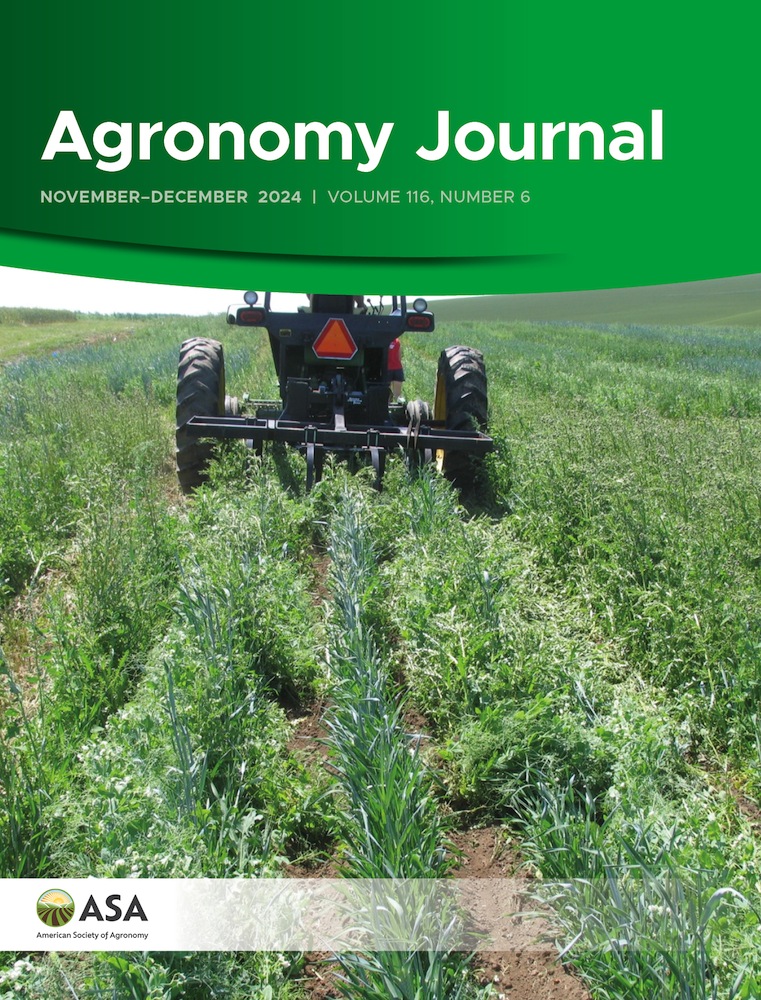
{"title":"Weed control approach but not fertility source influenced yield and weed populations during grain-based transition to organic production","authors":"William Osterholz, Steve Culman, Cathy Herms, Douglas Doohan","doi":"10.1002/agj2.70038","DOIUrl":null,"url":null,"abstract":"<p>Controlling weed populations and improving soil health while producing high yields are top priorities of organic crop farmers yet are difficult to achieve simultaneously due to the importance of cultivation for weed control. This study examined whether less frequent cultivation for weed control and the application of carbon-rich soil fertility amendments would enable progress toward those goals during the 3-year transition period to organic production. Standard weed control with cultivation was compared to high-frequency cultivation combined with delayed planting. The standard approach produced 7% higher crop yield over the course of a corn (<i>Zea mays</i> L.)–soybean [<i>Glycine max</i> (L.) Merr.]–small grain rotation, likely due in part to earlier corn and soybean planting. In-field weed counts and weed seedbank germination showed weed populations tended to be lower in the high-frequency cultivation treatment, although patterns were crop specific. Weed populations increased over the 3 years in all treatments, suggesting that additional weed control tactics may have been beneficial. Carbon-rich poultry manure had no significant effects on weed populations, soil health, or crop yield compared to an N-rich organic fertilizer. However, crop yields were positively related to soil health indicators, specifically greater soil total carbon and nitrogen and permanganate oxidizable carbon. The standard weed control approach was advantageous during the organic transition period, but the observed increase in weed populations might become problematic in future years of organic production.</p>","PeriodicalId":7522,"journal":{"name":"Agronomy Journal","volume":"117 2","pages":""},"PeriodicalIF":2.0000,"publicationDate":"2025-03-17","publicationTypes":"Journal Article","fieldsOfStudy":null,"isOpenAccess":false,"openAccessPdf":"","citationCount":"0","resultStr":null,"platform":"Semanticscholar","paperid":null,"PeriodicalName":"Agronomy Journal","FirstCategoryId":"97","ListUrlMain":"https://acsess.onlinelibrary.wiley.com/doi/10.1002/agj2.70038","RegionNum":3,"RegionCategory":"农林科学","ArticlePicture":[],"TitleCN":null,"AbstractTextCN":null,"PMCID":null,"EPubDate":"","PubModel":"","JCR":"Q2","JCRName":"AGRONOMY","Score":null,"Total":0}
引用次数: 0
Abstract
Controlling weed populations and improving soil health while producing high yields are top priorities of organic crop farmers yet are difficult to achieve simultaneously due to the importance of cultivation for weed control. This study examined whether less frequent cultivation for weed control and the application of carbon-rich soil fertility amendments would enable progress toward those goals during the 3-year transition period to organic production. Standard weed control with cultivation was compared to high-frequency cultivation combined with delayed planting. The standard approach produced 7% higher crop yield over the course of a corn (Zea mays L.)–soybean [Glycine max (L.) Merr.]–small grain rotation, likely due in part to earlier corn and soybean planting. In-field weed counts and weed seedbank germination showed weed populations tended to be lower in the high-frequency cultivation treatment, although patterns were crop specific. Weed populations increased over the 3 years in all treatments, suggesting that additional weed control tactics may have been beneficial. Carbon-rich poultry manure had no significant effects on weed populations, soil health, or crop yield compared to an N-rich organic fertilizer. However, crop yields were positively related to soil health indicators, specifically greater soil total carbon and nitrogen and permanganate oxidizable carbon. The standard weed control approach was advantageous during the organic transition period, but the observed increase in weed populations might become problematic in future years of organic production.
在高产的同时控制杂草数量和改善土壤健康是有机作物种植者的首要任务,但由于种植对杂草控制的重要性,很难同时实现。本研究考察了在向有机生产过渡的3年期间,减少杂草控制的种植频率和施用富含碳的土壤肥力改进剂是否有助于实现这些目标。将标准杂草控制与栽培相结合与高频栽培与延迟种植相结合进行了比较。在玉米(Zea mays L.)和大豆(Glycine max (L.))杂交的过程中,标准方法的作物产量高出7%。稳定。——粮食轮作减少,部分原因可能是玉米和大豆种植提前。田间杂草计数和杂草种子库萌发率表明,高频栽培处理的杂草数量倾向于较低,尽管模式是特定作物的。三年来,所有处理的杂草数量都有所增加,这表明额外的杂草控制策略可能是有益的。与富氮有机肥相比,富碳家禽肥对杂草数量、土壤健康或作物产量没有显著影响。作物产量与土壤健康指标呈显著正相关,特别是土壤全碳、全氮和高锰酸盐可氧化碳。标准的杂草控制方法在有机过渡时期是有利的,但观察到的杂草数量的增加可能在未来几年的有机生产中成为问题。
期刊介绍:
After critical review and approval by the editorial board, AJ publishes articles reporting research findings in soil–plant relationships; crop science; soil science; biometry; crop, soil, pasture, and range management; crop, forage, and pasture production and utilization; turfgrass; agroclimatology; agronomic models; integrated pest management; integrated agricultural systems; and various aspects of entomology, weed science, animal science, plant pathology, and agricultural economics as applied to production agriculture.
Notes are published about apparatus, observations, and experimental techniques. Observations usually are limited to studies and reports of unrepeatable phenomena or other unique circumstances. Review and interpretation papers are also published, subject to standard review. Contributions to the Forum section deal with current agronomic issues and questions in brief, thought-provoking form. Such papers are reviewed by the editor in consultation with the editorial board.



 京公网安备 11010802042870号
京ICP备2023020795号-1
京公网安备 11010802042870号
京ICP备2023020795号-1

 分享
分享
 求助内容:
求助内容: 应助结果提醒方式:
 扫码关注我们
