Xinhu Liang, Zhihao Zhang, Zhe Wang, Mingzhen Hu, Dan Cheng, Yue Jiang, Hao Ren, Fengyi Shen, Shitu Yang, Xiaoxin Yang, Wenkun Jiang, Xianghui Shi, Zihao Ma and Kebin Zhou
{"title":"Breaking the H2O dissociation-OH desorption scaling relationship in alkaline hydrogen evolution by oxophilic single atom M1–Run electrocatalysts†","authors":"Xinhu Liang, Zhihao Zhang, Zhe Wang, Mingzhen Hu, Dan Cheng, Yue Jiang, Hao Ren, Fengyi Shen, Shitu Yang, Xiaoxin Yang, Wenkun Jiang, Xianghui Shi, Zihao Ma and Kebin Zhou","doi":"10.1039/D5EE00152H","DOIUrl":null,"url":null,"abstract":"<p >The alkaline electrochemical hydrogen evolution reaction (HER) has been a hot topic in energy catalysis and engineering. Theoretically, intensifying OH adsorption on an electrocatalyst is vital for promoting water dissociation and thus supplying sufficient protons to expedite alkaline hydrogen evolution. However, the overbinding of OH largely impedes the recyclability of active centers and even causes catalyst deactivation. Herein, we report that H<small><sub>2</sub></small>O dissociation and OH desorption present an undesirable scaling relationship, which poses a major stumbling block to attaining maximized alkaline HER performance. However, dispersing highly oxophilic metal centers to single atoms greatly facilitates OH desorption and meanwhile keeps the high oxophilicity-enabled superb water dissociation merit, hence breaking the proportionality limitation. Based on this finding, a remarkable La<small><sub>1</sub></small>–Ru<small><sub><em>n</em></sub></small> catalyst is rationally synthesized, which operates durably at an ampere-level current density of 1000 mA cm<small><sup>−2</sup></small> for over two months with an ultra-low cell voltage of 1.74 V, showing great promise for practical applications.</p>","PeriodicalId":72,"journal":{"name":"Energy & Environmental Science","volume":" 9","pages":" 4302-4311"},"PeriodicalIF":30.8000,"publicationDate":"2025-03-18","publicationTypes":"Journal Article","fieldsOfStudy":null,"isOpenAccess":false,"openAccessPdf":"","citationCount":"0","resultStr":null,"platform":"Semanticscholar","paperid":null,"PeriodicalName":"Energy & Environmental Science","FirstCategoryId":"88","ListUrlMain":"https://pubs.rsc.org/en/content/articlelanding/2025/ee/d5ee00152h","RegionNum":1,"RegionCategory":"材料科学","ArticlePicture":[],"TitleCN":null,"AbstractTextCN":null,"PMCID":null,"EPubDate":"","PubModel":"","JCR":"Q1","JCRName":"CHEMISTRY, MULTIDISCIPLINARY","Score":null,"Total":0}
引用次数: 0
Abstract
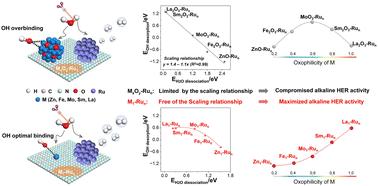
The alkaline electrochemical hydrogen evolution reaction (HER) has been a hot topic in energy catalysis and engineering. Theoretically, intensifying OH adsorption on an electrocatalyst is vital for promoting water dissociation and thus supplying sufficient protons to expedite alkaline hydrogen evolution. However, the overbinding of OH largely impedes the recyclability of active centers and even causes catalyst deactivation. Herein, we report that H2O dissociation and OH desorption present an undesirable scaling relationship, which poses a major stumbling block to attaining maximized alkaline HER performance. However, dispersing highly oxophilic metal centers to single atoms greatly facilitates OH desorption and meanwhile keeps the high oxophilicity-enabled superb water dissociation merit, hence breaking the proportionality limitation. Based on this finding, a remarkable La1–Run catalyst is rationally synthesized, which operates durably at an ampere-level current density of 1000 mA cm−2 for over two months with an ultra-low cell voltage of 1.74 V, showing great promise for practical applications.
碱性电化学析氢反应一直是能源催化和工程领域的研究热点。从理论上讲,加强OH在电催化剂上的吸附对于促进水的解离,从而提供足够的质子来加速碱性氢的析出至关重要。然而,OH的过结合在很大程度上阻碍了活性中心的可回收性,甚至导致催化剂失活。在此,我们报告了H2O解离和OH脱附存在不良的标度关系,这是实现碱性HER性能最大化的主要障碍。而将高亲氧性的金属中心分散到单个原子上,极大地促进了OH的解吸,同时保持了高亲氧性极佳的水解离特性,从而打破了比例限制。在此基础上,合理地合成了一种卓越的La1-Run催化剂,该催化剂在1000 mA cm-2的安培级电流密度下,在1.74 V的超低电池电压下,可持久工作两个多月,具有良好的实际应用前景。
期刊介绍:
Energy & Environmental Science, a peer-reviewed scientific journal, publishes original research and review articles covering interdisciplinary topics in the (bio)chemical and (bio)physical sciences, as well as chemical engineering disciplines. Published monthly by the Royal Society of Chemistry (RSC), a not-for-profit publisher, Energy & Environmental Science is recognized as a leading journal. It boasts an impressive impact factor of 8.500 as of 2009, ranking 8th among 140 journals in the category "Chemistry, Multidisciplinary," second among 71 journals in "Energy & Fuels," second among 128 journals in "Engineering, Chemical," and first among 181 scientific journals in "Environmental Sciences."
Energy & Environmental Science publishes various types of articles, including Research Papers (original scientific work), Review Articles, Perspectives, and Minireviews (feature review-type articles of broad interest), Communications (original scientific work of an urgent nature), Opinions (personal, often speculative viewpoints or hypotheses on current topics), and Analysis Articles (in-depth examination of energy-related issues).



 京公网安备 11010802042870号
京ICP备2023020795号-1
京公网安备 11010802042870号
京ICP备2023020795号-1

 分享
分享
 求助内容:
求助内容: 应助结果提醒方式:
 扫码关注我们
