Surface-confined growth of Ru amorphous sub-nanoclusters on reductive Mn3O4: a strongly coupled interface engineering for efficient neutral hydrogen production†
Li Wan, Haijun Wang, Biao Zeng, Wenwen Wang, Xinzheng Liu, Lixin Cao, Yubin Hu, Zhongyu Cui and Bohua Dong
{"title":"Surface-confined growth of Ru amorphous sub-nanoclusters on reductive Mn3O4: a strongly coupled interface engineering for efficient neutral hydrogen production†","authors":"Li Wan, Haijun Wang, Biao Zeng, Wenwen Wang, Xinzheng Liu, Lixin Cao, Yubin Hu, Zhongyu Cui and Bohua Dong","doi":"10.1039/D4EE05759G","DOIUrl":null,"url":null,"abstract":"<p >The electrochemical hydrogen evolution reaction (HER) under neutral conditions is of great importance but remains challenging for achieving practical hydrogen production due to additional water dissociation and a low proton supply rate. Herein, this work focuses on Ru amorphous sub-nanoclusters (Ru-ASNs), presenting an innovation that encompasses a surface-confined growth approach and a novel strongly coupled interface engineering strategy, wherein Ru-ASNs are grown on reductive Mn<small><sub>3</sub></small>O<small><sub>4</sub></small> nanocrystals to form an interfacial catalyst (Ru-ASN/Mn<small><sub>3</sub></small>O<small><sub>4</sub></small>) for a superior neutral HER. The strongly coupled effect induced by Ru-ASNs on the heterostructure interface increases the proton supply rate by accelerating water dissociation at Mn sites as well as boosting hydrogen migration at Ru sites, thus resulting in improved HER activity and stability under neutral conditions. The resulting electrocatalyst demonstrates low overpotentials of −8 mV at −10 mA cm<small><sup>−2</sup></small> and −190 mV at −500 mA cm<small><sup>−2</sup></small> only at a low loading of 7 μg<small><sub>Ru</sub></small> cm<small><sup>−2</sup></small> and a high mass activity of 8.78 A mg<small><sub>Ru</sub></small><small><sup>−1</sup></small> at −70 mV, and maintains stability for over 600 hours at −250 mA cm<small><sup>−2</sup></small>, representing the highest mass activity of Ru-based electrocatalysts and longest durability under neutral conditions. This work demonstrates the superiority of amorphous sub-nanoclusters in constructing a strongly coupled interface for developing advanced catalysts.</p>","PeriodicalId":72,"journal":{"name":"Energy & Environmental Science","volume":" 9","pages":" 4262-4275"},"PeriodicalIF":30.8000,"publicationDate":"2025-03-18","publicationTypes":"Journal Article","fieldsOfStudy":null,"isOpenAccess":false,"openAccessPdf":"","citationCount":"0","resultStr":null,"platform":"Semanticscholar","paperid":null,"PeriodicalName":"Energy & Environmental Science","FirstCategoryId":"88","ListUrlMain":"https://pubs.rsc.org/en/content/articlelanding/2025/ee/d4ee05759g","RegionNum":1,"RegionCategory":"材料科学","ArticlePicture":[],"TitleCN":null,"AbstractTextCN":null,"PMCID":null,"EPubDate":"","PubModel":"","JCR":"Q1","JCRName":"CHEMISTRY, MULTIDISCIPLINARY","Score":null,"Total":0}
引用次数: 0
Abstract
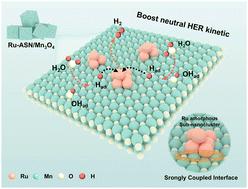
The electrochemical hydrogen evolution reaction (HER) under neutral conditions is of great importance but remains challenging for achieving practical hydrogen production due to additional water dissociation and a low proton supply rate. Herein, this work focuses on Ru amorphous sub-nanoclusters (Ru-ASNs), presenting an innovation that encompasses a surface-confined growth approach and a novel strongly coupled interface engineering strategy, wherein Ru-ASNs are grown on reductive Mn3O4 nanocrystals to form an interfacial catalyst (Ru-ASN/Mn3O4) for a superior neutral HER. The strongly coupled effect induced by Ru-ASNs on the heterostructure interface increases the proton supply rate by accelerating water dissociation at Mn sites as well as boosting hydrogen migration at Ru sites, thus resulting in improved HER activity and stability under neutral conditions. The resulting electrocatalyst demonstrates low overpotentials of −8 mV at −10 mA cm−2 and −190 mV at −500 mA cm−2 only at a low loading of 7 μgRu cm−2 and a high mass activity of 8.78 A mgRu−1 at −70 mV, and maintains stability for over 600 hours at −250 mA cm−2, representing the highest mass activity of Ru-based electrocatalysts and longest durability under neutral conditions. This work demonstrates the superiority of amorphous sub-nanoclusters in constructing a strongly coupled interface for developing advanced catalysts.
期刊介绍:
Energy & Environmental Science, a peer-reviewed scientific journal, publishes original research and review articles covering interdisciplinary topics in the (bio)chemical and (bio)physical sciences, as well as chemical engineering disciplines. Published monthly by the Royal Society of Chemistry (RSC), a not-for-profit publisher, Energy & Environmental Science is recognized as a leading journal. It boasts an impressive impact factor of 8.500 as of 2009, ranking 8th among 140 journals in the category "Chemistry, Multidisciplinary," second among 71 journals in "Energy & Fuels," second among 128 journals in "Engineering, Chemical," and first among 181 scientific journals in "Environmental Sciences."
Energy & Environmental Science publishes various types of articles, including Research Papers (original scientific work), Review Articles, Perspectives, and Minireviews (feature review-type articles of broad interest), Communications (original scientific work of an urgent nature), Opinions (personal, often speculative viewpoints or hypotheses on current topics), and Analysis Articles (in-depth examination of energy-related issues).



 京公网安备 11010802042870号
京ICP备2023020795号-1
京公网安备 11010802042870号
京ICP备2023020795号-1

 分享
分享
 求助内容:
求助内容: 应助结果提醒方式:
 扫码关注我们
