Zhijian Ding , Yuewu Li , Qingyan Fu , Mengke Tian , Fanglin Wang , Yunkai Wang , Kan Huang
{"title":"Volatile organic compounds in a typical petrochemical production area in Shanghai, China: Source profiles, human health and environmental impacts","authors":"Zhijian Ding , Yuewu Li , Qingyan Fu , Mengke Tian , Fanglin Wang , Yunkai Wang , Kan Huang","doi":"10.1016/j.envpol.2025.126074","DOIUrl":null,"url":null,"abstract":"<div><div>Volatile organic compounds (VOCs) emitted from industrial facilities include significant precursors to the formation of aerosols and ozone in urban areas, often affecting atmospheric environments and public health. By investigating the VOC emission profiles across nine petrochemical production units, the predominant component in VOC emission profiles was alkanes, followed by oxygenated VOCs, aromatics, halocarbons, and alkenes. Aldehydes were identified as major contributors to odorous pollution. Chloroform, benzene, and 1,2-dibromoethane from petrochemical industry emissions exceeded health thresholds and will require targeted reduction measures. Additionally, three years of ambient VOC measurements (2020–2022) at two typical sites were analyzed to clarify VOC pollution characteristics and environmental impacts. The VOCs measured at both the Jiangwan residential (JW) and petrochemical industrial (PI) sites exhibited similar diurnal variations but different seasonal patterns. Source apportionment of VOCs using a positive matrix factorization model revealed five sources at PI and six sources at JW. Specific VOCs (e.g., dichloromethane) identified at JW were related to the petrochemical industry and solvent usage processes. Quantification of VOC photochemical reactivity indicated that the aromatic industry and solvent usage from the petrochemical industry significantly contributed more to both ozone and secondary organic aerosol formation potential than other sources, which underscores the need for stringent control measures by policymakers, particularly focusing on aromatic hydrocarbon production processes and the adoption of green solvents. The findings provide valuable insights for developing targeted VOC control strategies to mitigate their adverse effects on human health and environmental quality in regions heavily influenced by petrochemical activities.</div></div>","PeriodicalId":311,"journal":{"name":"Environmental Pollution","volume":"372 ","pages":"Article 126074"},"PeriodicalIF":7.3000,"publicationDate":"2025-03-17","publicationTypes":"Journal Article","fieldsOfStudy":null,"isOpenAccess":false,"openAccessPdf":"","citationCount":"0","resultStr":null,"platform":"Semanticscholar","paperid":null,"PeriodicalName":"Environmental Pollution","FirstCategoryId":"93","ListUrlMain":"https://www.sciencedirect.com/science/article/pii/S0269749125004476","RegionNum":2,"RegionCategory":"环境科学与生态学","ArticlePicture":[],"TitleCN":null,"AbstractTextCN":null,"PMCID":null,"EPubDate":"","PubModel":"","JCR":"Q1","JCRName":"ENVIRONMENTAL SCIENCES","Score":null,"Total":0}
引用次数: 0
Abstract
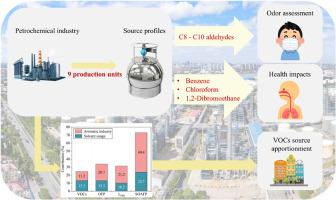
Volatile organic compounds (VOCs) emitted from industrial facilities include significant precursors to the formation of aerosols and ozone in urban areas, often affecting atmospheric environments and public health. By investigating the VOC emission profiles across nine petrochemical production units, the predominant component in VOC emission profiles was alkanes, followed by oxygenated VOCs, aromatics, halocarbons, and alkenes. Aldehydes were identified as major contributors to odorous pollution. Chloroform, benzene, and 1,2-dibromoethane from petrochemical industry emissions exceeded health thresholds and will require targeted reduction measures. Additionally, three years of ambient VOC measurements (2020–2022) at two typical sites were analyzed to clarify VOC pollution characteristics and environmental impacts. The VOCs measured at both the Jiangwan residential (JW) and petrochemical industrial (PI) sites exhibited similar diurnal variations but different seasonal patterns. Source apportionment of VOCs using a positive matrix factorization model revealed five sources at PI and six sources at JW. Specific VOCs (e.g., dichloromethane) identified at JW were related to the petrochemical industry and solvent usage processes. Quantification of VOC photochemical reactivity indicated that the aromatic industry and solvent usage from the petrochemical industry significantly contributed more to both ozone and secondary organic aerosol formation potential than other sources, which underscores the need for stringent control measures by policymakers, particularly focusing on aromatic hydrocarbon production processes and the adoption of green solvents. The findings provide valuable insights for developing targeted VOC control strategies to mitigate their adverse effects on human health and environmental quality in regions heavily influenced by petrochemical activities.
期刊介绍:
Environmental Pollution is an international peer-reviewed journal that publishes high-quality research papers and review articles covering all aspects of environmental pollution and its impacts on ecosystems and human health.
Subject areas include, but are not limited to:
• Sources and occurrences of pollutants that are clearly defined and measured in environmental compartments, food and food-related items, and human bodies;
• Interlinks between contaminant exposure and biological, ecological, and human health effects, including those of climate change;
• Contaminants of emerging concerns (including but not limited to antibiotic resistant microorganisms or genes, microplastics/nanoplastics, electronic wastes, light, and noise) and/or their biological, ecological, or human health effects;
• Laboratory and field studies on the remediation/mitigation of environmental pollution via new techniques and with clear links to biological, ecological, or human health effects;
• Modeling of pollution processes, patterns, or trends that is of clear environmental and/or human health interest;
• New techniques that measure and examine environmental occurrences, transport, behavior, and effects of pollutants within the environment or the laboratory, provided that they can be clearly used to address problems within regional or global environmental compartments.



 京公网安备 11010802042870号
京ICP备2023020795号-1
京公网安备 11010802042870号
京ICP备2023020795号-1

 分享
分享
 求助内容:
求助内容: 应助结果提醒方式:
 扫码关注我们
