{"title":"Toxic trace elements transport in stream sediments from the world-class Monte Amiata Hg mining district: Potential impact to the Mediterranean Sea","authors":"Alessia Nannoni , Guia Morelli , Pierfranco Lattanzi , Cesare Fagotti , Rossella Friani , Silvia Fornasaro , Francesco Ciani , Rosarosa Manca , Alessio Monnanni , Valentina Rimondi , Pilario Costagliola","doi":"10.1016/j.envpol.2025.126088","DOIUrl":null,"url":null,"abstract":"<div><div>The spatial and temporal variability of Hg, As, and Sb contents were assessed in stream sediments across the Fiora River catchment (Italy), which drains the dismissed Monte Amiata Mining District, the 3<sup>rd</sup> largest Hg producer worldwide. Mercury, As, and Sb concentrations of samples collected in 2022 along Fiora River tributaries were compared to data collected in 1985 after mine decommissioning. In 2022, the Fiora River showed downstream magnification of Hg pollution, close to the outflow into the Mediterranean Sea. At several sampling sites, concentrations are above the Italian safety limit of 1 mg/kg (up to 3300 mg/kg). Arsenic and Sb concentrations are high in the mid-catchment tributaries (up to 84 and 79 mg/kg, respectively). The river contributes to the pollutant budget of the Mediterranean Sea, and showed low resilience to Hg pollution in the period 1985–2022, whereas for As and Sb some attenuation occurred. The mass loads of Hg, As, and Sb discharged into the Mediterranean Sea from the Fiora River are at least 0.9, 2.2, and 1.8 t/y respectively. The estimated potential sediment-bound Hg flux from the whole Monte Amiata district to the Mediterranean Sea (1.2–6.6 t/y) is in the same range of that calculated for the Idrija district, highlighting the pivotal role of the Mt. Amiata district on the Mediterranean Sea pollution.</div></div>","PeriodicalId":311,"journal":{"name":"Environmental Pollution","volume":"372 ","pages":"Article 126088"},"PeriodicalIF":7.3000,"publicationDate":"2025-05-01","publicationTypes":"Journal Article","fieldsOfStudy":null,"isOpenAccess":false,"openAccessPdf":"","citationCount":"0","resultStr":null,"platform":"Semanticscholar","paperid":null,"PeriodicalName":"Environmental Pollution","FirstCategoryId":"93","ListUrlMain":"https://www.sciencedirect.com/science/article/pii/S0269749125004610","RegionNum":2,"RegionCategory":"环境科学与生态学","ArticlePicture":[],"TitleCN":null,"AbstractTextCN":null,"PMCID":null,"EPubDate":"2025/3/18 0:00:00","PubModel":"Epub","JCR":"Q1","JCRName":"ENVIRONMENTAL SCIENCES","Score":null,"Total":0}
引用次数: 0
Abstract
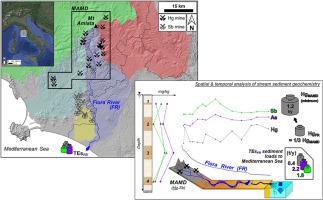
The spatial and temporal variability of Hg, As, and Sb contents were assessed in stream sediments across the Fiora River catchment (Italy), which drains the dismissed Monte Amiata Mining District, the 3rd largest Hg producer worldwide. Mercury, As, and Sb concentrations of samples collected in 2022 along Fiora River tributaries were compared to data collected in 1985 after mine decommissioning. In 2022, the Fiora River showed downstream magnification of Hg pollution, close to the outflow into the Mediterranean Sea. At several sampling sites, concentrations are above the Italian safety limit of 1 mg/kg (up to 3300 mg/kg). Arsenic and Sb concentrations are high in the mid-catchment tributaries (up to 84 and 79 mg/kg, respectively). The river contributes to the pollutant budget of the Mediterranean Sea, and showed low resilience to Hg pollution in the period 1985–2022, whereas for As and Sb some attenuation occurred. The mass loads of Hg, As, and Sb discharged into the Mediterranean Sea from the Fiora River are at least 0.9, 2.2, and 1.8 t/y respectively. The estimated potential sediment-bound Hg flux from the whole Monte Amiata district to the Mediterranean Sea (1.2–6.6 t/y) is in the same range of that calculated for the Idrija district, highlighting the pivotal role of the Mt. Amiata district on the Mediterranean Sea pollution.
期刊介绍:
Environmental Pollution is an international peer-reviewed journal that publishes high-quality research papers and review articles covering all aspects of environmental pollution and its impacts on ecosystems and human health.
Subject areas include, but are not limited to:
• Sources and occurrences of pollutants that are clearly defined and measured in environmental compartments, food and food-related items, and human bodies;
• Interlinks between contaminant exposure and biological, ecological, and human health effects, including those of climate change;
• Contaminants of emerging concerns (including but not limited to antibiotic resistant microorganisms or genes, microplastics/nanoplastics, electronic wastes, light, and noise) and/or their biological, ecological, or human health effects;
• Laboratory and field studies on the remediation/mitigation of environmental pollution via new techniques and with clear links to biological, ecological, or human health effects;
• Modeling of pollution processes, patterns, or trends that is of clear environmental and/or human health interest;
• New techniques that measure and examine environmental occurrences, transport, behavior, and effects of pollutants within the environment or the laboratory, provided that they can be clearly used to address problems within regional or global environmental compartments.



 京公网安备 11010802042870号
京ICP备2023020795号-1
京公网安备 11010802042870号
京ICP备2023020795号-1

 分享
分享
 求助内容:
求助内容: 应助结果提醒方式:
 扫码关注我们
