Bohong Su, Hong Li, Ke Zhang, Haiyang Li, Caiyun Fan, Meiling Zhong, Hui Zou, Rujie Li, Liyu Chen, Jing Bo Jin, Mingkun Huang, Baohui Liu, Fanjiang Kong, Zhihui Sun
{"title":"Evening complex component ELF3 interacts with LUX proteins to repress soybean root nodulation","authors":"Bohong Su, Hong Li, Ke Zhang, Haiyang Li, Caiyun Fan, Meiling Zhong, Hui Zou, Rujie Li, Liyu Chen, Jing Bo Jin, Mingkun Huang, Baohui Liu, Fanjiang Kong, Zhihui Sun","doi":"10.1111/pbi.70053","DOIUrl":null,"url":null,"abstract":"<p>Formation of root nodules is a unique hallmark of the symbiotic interaction between legume host plants and rhizobia and is governed by a complex regulatory framework that balances the appropriate orchestration of rhizobial infection and subsequent nodule organogenesis. In contrast to prominent model species such as <i>Medicago truncatula</i> and <i>Lotus japonicus</i>, research on symbiotic signal transduction in the staple-crop soybean <i>Glycine max</i> remains relatively insufficient. Here, we identified a soybean mutant with ~25% additional root nodules over wild-type, designated as <i>increased number of nodules 1</i> (<i>inn1</i>). Through map-based cloning, <i>INN1</i> encodes the EARLY FLOWERING 3a (ELF3a) protein component of the soybean Evening Complex, together with LUX1 and LUX2. <i>INN1</i> is co-expressed with <i>LUX1</i> and <i>LUX2</i> in roots, and knockout of <i>INN1</i> or knockdown of <i>LUX1</i> and <i>LUX2</i> enhances root nodulation. The function of INN1 in negatively regulating nodulation is genetically and biochemically dependent upon LUXs, as the INN1–LUX complex binds to the promoter of the downstream pro-nodulation target <i>ENOD40</i>, repressing its expression. ELF3a/INN1's repression of root-nodule formation extends beyond its established roles in diverse above-ground developmental and physiological processes and offers a theoretical basis for enhancing the biological-nitrogen fixation capacity of soybean.</p>","PeriodicalId":221,"journal":{"name":"Plant Biotechnology Journal","volume":"23 6","pages":"2194-2206"},"PeriodicalIF":10.5000,"publicationDate":"2025-03-17","publicationTypes":"Journal Article","fieldsOfStudy":null,"isOpenAccess":false,"openAccessPdf":"https://onlinelibrary.wiley.com/doi/epdf/10.1111/pbi.70053","citationCount":"0","resultStr":null,"platform":"Semanticscholar","paperid":null,"PeriodicalName":"Plant Biotechnology Journal","FirstCategoryId":"5","ListUrlMain":"https://onlinelibrary.wiley.com/doi/10.1111/pbi.70053","RegionNum":1,"RegionCategory":"生物学","ArticlePicture":[],"TitleCN":null,"AbstractTextCN":null,"PMCID":null,"EPubDate":"","PubModel":"","JCR":"Q1","JCRName":"BIOTECHNOLOGY & APPLIED MICROBIOLOGY","Score":null,"Total":0}
引用次数: 0
Abstract
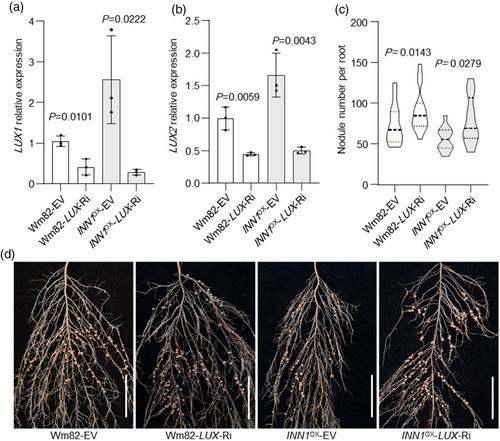
Formation of root nodules is a unique hallmark of the symbiotic interaction between legume host plants and rhizobia and is governed by a complex regulatory framework that balances the appropriate orchestration of rhizobial infection and subsequent nodule organogenesis. In contrast to prominent model species such as Medicago truncatula and Lotus japonicus, research on symbiotic signal transduction in the staple-crop soybean Glycine max remains relatively insufficient. Here, we identified a soybean mutant with ~25% additional root nodules over wild-type, designated as increased number of nodules 1 (inn1). Through map-based cloning, INN1 encodes the EARLY FLOWERING 3a (ELF3a) protein component of the soybean Evening Complex, together with LUX1 and LUX2. INN1 is co-expressed with LUX1 and LUX2 in roots, and knockout of INN1 or knockdown of LUX1 and LUX2 enhances root nodulation. The function of INN1 in negatively regulating nodulation is genetically and biochemically dependent upon LUXs, as the INN1–LUX complex binds to the promoter of the downstream pro-nodulation target ENOD40, repressing its expression. ELF3a/INN1's repression of root-nodule formation extends beyond its established roles in diverse above-ground developmental and physiological processes and offers a theoretical basis for enhancing the biological-nitrogen fixation capacity of soybean.
期刊介绍:
Plant Biotechnology Journal aspires to publish original research and insightful reviews of high impact, authored by prominent researchers in applied plant science. The journal places a special emphasis on molecular plant sciences and their practical applications through plant biotechnology. Our goal is to establish a platform for showcasing significant advances in the field, encompassing curiosity-driven studies with potential applications, strategic research in plant biotechnology, scientific analysis of crucial issues for the beneficial utilization of plant sciences, and assessments of the performance of plant biotechnology products in practical applications.



 京公网安备 11010802042870号
京ICP备2023020795号-1
京公网安备 11010802042870号
京ICP备2023020795号-1

 分享
分享
 求助内容:
求助内容: 应助结果提醒方式:
 扫码关注我们
