{"title":"Enhanced Magnetic-Flux Pinning Through High-Density Vertically Aligned BaCuO2 Nanorods in Gd0.5Yb0.5Ba2Cu3O7-δ Films","authors":"Qianfu Wang, Yaoyao Zhao, Meng Li, Shiwei Xu, Ping Jiang, Shudong Zhang, Ziming Fan, Dexian Jin, Yimin Chen","doi":"10.1002/smll.202409125","DOIUrl":null,"url":null,"abstract":"<p>A novel flux-pinning design for REBa<sub>2</sub>Cu<sub>3</sub>O<sub>7-δ</sub> (REBCO) films intended for high-field magnet applications is proposed, which is based on BaCuO<sub>2</sub> nanorods in Gd<sub>0.5</sub>Yb<sub>0.5</sub>Ba<sub>2</sub>Cu<sub>3</sub>O<sub>7-δ</sub> (Gd<sub>0.5</sub>Yb<sub>0.5</sub>BCO) films. The metal–organic chemical vapor deposition (MOCVD) process has been developed to achieve the desired microstructure. The influence of MOCVD parameters on the microstructure and critical current behavior of Gd<sub>0.5</sub>Yb<sub>0.5</sub>BCO films is systematically investigated. The morphology and density of BaCuO<sub>2</sub> crystallites within the films are highly sensitive to deposition temperature, oxygen partial pressure, and deposition rate. Notably, forming thin, elongated, vertically aligned BaCuO<sub>2</sub> nanorods requires precise control within a narrow processing window for these three parameters. The optimized MOCVD process results in a dense array of vertically aligned BaCuO<sub>2</sub> nanorods within the Gd<sub>0.5</sub>Yb<sub>0.5</sub>BCO film, significantly enhancing magnetic-flux pinning, particularly in the low-temperature and high-magnetic-field regime. Superconducting tapes coated with Gd<sub>0.5</sub>Yb<sub>0.5</sub>BCO films using the optimized MOCVD process exhibit a power-law exponent (<i>α</i> value) of 0.40 for the critical current decay with magnetic field at 4 K, which is substantially lower than that of other REBCO coated conductors reported to date.</p>","PeriodicalId":228,"journal":{"name":"Small","volume":"21 22","pages":""},"PeriodicalIF":12.1000,"publicationDate":"2025-03-18","publicationTypes":"Journal Article","fieldsOfStudy":null,"isOpenAccess":false,"openAccessPdf":"","citationCount":"0","resultStr":null,"platform":"Semanticscholar","paperid":null,"PeriodicalName":"Small","FirstCategoryId":"88","ListUrlMain":"https://onlinelibrary.wiley.com/doi/10.1002/smll.202409125","RegionNum":2,"RegionCategory":"材料科学","ArticlePicture":[],"TitleCN":null,"AbstractTextCN":null,"PMCID":null,"EPubDate":"","PubModel":"","JCR":"Q1","JCRName":"CHEMISTRY, MULTIDISCIPLINARY","Score":null,"Total":0}
引用次数: 0
Abstract
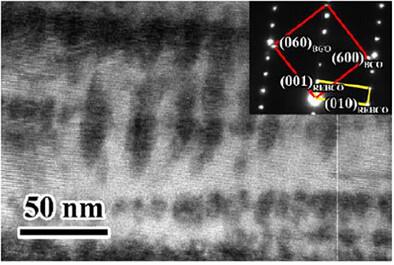
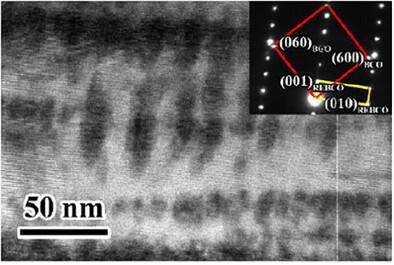
A novel flux-pinning design for REBa2Cu3O7-δ (REBCO) films intended for high-field magnet applications is proposed, which is based on BaCuO2 nanorods in Gd0.5Yb0.5Ba2Cu3O7-δ (Gd0.5Yb0.5BCO) films. The metal–organic chemical vapor deposition (MOCVD) process has been developed to achieve the desired microstructure. The influence of MOCVD parameters on the microstructure and critical current behavior of Gd0.5Yb0.5BCO films is systematically investigated. The morphology and density of BaCuO2 crystallites within the films are highly sensitive to deposition temperature, oxygen partial pressure, and deposition rate. Notably, forming thin, elongated, vertically aligned BaCuO2 nanorods requires precise control within a narrow processing window for these three parameters. The optimized MOCVD process results in a dense array of vertically aligned BaCuO2 nanorods within the Gd0.5Yb0.5BCO film, significantly enhancing magnetic-flux pinning, particularly in the low-temperature and high-magnetic-field regime. Superconducting tapes coated with Gd0.5Yb0.5BCO films using the optimized MOCVD process exhibit a power-law exponent (α value) of 0.40 for the critical current decay with magnetic field at 4 K, which is substantially lower than that of other REBCO coated conductors reported to date.
期刊介绍:
Small serves as an exceptional platform for both experimental and theoretical studies in fundamental and applied interdisciplinary research at the nano- and microscale. The journal offers a compelling mix of peer-reviewed Research Articles, Reviews, Perspectives, and Comments.
With a remarkable 2022 Journal Impact Factor of 13.3 (Journal Citation Reports from Clarivate Analytics, 2023), Small remains among the top multidisciplinary journals, covering a wide range of topics at the interface of materials science, chemistry, physics, engineering, medicine, and biology.
Small's readership includes biochemists, biologists, biomedical scientists, chemists, engineers, information technologists, materials scientists, physicists, and theoreticians alike.



 京公网安备 11010802042870号
京ICP备2023020795号-1
京公网安备 11010802042870号
京ICP备2023020795号-1

 分享
分享
 求助内容:
求助内容: 应助结果提醒方式:
 扫码关注我们
