Xiangyu Chu , Dongqi Li , Xiaocui Fang , Fuming Liang , Ping Li , Qing You , Chen Wang , Ling Zhu , Yanlian Yang , Yinmo Yang , Xiaodong Tian
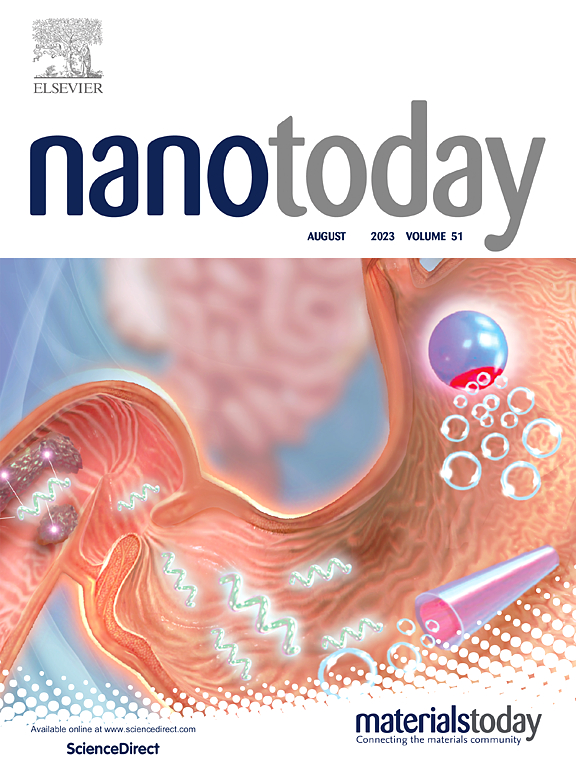
{"title":"Immunochemotherapeutic nanoparticles inhibit cancer-promoting fibroblasts subtypes for pancreatic ductal adenocarcinoma","authors":"Xiangyu Chu , Dongqi Li , Xiaocui Fang , Fuming Liang , Ping Li , Qing You , Chen Wang , Ling Zhu , Yanlian Yang , Yinmo Yang , Xiaodong Tian","doi":"10.1016/j.nantod.2025.102709","DOIUrl":null,"url":null,"abstract":"<div><div>Cancer-associated fibroblasts (CAFs) and immunosuppressive microenvironment play important roles in the progression of pancreatic ductal adenocarcinoma (PDAC). Myofibroblast CAFs (myCAFs) and antigen-presenting CAFs (apCAFs) are cancer-promoting fibroblast (CPF) subtypes which could promote dense extracellular matrix (ECM) formation to inhibit drug penetration and induce the immunosuppressive microenvironment. The inhibition of CPF subtypes may help improve the PDAC treatment efficacy. Herein the engineered CPF-inhibiting nanoparticles are constructed with BSA-MnO<sub>2</sub>-Niclosamide nanoparticles coated with exosomes encapsulating gemcitabine (BMN/GEM@PE) to substantially inhibit the progression and liver metastasis of PDAC by inhibiting the STAT3/p-STAT3 signals. The nanoparticles could significantly reduce the proportion of cancer-promoting CAF subtypes (myCAFs and apCAFs), which induce a shift from immune \"cold\" tumor to \"hot\" tumor phenotype. The reduced myCAFs by nanoparticles could promote the drug penetration and the infiltration of CD8<sup>+</sup> T cells, and the decreased apCAFs lead to the decrease of the regulatory T cells. The new nanoparticles-based treatment strategies that the CAFs-subtypes modulation may influence the tumor immune microenvironment, which provide an opportunity to improve the immunochemotherapy for PDAC.</div></div>","PeriodicalId":395,"journal":{"name":"Nano Today","volume":"62 ","pages":"Article 102709"},"PeriodicalIF":10.9000,"publicationDate":"2025-06-01","publicationTypes":"Journal Article","fieldsOfStudy":null,"isOpenAccess":false,"openAccessPdf":"","citationCount":"0","resultStr":null,"platform":"Semanticscholar","paperid":null,"PeriodicalName":"Nano Today","FirstCategoryId":"88","ListUrlMain":"https://www.sciencedirect.com/science/article/pii/S1748013225000817","RegionNum":1,"RegionCategory":"材料科学","ArticlePicture":[],"TitleCN":null,"AbstractTextCN":null,"PMCID":null,"EPubDate":"2025/3/18 0:00:00","PubModel":"Epub","JCR":"Q1","JCRName":"CHEMISTRY, MULTIDISCIPLINARY","Score":null,"Total":0}
引用次数: 0
Abstract
Cancer-associated fibroblasts (CAFs) and immunosuppressive microenvironment play important roles in the progression of pancreatic ductal adenocarcinoma (PDAC). Myofibroblast CAFs (myCAFs) and antigen-presenting CAFs (apCAFs) are cancer-promoting fibroblast (CPF) subtypes which could promote dense extracellular matrix (ECM) formation to inhibit drug penetration and induce the immunosuppressive microenvironment. The inhibition of CPF subtypes may help improve the PDAC treatment efficacy. Herein the engineered CPF-inhibiting nanoparticles are constructed with BSA-MnO2-Niclosamide nanoparticles coated with exosomes encapsulating gemcitabine (BMN/GEM@PE) to substantially inhibit the progression and liver metastasis of PDAC by inhibiting the STAT3/p-STAT3 signals. The nanoparticles could significantly reduce the proportion of cancer-promoting CAF subtypes (myCAFs and apCAFs), which induce a shift from immune "cold" tumor to "hot" tumor phenotype. The reduced myCAFs by nanoparticles could promote the drug penetration and the infiltration of CD8+ T cells, and the decreased apCAFs lead to the decrease of the regulatory T cells. The new nanoparticles-based treatment strategies that the CAFs-subtypes modulation may influence the tumor immune microenvironment, which provide an opportunity to improve the immunochemotherapy for PDAC.
期刊介绍:
Nano Today is a journal dedicated to publishing influential and innovative work in the field of nanoscience and technology. It covers a wide range of subject areas including biomaterials, materials chemistry, materials science, chemistry, bioengineering, biochemistry, genetics and molecular biology, engineering, and nanotechnology. The journal considers articles that inform readers about the latest research, breakthroughs, and topical issues in these fields. It provides comprehensive coverage through a mixture of peer-reviewed articles, research news, and information on key developments. Nano Today is abstracted and indexed in Science Citation Index, Ei Compendex, Embase, Scopus, and INSPEC.



 京公网安备 11010802042870号
京ICP备2023020795号-1
京公网安备 11010802042870号
京ICP备2023020795号-1

 分享
分享
 求助内容:
求助内容: 应助结果提醒方式:
 扫码关注我们
