Zhi Wang , Jiaxing Zhang , Shengping You , Rongxin Su , Wei Qi
{"title":"Energy-guided accumulated mutation strategy achieves a highly efficient polyethylene terephthalate-degrading enzyme","authors":"Zhi Wang , Jiaxing Zhang , Shengping You , Rongxin Su , Wei Qi","doi":"10.1016/j.bej.2025.109708","DOIUrl":null,"url":null,"abstract":"<div><div>The extensive application of polyethylene terephthalate (PET) has led to severe environmental pollution. Enzymatic degradation provides a sustainable solution for PET recycling, but the limited hydrolytic activity of current PET hydrolases hinders its practical application. Here, we designed an Energy-Guided Accumulated Mutation Strategy (EGAMS) for the rational design of PET enzyme PHL7. By applying multiple rounds of evolution to enhance the degradation activity and thermostability of PHL7, we achieved the excellent PET degradation enzyme FlashPETase (PHL7<sup>E148K/T158P/S184E/H185Y</sup>) with 238.8 % PET degradation activity of PHL7 and 82.93 °C melting temperature. FlashPETase completely degrades PET at 72 °C with an enzyme loading of 1.5 mg<sub>enzyme</sub> g<sub>PET</sub><sup>−1</sup>, without any substrate pretreatment or additional processing. As for PET substrates with high crystallinity, FlashPETase still performs well. Furthermore, molecular simulations revealed the structural mechanisms of FlashPETase’s enhanced activity and stability. In summary, the EGAMS protocol and the variants discussed in this work advance the fields of PET degradation and enzyme engineering, offering valuable insights for future research.</div></div>","PeriodicalId":8766,"journal":{"name":"Biochemical Engineering Journal","volume":"219 ","pages":"Article 109708"},"PeriodicalIF":3.7000,"publicationDate":"2025-03-08","publicationTypes":"Journal Article","fieldsOfStudy":null,"isOpenAccess":false,"openAccessPdf":"","citationCount":"0","resultStr":null,"platform":"Semanticscholar","paperid":null,"PeriodicalName":"Biochemical Engineering Journal","FirstCategoryId":"5","ListUrlMain":"https://www.sciencedirect.com/science/article/pii/S1369703X25000828","RegionNum":3,"RegionCategory":"生物学","ArticlePicture":[],"TitleCN":null,"AbstractTextCN":null,"PMCID":null,"EPubDate":"","PubModel":"","JCR":"Q2","JCRName":"BIOTECHNOLOGY & APPLIED MICROBIOLOGY","Score":null,"Total":0}
引用次数: 0
Abstract
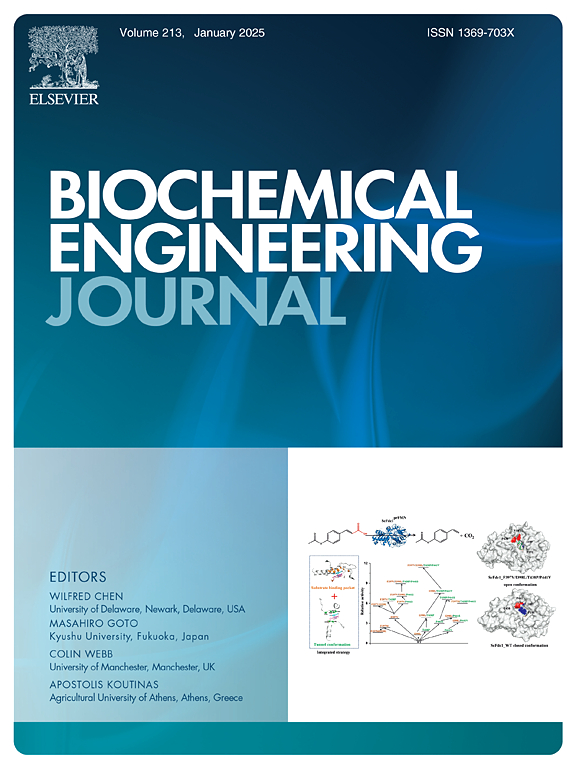
The extensive application of polyethylene terephthalate (PET) has led to severe environmental pollution. Enzymatic degradation provides a sustainable solution for PET recycling, but the limited hydrolytic activity of current PET hydrolases hinders its practical application. Here, we designed an Energy-Guided Accumulated Mutation Strategy (EGAMS) for the rational design of PET enzyme PHL7. By applying multiple rounds of evolution to enhance the degradation activity and thermostability of PHL7, we achieved the excellent PET degradation enzyme FlashPETase (PHL7E148K/T158P/S184E/H185Y) with 238.8 % PET degradation activity of PHL7 and 82.93 °C melting temperature. FlashPETase completely degrades PET at 72 °C with an enzyme loading of 1.5 mgenzyme gPET−1, without any substrate pretreatment or additional processing. As for PET substrates with high crystallinity, FlashPETase still performs well. Furthermore, molecular simulations revealed the structural mechanisms of FlashPETase’s enhanced activity and stability. In summary, the EGAMS protocol and the variants discussed in this work advance the fields of PET degradation and enzyme engineering, offering valuable insights for future research.
期刊介绍:
The Biochemical Engineering Journal aims to promote progress in the crucial chemical engineering aspects of the development of biological processes associated with everything from raw materials preparation to product recovery relevant to industries as diverse as medical/healthcare, industrial biotechnology, and environmental biotechnology.
The Journal welcomes full length original research papers, short communications, and review papers* in the following research fields:
Biocatalysis (enzyme or microbial) and biotransformations, including immobilized biocatalyst preparation and kinetics
Biosensors and Biodevices including biofabrication and novel fuel cell development
Bioseparations including scale-up and protein refolding/renaturation
Environmental Bioengineering including bioconversion, bioremediation, and microbial fuel cells
Bioreactor Systems including characterization, optimization and scale-up
Bioresources and Biorefinery Engineering including biomass conversion, biofuels, bioenergy, and optimization
Industrial Biotechnology including specialty chemicals, platform chemicals and neutraceuticals
Biomaterials and Tissue Engineering including bioartificial organs, cell encapsulation, and controlled release
Cell Culture Engineering (plant, animal or insect cells) including viral vectors, monoclonal antibodies, recombinant proteins, vaccines, and secondary metabolites
Cell Therapies and Stem Cells including pluripotent, mesenchymal and hematopoietic stem cells; immunotherapies; tissue-specific differentiation; and cryopreservation
Metabolic Engineering, Systems and Synthetic Biology including OMICS, bioinformatics, in silico biology, and metabolic flux analysis
Protein Engineering including enzyme engineering and directed evolution.



 京公网安备 11010802042870号
京ICP备2023020795号-1
京公网安备 11010802042870号
京ICP备2023020795号-1

 分享
分享
 求助内容:
求助内容: 应助结果提醒方式:
 扫码关注我们
