{"title":"Aluminum titanate-based nanocomposite layers in photoelectrochemical water splitting under visible light","authors":"Shima Kashani , Hamid Reza Madaah Hosseini","doi":"10.1016/j.matchemphys.2025.130652","DOIUrl":null,"url":null,"abstract":"<div><div>Although Al<sub>2</sub>TiO<sub>5</sub>-based nanocomposites are known to be promising photocatalysts, their potential application in photoelectrochemical (PEC) water splitting has not yet been explored. In this study, innovative photoanodes composed of TiO<sub>2</sub>/Al<sub>2</sub>TiO<sub>5</sub>/Al<sub>2</sub>O<sub>3</sub> nanocomposite powders were developed. These powders were synthesized via sol-gel method and deposited on fluorine-doped tin oxide (FTO) substrates. The crystalline phase ratio in these nanocomposites was controlled by adjusting the calcination temperature between 800 and 1000 °C, and then identified by the X-ray diffraction analysis. The microstructure properties of the samples were examined by Field-emission scanning electron microscopy. UV–Vis spectroscopy and Mott-Schottky analyses were employed to determine the bandgap energies and band edge positions of the materials. For the TiO<sub>2</sub>/Al<sub>2</sub>TiO<sub>5</sub>/Al<sub>2</sub>O<sub>3</sub> nanocomposites, the bandgap values were found to range from 2.9 to 3.1 eV. Photoluminescence analysis indicated a reduced electron-hole pair recombination rate in tialite-based photoanodes compared to TiO<sub>2</sub> films. Electrochemical impedance spectroscopy (EIS) showed that the sample with the highest tialite (Al<sub>2</sub>TiO<sub>5</sub>) concentration had significantly lower charge transfer resistance. Due to the relative positions of the band edges in this composite, photogenerated holes can be injected from the valence band of other photocatalyst phases into the valence band of Al<sub>2</sub>TiO<sub>5</sub> and then transferred to the electrolyte, contributing to the photoelectrochemical water oxidation reaction. Under illumination of 100 mW cm<sup>−2</sup>, the photocurrent density of the AT-based photoelectrodes reached 0.42 mA cm<sup>−2</sup> at 1.23 V versus the reversible hydrogen electrode, which was approximately 2.5 times higher than that of the TiO<sub>2</sub> sample.</div></div>","PeriodicalId":18227,"journal":{"name":"Materials Chemistry and Physics","volume":"339 ","pages":"Article 130652"},"PeriodicalIF":4.7000,"publicationDate":"2025-03-08","publicationTypes":"Journal Article","fieldsOfStudy":null,"isOpenAccess":false,"openAccessPdf":"","citationCount":"0","resultStr":null,"platform":"Semanticscholar","paperid":null,"PeriodicalName":"Materials Chemistry and Physics","FirstCategoryId":"88","ListUrlMain":"https://www.sciencedirect.com/science/article/pii/S0254058425002986","RegionNum":3,"RegionCategory":"材料科学","ArticlePicture":[],"TitleCN":null,"AbstractTextCN":null,"PMCID":null,"EPubDate":"","PubModel":"","JCR":"Q2","JCRName":"MATERIALS SCIENCE, MULTIDISCIPLINARY","Score":null,"Total":0}
引用次数: 0
Abstract
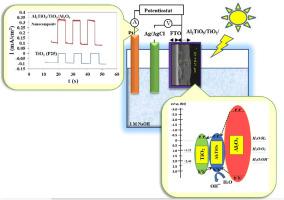
Although Al2TiO5-based nanocomposites are known to be promising photocatalysts, their potential application in photoelectrochemical (PEC) water splitting has not yet been explored. In this study, innovative photoanodes composed of TiO2/Al2TiO5/Al2O3 nanocomposite powders were developed. These powders were synthesized via sol-gel method and deposited on fluorine-doped tin oxide (FTO) substrates. The crystalline phase ratio in these nanocomposites was controlled by adjusting the calcination temperature between 800 and 1000 °C, and then identified by the X-ray diffraction analysis. The microstructure properties of the samples were examined by Field-emission scanning electron microscopy. UV–Vis spectroscopy and Mott-Schottky analyses were employed to determine the bandgap energies and band edge positions of the materials. For the TiO2/Al2TiO5/Al2O3 nanocomposites, the bandgap values were found to range from 2.9 to 3.1 eV. Photoluminescence analysis indicated a reduced electron-hole pair recombination rate in tialite-based photoanodes compared to TiO2 films. Electrochemical impedance spectroscopy (EIS) showed that the sample with the highest tialite (Al2TiO5) concentration had significantly lower charge transfer resistance. Due to the relative positions of the band edges in this composite, photogenerated holes can be injected from the valence band of other photocatalyst phases into the valence band of Al2TiO5 and then transferred to the electrolyte, contributing to the photoelectrochemical water oxidation reaction. Under illumination of 100 mW cm−2, the photocurrent density of the AT-based photoelectrodes reached 0.42 mA cm−2 at 1.23 V versus the reversible hydrogen electrode, which was approximately 2.5 times higher than that of the TiO2 sample.
期刊介绍:
Materials Chemistry and Physics is devoted to short communications, full-length research papers and feature articles on interrelationships among structure, properties, processing and performance of materials. The Editors welcome manuscripts on thin films, surface and interface science, materials degradation and reliability, metallurgy, semiconductors and optoelectronic materials, fine ceramics, magnetics, superconductors, specialty polymers, nano-materials and composite materials.



 京公网安备 11010802042870号
京ICP备2023020795号-1
京公网安备 11010802042870号
京ICP备2023020795号-1

 分享
分享
 求助内容:
求助内容: 应助结果提醒方式:
 扫码关注我们
