Min Hee Lee , Seung-Ju Choi , Seoktae Kang , Hee-Jung Jung , Dong Soo Hwang
{"title":"Proteomics and RNA sequencing analysis of Escherichia coli biofilm on reverse osmosis membrane for wastewater reclamation","authors":"Min Hee Lee , Seung-Ju Choi , Seoktae Kang , Hee-Jung Jung , Dong Soo Hwang","doi":"10.1016/j.desal.2025.118814","DOIUrl":null,"url":null,"abstract":"<div><div>As the molecular mechanisms of biofouling and biofilm formation are not fully understood, biofouling during the reverse osmosis (RO) process remains a challenging problem. In this study, the proteome from extracellular polymeric substances (EPS) of <em>Escherichia coli</em> biofilm as a model biofilm, was analyzed during the RO membrane process to understand the biofouling mechanism. Employing liquid chromatography combined with tandem mass spectrometry (LC-MS/MS), the intrinsically disordered peptide (IDP) INLLDDNQFTR located in outer membrane porin C (OmpC) was identified as one of the main fragments in the proteome. This peptide enhanced both the attachment of cells on the membrane surface and microbial swarming. A RNA sequencing analysis revealed that genes regulating cell division and flagellar movements were up-regulated for the formation of` biofilms. Nanomechanics based on atomic force microscopy (AFM) showed that the peptide strongly interacts with the lipopolysaccharides (LPS) of the cell wall. Overall, the OmpC IDP stimulates cell attachment through cell-to-cell communication or cell division, accelerating biofouling of the membrane surface. It is anticipated that an antagonist of the IDP of OmpC could be effective for regulating biofouling during the RO process.</div></div>","PeriodicalId":299,"journal":{"name":"Desalination","volume":"607 ","pages":"Article 118814"},"PeriodicalIF":9.8000,"publicationDate":"2025-07-15","publicationTypes":"Journal Article","fieldsOfStudy":null,"isOpenAccess":false,"openAccessPdf":"","citationCount":"0","resultStr":null,"platform":"Semanticscholar","paperid":null,"PeriodicalName":"Desalination","FirstCategoryId":"5","ListUrlMain":"https://www.sciencedirect.com/science/article/pii/S0011916425002899","RegionNum":1,"RegionCategory":"工程技术","ArticlePicture":[],"TitleCN":null,"AbstractTextCN":null,"PMCID":null,"EPubDate":"2025/3/14 0:00:00","PubModel":"Epub","JCR":"Q1","JCRName":"ENGINEERING, CHEMICAL","Score":null,"Total":0}
引用次数: 0
Abstract
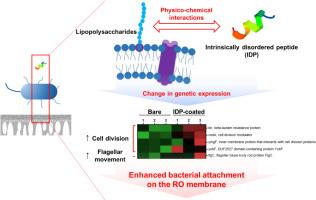
As the molecular mechanisms of biofouling and biofilm formation are not fully understood, biofouling during the reverse osmosis (RO) process remains a challenging problem. In this study, the proteome from extracellular polymeric substances (EPS) of Escherichia coli biofilm as a model biofilm, was analyzed during the RO membrane process to understand the biofouling mechanism. Employing liquid chromatography combined with tandem mass spectrometry (LC-MS/MS), the intrinsically disordered peptide (IDP) INLLDDNQFTR located in outer membrane porin C (OmpC) was identified as one of the main fragments in the proteome. This peptide enhanced both the attachment of cells on the membrane surface and microbial swarming. A RNA sequencing analysis revealed that genes regulating cell division and flagellar movements were up-regulated for the formation of` biofilms. Nanomechanics based on atomic force microscopy (AFM) showed that the peptide strongly interacts with the lipopolysaccharides (LPS) of the cell wall. Overall, the OmpC IDP stimulates cell attachment through cell-to-cell communication or cell division, accelerating biofouling of the membrane surface. It is anticipated that an antagonist of the IDP of OmpC could be effective for regulating biofouling during the RO process.
期刊介绍:
Desalination is a scholarly journal that focuses on the field of desalination materials, processes, and associated technologies. It encompasses a wide range of disciplines and aims to publish exceptional papers in this area.
The journal invites submissions that explicitly revolve around water desalting and its applications to various sources such as seawater, groundwater, and wastewater. It particularly encourages research on diverse desalination methods including thermal, membrane, sorption, and hybrid processes.
By providing a platform for innovative studies, Desalination aims to advance the understanding and development of desalination technologies, promoting sustainable solutions for water scarcity challenges.




 京公网安备 11010802042870号
京ICP备2023020795号-1
京公网安备 11010802042870号
京ICP备2023020795号-1

 分享
分享
 求助内容:
求助内容: 应助结果提醒方式:
 扫码关注我们
