Yushuo Hu , Cien Liu , Guangyu Cao , Xing Zhang , Yihong Chen , Hongwei Dai , Xiyao He , Hao Long , Shengwang Yu , Xiangyu Xu , Kelvin H.L. Zhang
{"title":"MPCVD grown high quality diamond single crystal film for high-speed solar-blind UV photodetectors with TiC ohmic contacts","authors":"Yushuo Hu , Cien Liu , Guangyu Cao , Xing Zhang , Yihong Chen , Hongwei Dai , Xiyao He , Hao Long , Shengwang Yu , Xiangyu Xu , Kelvin H.L. Zhang","doi":"10.1016/j.diamond.2025.112199","DOIUrl":null,"url":null,"abstract":"<div><div>Single crystal diamond has emerged as promising semiconductor for power electronics, quantum sensing and radiation detection, because of its ultra-wide bandgap, high breakdown field and high stability. In this work, we report the growth of high-quality single crystal diamond film using microwave plasma-enhanced chemical vapor deposition (MPCVD) and the fabrication of metal-semiconductor-metal (MSM) structured photodetectors for solar blind UV light detection. The single crystal diamond film has a full width at half maximum (FWHM) of 80 arcsec and a Raman FWHM of 2.1 cm<sup>−1</sup>, and a low root mean square (RMS) surface roughness of 0.5 nm. The solar-blind photodetectors (SBPDs) are highly sensitive to solar-blind UV spectrum with the specific wavelength of 222 nm, and achieve a low dark current of 2.3 × 10<sup>−11</sup> An under 20 V bias, a specific detectivity of 4.4 × 10<sup>12</sup> Jones and a rapid response speed with a decay time of 78.6 μs. The enhanced performance of the SBPDs is attributed to the high crystalline quality of the diamond films and the optimized ohmic contact at the device interface, which facilitates the efficient transport of photogenerated charge carriers. The diamond-based photodetectors with high sensitivity, rapid response and stability have potential applications in the field of space detection, medical diagnosis and environmental monitoring.</div></div>","PeriodicalId":11266,"journal":{"name":"Diamond and Related Materials","volume":"154 ","pages":"Article 112199"},"PeriodicalIF":5.1000,"publicationDate":"2025-03-12","publicationTypes":"Journal Article","fieldsOfStudy":null,"isOpenAccess":false,"openAccessPdf":"","citationCount":"0","resultStr":null,"platform":"Semanticscholar","paperid":null,"PeriodicalName":"Diamond and Related Materials","FirstCategoryId":"88","ListUrlMain":"https://www.sciencedirect.com/science/article/pii/S0925963525002560","RegionNum":3,"RegionCategory":"材料科学","ArticlePicture":[],"TitleCN":null,"AbstractTextCN":null,"PMCID":null,"EPubDate":"","PubModel":"","JCR":"Q2","JCRName":"MATERIALS SCIENCE, COATINGS & FILMS","Score":null,"Total":0}
引用次数: 0
Abstract
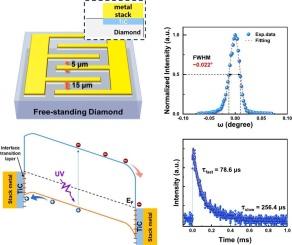
Single crystal diamond has emerged as promising semiconductor for power electronics, quantum sensing and radiation detection, because of its ultra-wide bandgap, high breakdown field and high stability. In this work, we report the growth of high-quality single crystal diamond film using microwave plasma-enhanced chemical vapor deposition (MPCVD) and the fabrication of metal-semiconductor-metal (MSM) structured photodetectors for solar blind UV light detection. The single crystal diamond film has a full width at half maximum (FWHM) of 80 arcsec and a Raman FWHM of 2.1 cm−1, and a low root mean square (RMS) surface roughness of 0.5 nm. The solar-blind photodetectors (SBPDs) are highly sensitive to solar-blind UV spectrum with the specific wavelength of 222 nm, and achieve a low dark current of 2.3 × 10⁻¹¹ An under 20 V bias, a specific detectivity of 4.4 × 10¹² Jones and a rapid response speed with a decay time of 78.6 μs. The enhanced performance of the SBPDs is attributed to the high crystalline quality of the diamond films and the optimized ohmic contact at the device interface, which facilitates the efficient transport of photogenerated charge carriers. The diamond-based photodetectors with high sensitivity, rapid response and stability have potential applications in the field of space detection, medical diagnosis and environmental monitoring.
期刊介绍:
DRM is a leading international journal that publishes new fundamental and applied research on all forms of diamond, the integration of diamond with other advanced materials and development of technologies exploiting diamond. The synthesis, characterization and processing of single crystal diamond, polycrystalline films, nanodiamond powders and heterostructures with other advanced materials are encouraged topics for technical and review articles. In addition to diamond, the journal publishes manuscripts on the synthesis, characterization and application of other related materials including diamond-like carbons, carbon nanotubes, graphene, and boron and carbon nitrides. Articles are sought on the chemical functionalization of diamond and related materials as well as their use in electrochemistry, energy storage and conversion, chemical and biological sensing, imaging, thermal management, photonic and quantum applications, electron emission and electronic devices.
The International Conference on Diamond and Carbon Materials has evolved into the largest and most well attended forum in the field of diamond, providing a forum to showcase the latest results in the science and technology of diamond and other carbon materials such as carbon nanotubes, graphene, and diamond-like carbon. Run annually in association with Diamond and Related Materials the conference provides junior and established researchers the opportunity to exchange the latest results ranging from fundamental physical and chemical concepts to applied research focusing on the next generation carbon-based devices.



 京公网安备 11010802042870号
京ICP备2023020795号-1
京公网安备 11010802042870号
京ICP备2023020795号-1

 分享
分享
 求助内容:
求助内容: 应助结果提醒方式:
 扫码关注我们
