Vignesh Subramaniam , Carolina Abrahan , Brett R. Higgins , Steven J. Chisolm , Baleigh Sweeney , Senthilkumar Duraivel , Leandro Balzano-Nogueira , Tia Monjure , Chih-Yi Wang , Glyn D. Palmer , Thomas E. Angelini
{"title":"A functional human liver tissue model: 3D bioprinted co-culture discoids","authors":"Vignesh Subramaniam , Carolina Abrahan , Brett R. Higgins , Steven J. Chisolm , Baleigh Sweeney , Senthilkumar Duraivel , Leandro Balzano-Nogueira , Tia Monjure , Chih-Yi Wang , Glyn D. Palmer , Thomas E. Angelini","doi":"10.1016/j.bioadv.2025.214288","DOIUrl":null,"url":null,"abstract":"<div><div>To reduce costs and delays related to developing new and effective drugs, there is a critical need for improved human liver tissue models. Here we describe an approach for 3D bioprinting functional human liver tissue models, in which we fabricate disc-shaped structures (discoids) 200 μm in thickness and 1–3 mm in diameter from mixtures of cells and collagen-1, embedded in a highly permeable support medium made from packed polyethylene glycol (PEG) microgels. We demonstrate that the method is precise, accurate, and scalable; up to 100 tissues/h can be manufactured with a variability and error in diameter of about 4 %. Histologic and immunohistochemical evaluation of printed discs reveal self-organization, cell cohesion, and key liver marker expression. Over the course of three weeks in culture, the tissues stably synthesize albumin and urea at high levels, outperforming spheroid tissue models. We find the tissues express >100 genes associated with molecular absorption, distribution, metabolism, and excretion (ADME) at levels within the range of human liver. The liver tissue models exhibit enzymatic formation of metabolites after exposure to multiple test compounds. Together, these results demonstrate the promise of 3D printed discoids for pharmacological and toxicological applications.</div></div>","PeriodicalId":51111,"journal":{"name":"Materials Science & Engineering C-Materials for Biological Applications","volume":"173 ","pages":"Article 214288"},"PeriodicalIF":6.0000,"publicationDate":"2025-08-01","publicationTypes":"Journal Article","fieldsOfStudy":null,"isOpenAccess":false,"openAccessPdf":"","citationCount":"0","resultStr":null,"platform":"Semanticscholar","paperid":null,"PeriodicalName":"Materials Science & Engineering C-Materials for Biological Applications","FirstCategoryId":"1085","ListUrlMain":"https://www.sciencedirect.com/science/article/pii/S2772950825001153","RegionNum":2,"RegionCategory":"医学","ArticlePicture":[],"TitleCN":null,"AbstractTextCN":null,"PMCID":null,"EPubDate":"2025/3/17 0:00:00","PubModel":"Epub","JCR":"Q2","JCRName":"MATERIALS SCIENCE, BIOMATERIALS","Score":null,"Total":0}
引用次数: 0
Abstract
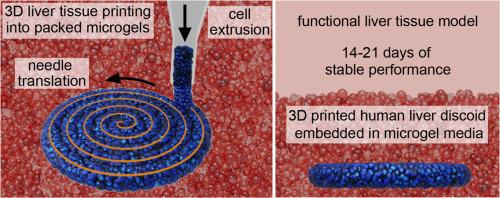
To reduce costs and delays related to developing new and effective drugs, there is a critical need for improved human liver tissue models. Here we describe an approach for 3D bioprinting functional human liver tissue models, in which we fabricate disc-shaped structures (discoids) 200 μm in thickness and 1–3 mm in diameter from mixtures of cells and collagen-1, embedded in a highly permeable support medium made from packed polyethylene glycol (PEG) microgels. We demonstrate that the method is precise, accurate, and scalable; up to 100 tissues/h can be manufactured with a variability and error in diameter of about 4 %. Histologic and immunohistochemical evaluation of printed discs reveal self-organization, cell cohesion, and key liver marker expression. Over the course of three weeks in culture, the tissues stably synthesize albumin and urea at high levels, outperforming spheroid tissue models. We find the tissues express >100 genes associated with molecular absorption, distribution, metabolism, and excretion (ADME) at levels within the range of human liver. The liver tissue models exhibit enzymatic formation of metabolites after exposure to multiple test compounds. Together, these results demonstrate the promise of 3D printed discoids for pharmacological and toxicological applications.
期刊介绍:
Biomaterials Advances, previously known as Materials Science and Engineering: C-Materials for Biological Applications (P-ISSN: 0928-4931, E-ISSN: 1873-0191). Includes topics at the interface of the biomedical sciences and materials engineering. These topics include:
• Bioinspired and biomimetic materials for medical applications
• Materials of biological origin for medical applications
• Materials for "active" medical applications
• Self-assembling and self-healing materials for medical applications
• "Smart" (i.e., stimulus-response) materials for medical applications
• Ceramic, metallic, polymeric, and composite materials for medical applications
• Materials for in vivo sensing
• Materials for in vivo imaging
• Materials for delivery of pharmacologic agents and vaccines
• Novel approaches for characterizing and modeling materials for medical applications
Manuscripts on biological topics without a materials science component, or manuscripts on materials science without biological applications, will not be considered for publication in Materials Science and Engineering C. New submissions are first assessed for language, scope and originality (plagiarism check) and can be desk rejected before review if they need English language improvements, are out of scope or present excessive duplication with published sources.
Biomaterials Advances sits within Elsevier''s biomaterials science portfolio alongside Biomaterials, Materials Today Bio and Biomaterials and Biosystems. As part of the broader Materials Today family, Biomaterials Advances offers authors rigorous peer review, rapid decisions, and high visibility. We look forward to receiving your submissions!



 京公网安备 11010802042870号
京ICP备2023020795号-1
京公网安备 11010802042870号
京ICP备2023020795号-1

 分享
分享
 求助内容:
求助内容: 应助结果提醒方式:
 扫码关注我们
