Li Fu , Jianping Huang , Guolong Zhang , Dongliang Han , Lei Ding , Yun Wei , Xiaoyue Liu , Changyu Li , Haipeng Yu
{"title":"Abrupt loss of species richness caused by ecosystem transition","authors":"Li Fu , Jianping Huang , Guolong Zhang , Dongliang Han , Lei Ding , Yun Wei , Xiaoyue Liu , Changyu Li , Haipeng Yu","doi":"10.1016/j.scib.2025.03.001","DOIUrl":null,"url":null,"abstract":"<div><div>Ecosystem transition occurs when ecological thresholds are crossed, causing ecosystems to irreversibly shift from secure to insecure states. However, how ecosystem transition exacerbates species richness loss remains poorly understood. This hinders the effective protection of species richness, which is an urgent global priority. In this study, we integrated multiple ecosystem variables to elucidate ecosystem transition and its impacts on species richness loss. Our findings reveal that species richness declines abruptly following ecosystem transition, as insecure ecosystems are characterized by reduced plant cover and productivity, intensified warming and drying, and diminished oxygen production. Insecure ecosystems imperil the survival of all species, including 39.4% of threatened birds and 29.2% of threatened mammal species. We project that by 2100, the ecosystem areas considered insecure will encompass 40.4% of the global land areas under the RCP8.5 scenario, contributing to 51.6% of species richness loss. In contrast, hyper-secure ecosystems are projected to account for 18.1% of species richness loss. This study identifies ecosystem transition as a critical driver of species richness loss that should be accounted for by policymakers in designing targeted conservation strategies.</div></div>","PeriodicalId":421,"journal":{"name":"Science Bulletin","volume":"70 9","pages":"Pages 1523-1532"},"PeriodicalIF":21.1000,"publicationDate":"2025-05-15","publicationTypes":"Journal Article","fieldsOfStudy":null,"isOpenAccess":false,"openAccessPdf":"","citationCount":"0","resultStr":null,"platform":"Semanticscholar","paperid":null,"PeriodicalName":"Science Bulletin","FirstCategoryId":"103","ListUrlMain":"https://www.sciencedirect.com/science/article/pii/S2095927325002245","RegionNum":1,"RegionCategory":"综合性期刊","ArticlePicture":[],"TitleCN":null,"AbstractTextCN":null,"PMCID":null,"EPubDate":"2025/3/3 0:00:00","PubModel":"Epub","JCR":"Q1","JCRName":"MULTIDISCIPLINARY SCIENCES","Score":null,"Total":0}
引用次数: 0
Abstract
Ecosystem transition occurs when ecological thresholds are crossed, causing ecosystems to irreversibly shift from secure to insecure states. However, how ecosystem transition exacerbates species richness loss remains poorly understood. This hinders the effective protection of species richness, which is an urgent global priority. In this study, we integrated multiple ecosystem variables to elucidate ecosystem transition and its impacts on species richness loss. Our findings reveal that species richness declines abruptly following ecosystem transition, as insecure ecosystems are characterized by reduced plant cover and productivity, intensified warming and drying, and diminished oxygen production. Insecure ecosystems imperil the survival of all species, including 39.4% of threatened birds and 29.2% of threatened mammal species. We project that by 2100, the ecosystem areas considered insecure will encompass 40.4% of the global land areas under the RCP8.5 scenario, contributing to 51.6% of species richness loss. In contrast, hyper-secure ecosystems are projected to account for 18.1% of species richness loss. This study identifies ecosystem transition as a critical driver of species richness loss that should be accounted for by policymakers in designing targeted conservation strategies.
期刊介绍:
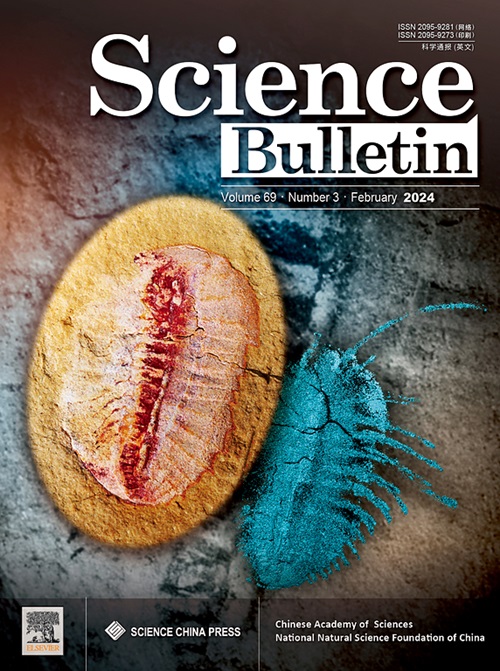
Science Bulletin (Sci. Bull., formerly known as Chinese Science Bulletin) is a multidisciplinary academic journal supervised by the Chinese Academy of Sciences (CAS) and co-sponsored by the CAS and the National Natural Science Foundation of China (NSFC). Sci. Bull. is a semi-monthly international journal publishing high-caliber peer-reviewed research on a broad range of natural sciences and high-tech fields on the basis of its originality, scientific significance and whether it is of general interest. In addition, we are committed to serving the scientific community with immediate, authoritative news and valuable insights into upcoming trends around the globe.




 京公网安备 11010802042870号
京ICP备2023020795号-1
京公网安备 11010802042870号
京ICP备2023020795号-1

 分享
分享
 求助内容:
求助内容: 应助结果提醒方式:
 扫码关注我们
