{"title":"Estimating HIV incidence in Türkiye: results from two mathematical models.","authors":"Emine Yaylali, Zikriye Melisa Erdogan","doi":"10.1186/s12879-025-10718-8","DOIUrl":null,"url":null,"abstract":"<p><strong>Background: </strong>The number of HIV patients has been decreasing globally due to world-wide efforts to end this epidemic; however, HIV incidence has been significantly increasing in Türkiye in the last five years. This study aimed to develop mathematical models to analyze and forecast HIV incidence and prevalence in Türkiye up to 2030.</p><p><strong>Methods: </strong>First, we utilized a Bernoulli model and estimated the annual HIV incidence for risk groups such as heterosexuals (HET), men who have sex with men (MSM), persons who inject drugs (PWID) and female sex workers (FSW). We then developed a dynamic compartmental model of HIV transmission and progression to estimate the incidence of HIV from 2024 to 2030 and further determine the continuum of care levels, such as the proportion of people living with diagnosed HIV and the proportion of people receiving antiretroviral treatment. We also conducted sensitivity analyses for both models on key parameters to explore the robustness of our results.</p><p><strong>Results: </strong>The Bernoulli model indicates that the majority of HIV incidence is driven by two primary risk groups: men who have sex with men (MSM) (41%) and high-risk heterosexuals (HET) (38%). While the risk of HIV transmission is high for people who inject drugs (PWID) (0.07%) and female sex workers (FSW) (0.85%), their contribution to total incidence is lower due to their smaller population sizes. Results from the dynamic compartmental model predict that both the incidence of HIV and the number of HIV-related deaths will continue to rise over the next decade. HIV incidence is projected to reach 27,036 cases in 2025 and increase 2.9-times to 105,202 cases by 2030. According to our models, a significant portion of the HIV-positive population remains undiagnosed (49%), and individuals at high risk of HIV transmission (41% of estimated HIV incidence) are the primary drivers of the epidemic.</p><p><strong>Conclusions: </strong>The number of HIV cases could significantly increase with existing prevention efforts, and HIV could become a major public health threat in the near future in Türkiye.</p>","PeriodicalId":8981,"journal":{"name":"BMC Infectious Diseases","volume":"25 1","pages":"367"},"PeriodicalIF":3.0000,"publicationDate":"2025-03-17","publicationTypes":"Journal Article","fieldsOfStudy":null,"isOpenAccess":false,"openAccessPdf":"https://www.ncbi.nlm.nih.gov/pmc/articles/PMC11912790/pdf/","citationCount":"0","resultStr":null,"platform":"Semanticscholar","paperid":null,"PeriodicalName":"BMC Infectious Diseases","FirstCategoryId":"3","ListUrlMain":"https://doi.org/10.1186/s12879-025-10718-8","RegionNum":3,"RegionCategory":"医学","ArticlePicture":[],"TitleCN":null,"AbstractTextCN":null,"PMCID":null,"EPubDate":"","PubModel":"","JCR":"Q2","JCRName":"INFECTIOUS DISEASES","Score":null,"Total":0}
引用次数: 0
Abstract
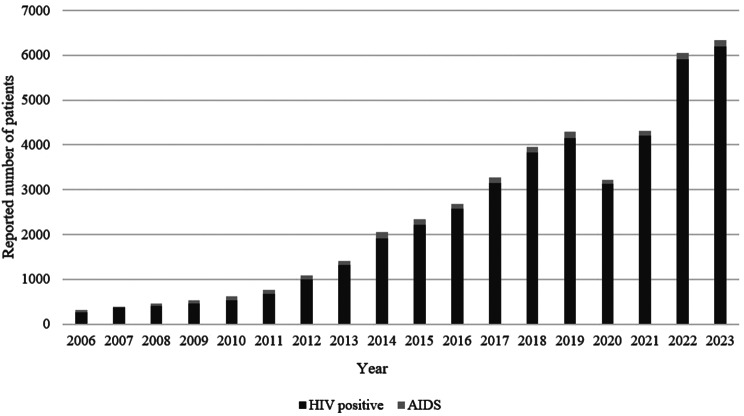
Background: The number of HIV patients has been decreasing globally due to world-wide efforts to end this epidemic; however, HIV incidence has been significantly increasing in Türkiye in the last five years. This study aimed to develop mathematical models to analyze and forecast HIV incidence and prevalence in Türkiye up to 2030.
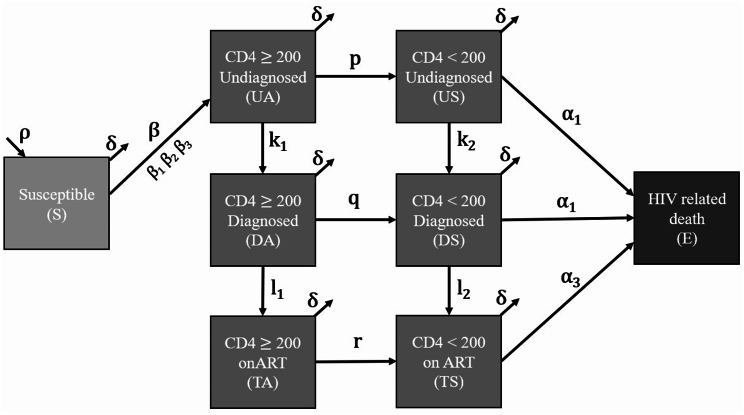
Methods: First, we utilized a Bernoulli model and estimated the annual HIV incidence for risk groups such as heterosexuals (HET), men who have sex with men (MSM), persons who inject drugs (PWID) and female sex workers (FSW). We then developed a dynamic compartmental model of HIV transmission and progression to estimate the incidence of HIV from 2024 to 2030 and further determine the continuum of care levels, such as the proportion of people living with diagnosed HIV and the proportion of people receiving antiretroviral treatment. We also conducted sensitivity analyses for both models on key parameters to explore the robustness of our results.
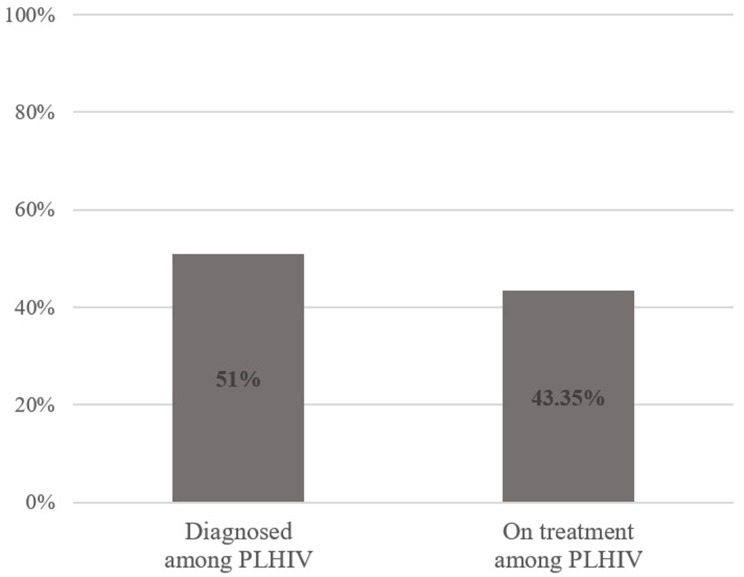
Results: The Bernoulli model indicates that the majority of HIV incidence is driven by two primary risk groups: men who have sex with men (MSM) (41%) and high-risk heterosexuals (HET) (38%). While the risk of HIV transmission is high for people who inject drugs (PWID) (0.07%) and female sex workers (FSW) (0.85%), their contribution to total incidence is lower due to their smaller population sizes. Results from the dynamic compartmental model predict that both the incidence of HIV and the number of HIV-related deaths will continue to rise over the next decade. HIV incidence is projected to reach 27,036 cases in 2025 and increase 2.9-times to 105,202 cases by 2030. According to our models, a significant portion of the HIV-positive population remains undiagnosed (49%), and individuals at high risk of HIV transmission (41% of estimated HIV incidence) are the primary drivers of the epidemic.
Conclusions: The number of HIV cases could significantly increase with existing prevention efforts, and HIV could become a major public health threat in the near future in Türkiye.
期刊介绍:
BMC Infectious Diseases is an open access, peer-reviewed journal that considers articles on all aspects of the prevention, diagnosis and management of infectious and sexually transmitted diseases in humans, as well as related molecular genetics, pathophysiology, and epidemiology.



 京公网安备 11010802042870号
京ICP备2023020795号-1
京公网安备 11010802042870号
京ICP备2023020795号-1

 分享
分享
 求助内容:
求助内容: 应助结果提醒方式:
 扫码关注我们
