Xuan Duc Nguyen, Audrey Horn, Dania Fischer, Grietje Beck, Cora C Spannenberger, Brice Gaudilliere, Jean-Louis Horn, Hermann-Josef Thierse, Thomas Frietsch
{"title":"Suppressive effects of deep balanced anesthesia on cellular immunity and protein expression: a randomized-controlled pilot study.","authors":"Xuan Duc Nguyen, Audrey Horn, Dania Fischer, Grietje Beck, Cora C Spannenberger, Brice Gaudilliere, Jean-Louis Horn, Hermann-Josef Thierse, Thomas Frietsch","doi":"10.1186/s12871-025-02980-9","DOIUrl":null,"url":null,"abstract":"<p><strong>Background: </strong>It is questionable whether or not a short period of deep anesthesia can have long lasting effects on immune suppression.</p><p><strong>Methods: </strong>To analyze specific effects of deep anesthesia on immune modulation, a randomized-controlled, single-blinded study, monocentric, pilot-study was conducted at a level 1 orthopedic and trauma center. Inclusion criteria were patients scheduled for extended shoulder surgery with an ASA score between 1 to 3 (n = 186). Patients on immune modulating drugs or with immune deficits were excluded. The remaining patients were enrolled and randomized to either deep or light anesthesia (n = 18). Patient were randomized to receive either deep anesthesia or light anesthesia for 60 min or longer. The primary aim of the study was to compare cellular activity of T-cells, NK-cells and monocytes after anesthesia. Phagocytosis and cellular lysis activity of neutrophils and monocytes were analyzed by flow cytometry. Secondly, we analyzed anesthesia induced protein expresssion pattern in human monocytes by a standardized proteomic approach, implicating quantitative two-dimensional (2D) differential gel electrophoresis and Delta2D software analyses coupled with matrix-assisted laser desorption/ionization mass spectrometry (MALDI-MS) and Mascot analysis.</p><p><strong>Results: </strong>Anesthesia duration was 109 min in the deep anesthesia group with 81 ± 17 min of BIS < 45 and a mean BIS of 38 ± 14. The light anesthesia group received anesthesia for 111 min with 13 ± 8 min of BIS < 45 and a mean BIS 56 ± 8. Cytotoxic T-cells decreased fivefold in the light anesthesia group compared to the deep anesthesia group (-28 ± 13% vs. -6 ± 18%, respectively). The number of NK-cells (p = 0.0127) and regulatory T-cells (p = 0.0217) both dropped after deep anesthesia to almost half of the plasma level. Phagocytosis activity of neutrophils and monocytes was constant with a 67% decreased trend of intracellular lysis in monocytes (p = 0.0625). Quantitative proteomic analyses revealed 27 anesthesia-regulated protein spots in human monocytes, 14 of which were significantly identified by MALDI-MS, and were related to processes such as macrophage function and lymphocyte proliferation, tumor progression and apoptosis.</p><p><strong>Conclusions: </strong>Deep anesthesia inhibited immune competent defense cells (killer cells and regulatory T-cells) and had a general suppression on the phagocytic function of all circulating immune competent cells.</p><p><strong>Trial registration: </strong>Clinicaltrial.gov identifier: NCT02794896.</p>","PeriodicalId":9190,"journal":{"name":"BMC Anesthesiology","volume":"25 1","pages":"129"},"PeriodicalIF":2.6000,"publicationDate":"2025-03-17","publicationTypes":"Journal Article","fieldsOfStudy":null,"isOpenAccess":false,"openAccessPdf":"https://www.ncbi.nlm.nih.gov/pmc/articles/PMC11912595/pdf/","citationCount":"0","resultStr":null,"platform":"Semanticscholar","paperid":null,"PeriodicalName":"BMC Anesthesiology","FirstCategoryId":"3","ListUrlMain":"https://doi.org/10.1186/s12871-025-02980-9","RegionNum":3,"RegionCategory":"医学","ArticlePicture":[],"TitleCN":null,"AbstractTextCN":null,"PMCID":null,"EPubDate":"","PubModel":"","JCR":"Q2","JCRName":"ANESTHESIOLOGY","Score":null,"Total":0}
引用次数: 0
Abstract
Background: It is questionable whether or not a short period of deep anesthesia can have long lasting effects on immune suppression.
Methods: To analyze specific effects of deep anesthesia on immune modulation, a randomized-controlled, single-blinded study, monocentric, pilot-study was conducted at a level 1 orthopedic and trauma center. Inclusion criteria were patients scheduled for extended shoulder surgery with an ASA score between 1 to 3 (n = 186). Patients on immune modulating drugs or with immune deficits were excluded. The remaining patients were enrolled and randomized to either deep or light anesthesia (n = 18). Patient were randomized to receive either deep anesthesia or light anesthesia for 60 min or longer. The primary aim of the study was to compare cellular activity of T-cells, NK-cells and monocytes after anesthesia. Phagocytosis and cellular lysis activity of neutrophils and monocytes were analyzed by flow cytometry. Secondly, we analyzed anesthesia induced protein expresssion pattern in human monocytes by a standardized proteomic approach, implicating quantitative two-dimensional (2D) differential gel electrophoresis and Delta2D software analyses coupled with matrix-assisted laser desorption/ionization mass spectrometry (MALDI-MS) and Mascot analysis.
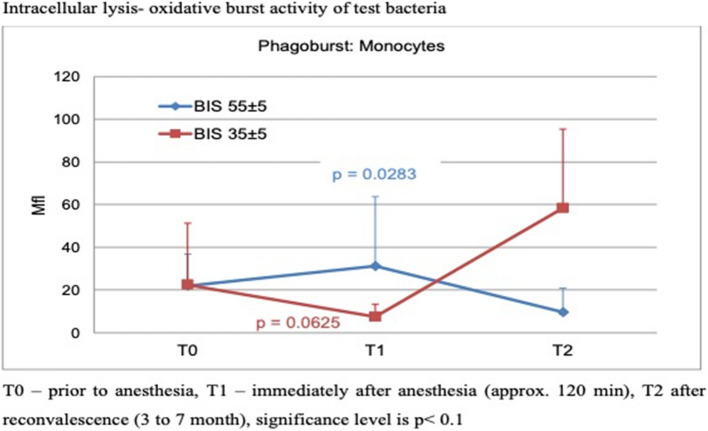
Results: Anesthesia duration was 109 min in the deep anesthesia group with 81 ± 17 min of BIS < 45 and a mean BIS of 38 ± 14. The light anesthesia group received anesthesia for 111 min with 13 ± 8 min of BIS < 45 and a mean BIS 56 ± 8. Cytotoxic T-cells decreased fivefold in the light anesthesia group compared to the deep anesthesia group (-28 ± 13% vs. -6 ± 18%, respectively). The number of NK-cells (p = 0.0127) and regulatory T-cells (p = 0.0217) both dropped after deep anesthesia to almost half of the plasma level. Phagocytosis activity of neutrophils and monocytes was constant with a 67% decreased trend of intracellular lysis in monocytes (p = 0.0625). Quantitative proteomic analyses revealed 27 anesthesia-regulated protein spots in human monocytes, 14 of which were significantly identified by MALDI-MS, and were related to processes such as macrophage function and lymphocyte proliferation, tumor progression and apoptosis.
Conclusions: Deep anesthesia inhibited immune competent defense cells (killer cells and regulatory T-cells) and had a general suppression on the phagocytic function of all circulating immune competent cells.
期刊介绍:
BMC Anesthesiology is an open access, peer-reviewed journal that considers articles on all aspects of anesthesiology, critical care, perioperative care and pain management, including clinical and experimental research into anesthetic mechanisms, administration and efficacy, technology and monitoring, and associated economic issues.





 京公网安备 11010802042870号
京ICP备2023020795号-1
京公网安备 11010802042870号
京ICP备2023020795号-1

 分享
分享
 求助内容:
求助内容: 应助结果提醒方式:
 扫码关注我们
