Taehwa Kim, Eunjeong Son, Min Wook So, Doosoo Jeon, Hye Ju Yeo, Seung Eun Lee, Yun Seong Kim
{"title":"Predicting Healthcare-Associated Infection in Patients with Pneumonia via QuantiFERON<sup>®</sup>-Monitoring.","authors":"Taehwa Kim, Eunjeong Son, Min Wook So, Doosoo Jeon, Hye Ju Yeo, Seung Eun Lee, Yun Seong Kim","doi":"10.2147/IDR.S499765","DOIUrl":null,"url":null,"abstract":"<p><strong>Objective: </strong>A functional immune system is essential for recovery from pneumonia; hence, measuring and monitoring immune-status indicators is clinically important. This study aimed to determine whether QuantiFERON monitoring (QMF) could predict healthcare-associated infection (HCAI) according to the immune-status of patients with pneumonia.</p><p><strong>Methods: </strong>Prospective, observational, single-center study, patients ≥19 years hospitalized for pneumonia between October 2020 and November 2021. QFM was performed at hospital admission (D1) and seven days after (D2). Data from 90 patients in the D1 QFM group were analyzed, which was further divided into the non-healthcare-associated infection (non-HCAI, n = 41, 45.6%) and HCAI (n = 49, 54.4%) groups.</p><p><strong>Results: </strong>The D1 and D2 QFM levels were both significantly higher in the non-HCAI group than in the HCAI group (D1 hCAI vs non-HCAI: 4.40 vs 5.75 IU/mL, D2 hCAI vs non-HCAI: 4.38 vs 6.10 IU/mL). Analysis of the change in D1 and D2 QFM levels by each group showed that D2 QFM levels increased over D1 QFM levels in the non-HCAI group (5.75 vs 6.10 IU/mL), while D2 QFM levels decreased over D1 QFM levels in the HCAI group (4.40 vs 4.38 IU/mL). D1 QFM was consistently negatively correlated with TNF-α and CRP. The integrated analysis of D1 QFM and CCI and D1 QFM and CURB-65 had fair to predict the occurrence of HCAI.</p><p><strong>Conclusion: </strong>QFM can be used to predict the immune-status of patients in the context of healthcare-associated infections. These findings provide important insights into the current understanding of pneumonia treatment and recovery.</p>","PeriodicalId":13577,"journal":{"name":"Infection and Drug Resistance","volume":"18 ","pages":"1381-1391"},"PeriodicalIF":3.2000,"publicationDate":"2025-03-12","publicationTypes":"Journal Article","fieldsOfStudy":null,"isOpenAccess":false,"openAccessPdf":"https://www.ncbi.nlm.nih.gov/pmc/articles/PMC11911649/pdf/","citationCount":"0","resultStr":null,"platform":"Semanticscholar","paperid":null,"PeriodicalName":"Infection and Drug Resistance","FirstCategoryId":"3","ListUrlMain":"https://doi.org/10.2147/IDR.S499765","RegionNum":3,"RegionCategory":"医学","ArticlePicture":[],"TitleCN":null,"AbstractTextCN":null,"PMCID":null,"EPubDate":"2025/1/1 0:00:00","PubModel":"eCollection","JCR":"Q2","JCRName":"INFECTIOUS DISEASES","Score":null,"Total":0}
引用次数: 0
Abstract
Objective: A functional immune system is essential for recovery from pneumonia; hence, measuring and monitoring immune-status indicators is clinically important. This study aimed to determine whether QuantiFERON monitoring (QMF) could predict healthcare-associated infection (HCAI) according to the immune-status of patients with pneumonia.
Methods: Prospective, observational, single-center study, patients ≥19 years hospitalized for pneumonia between October 2020 and November 2021. QFM was performed at hospital admission (D1) and seven days after (D2). Data from 90 patients in the D1 QFM group were analyzed, which was further divided into the non-healthcare-associated infection (non-HCAI, n = 41, 45.6%) and HCAI (n = 49, 54.4%) groups.
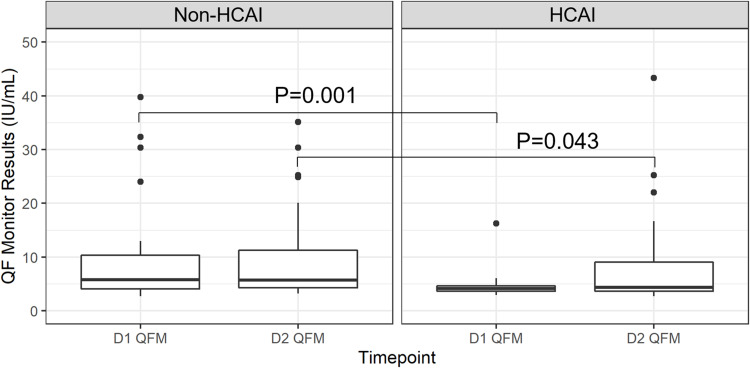
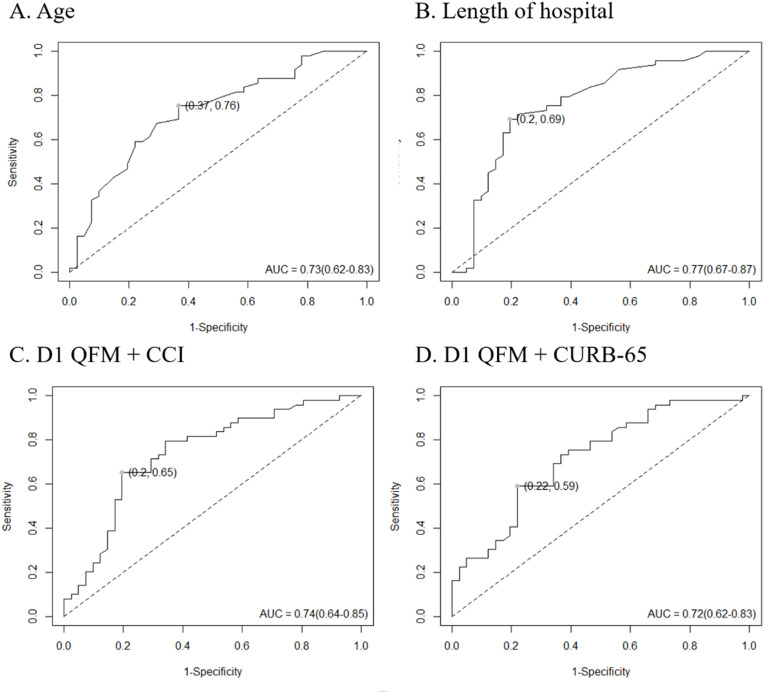
Results: The D1 and D2 QFM levels were both significantly higher in the non-HCAI group than in the HCAI group (D1 hCAI vs non-HCAI: 4.40 vs 5.75 IU/mL, D2 hCAI vs non-HCAI: 4.38 vs 6.10 IU/mL). Analysis of the change in D1 and D2 QFM levels by each group showed that D2 QFM levels increased over D1 QFM levels in the non-HCAI group (5.75 vs 6.10 IU/mL), while D2 QFM levels decreased over D1 QFM levels in the HCAI group (4.40 vs 4.38 IU/mL). D1 QFM was consistently negatively correlated with TNF-α and CRP. The integrated analysis of D1 QFM and CCI and D1 QFM and CURB-65 had fair to predict the occurrence of HCAI.
Conclusion: QFM can be used to predict the immune-status of patients in the context of healthcare-associated infections. These findings provide important insights into the current understanding of pneumonia treatment and recovery.
期刊介绍:
About Journal
Editors
Peer Reviewers
Articles
Article Publishing Charges
Aims and Scope
Call For Papers
ISSN: 1178-6973
Editor-in-Chief: Professor Suresh Antony
An international, peer-reviewed, open access journal that focuses on the optimal treatment of infection (bacterial, fungal and viral) and the development and institution of preventative strategies to minimize the development and spread of resistance.





 京公网安备 11010802042870号
京ICP备2023020795号-1
京公网安备 11010802042870号
京ICP备2023020795号-1

 分享
分享
 求助内容:
求助内容: 应助结果提醒方式:
 扫码关注我们
