{"title":"Global Ragweed Allergy: Molecular Allergens and Integrated Control Strategies.","authors":"Zi-Lu Cheng, Ting-Ting Ma, Zhong-Shan Gao, Wen-Hua Ming, Mei-Rong Yang, Xue-Yan Wang","doi":"10.2147/JAA.S506897","DOIUrl":null,"url":null,"abstract":"<p><p>Originally native to North America, ragweed has become a pervasive invasive species worldwide over the past century, posing a substantial public health risk as a potent allergen. This review explores the key allergens found in common ragweed, assesses global trends in ragweed sensitization, particularly in China, and examines various therapeutic and biological control methods. There are currently 11 identified ragweed allergens, with Amb a 1 and 11 recognized as the primary triggers. Epidemiological data indicate higher rates of sensitization in North America and Europe, with a growing trend observed in China. Ragweed-induced type I hypersensitivity typically presents as seasonal allergic rhinitis, conjunctivitis, and asthma symptoms. Strategies for managing ragweed allergy include allergen avoidance, pharmacotherapy, and allergen immunotherapy (AIT). Biological control using <i>Ophraella communa</i> and <i>Epiblema strenuana</i> effectively limits ragweed proliferation. Accurate allergen identification and personalized treatment can significantly reduce the health burden associated with ragweed. An in-depth understanding of ragweed sensitization patterns and biological control measures is essential for the long-term prevention of ragweed allergies.</p>","PeriodicalId":15079,"journal":{"name":"Journal of Asthma and Allergy","volume":"18 ","pages":"403-416"},"PeriodicalIF":3.0000,"publicationDate":"2025-03-12","publicationTypes":"Journal Article","fieldsOfStudy":null,"isOpenAccess":false,"openAccessPdf":"https://www.ncbi.nlm.nih.gov/pmc/articles/PMC11911648/pdf/","citationCount":"0","resultStr":null,"platform":"Semanticscholar","paperid":null,"PeriodicalName":"Journal of Asthma and Allergy","FirstCategoryId":"3","ListUrlMain":"https://doi.org/10.2147/JAA.S506897","RegionNum":3,"RegionCategory":"医学","ArticlePicture":[],"TitleCN":null,"AbstractTextCN":null,"PMCID":null,"EPubDate":"2025/1/1 0:00:00","PubModel":"eCollection","JCR":"Q2","JCRName":"ALLERGY","Score":null,"Total":0}
引用次数: 0
Abstract
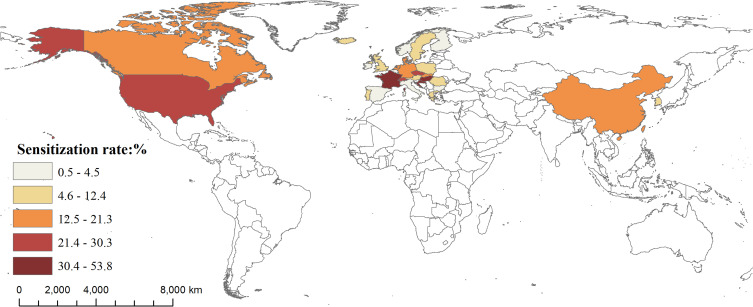
Originally native to North America, ragweed has become a pervasive invasive species worldwide over the past century, posing a substantial public health risk as a potent allergen. This review explores the key allergens found in common ragweed, assesses global trends in ragweed sensitization, particularly in China, and examines various therapeutic and biological control methods. There are currently 11 identified ragweed allergens, with Amb a 1 and 11 recognized as the primary triggers. Epidemiological data indicate higher rates of sensitization in North America and Europe, with a growing trend observed in China. Ragweed-induced type I hypersensitivity typically presents as seasonal allergic rhinitis, conjunctivitis, and asthma symptoms. Strategies for managing ragweed allergy include allergen avoidance, pharmacotherapy, and allergen immunotherapy (AIT). Biological control using Ophraella communa and Epiblema strenuana effectively limits ragweed proliferation. Accurate allergen identification and personalized treatment can significantly reduce the health burden associated with ragweed. An in-depth understanding of ragweed sensitization patterns and biological control measures is essential for the long-term prevention of ragweed allergies.
期刊介绍:
An international, peer-reviewed journal publishing original research, reports, editorials and commentaries on the following topics: Asthma; Pulmonary physiology; Asthma related clinical health; Clinical immunology and the immunological basis of disease; Pharmacological interventions and new therapies.
Although the main focus of the journal will be to publish research and clinical results in humans, preclinical, animal and in vitro studies will be published where they shed light on disease processes and potential new therapies.



 京公网安备 11010802042870号
京ICP备2023020795号-1
京公网安备 11010802042870号
京ICP备2023020795号-1

 分享
分享
 求助内容:
求助内容: 应助结果提醒方式:
 扫码关注我们
