{"title":"Investigating the therapeutic potential of 1,2,3,4,6 penta-O-galloyl-β-D-glucose in Alzheimer's disease: a scoping review.","authors":"Ezaldean Kahil, Anisha Jackson, Bernadette D'Souza, Gregory Gorman, Patricia Jumbo-Lucioni","doi":"10.1080/14786419.2025.2477226","DOIUrl":null,"url":null,"abstract":"<p><p>The gallotannin 1,2,3,4,6-Penta-O-Galloyl-β-D-Glucose (β-PGG) has recently garnered scientific interest due to its potent antioxidant, anti-inflammatory and neuroprotective properties. Alzheimer's disease (AD), a neurodegenerative disorder marked by neuroinflammation, oxidative stress, cholinergic dysfunction, accumulation of amyloid β (Aβ), tau and metal ions, may benefit from β-PGG interventions. This review synthesises existing literature to explore the therapeutic potential of β-PGG in AD. Experimental evidence suggests that β-PGG can suppress pro-inflammatory mediator release and inhibit NF-κB and MAPK signalling pathways, both critical in AD progression. <i>In vitro</i> studies highlight β-PGG's ability to scavenge free radicals, enhance antioxidant enzyme function, and prevent lipid peroxidation, well-known phenomena in AD. Additionally, neuroprotection may be conferred by β-PGG's capacity to reduce metal ion accumulation, inhibit Aβ and tau aggregation, and modulate cholinergic neurotransmission <i>in vitro</i>. In summary, while β-PGG shows promise in targeting AD hallmarks <i>in vitro</i>, further <i>in vivo</i> studies are crucial to validate its therapeutic potential.</p>","PeriodicalId":18990,"journal":{"name":"Natural Product Research","volume":" ","pages":"1-15"},"PeriodicalIF":1.6000,"publicationDate":"2025-03-17","publicationTypes":"Journal Article","fieldsOfStudy":null,"isOpenAccess":false,"openAccessPdf":"","citationCount":"0","resultStr":null,"platform":"Semanticscholar","paperid":null,"PeriodicalName":"Natural Product Research","FirstCategoryId":"92","ListUrlMain":"https://doi.org/10.1080/14786419.2025.2477226","RegionNum":3,"RegionCategory":"化学","ArticlePicture":[],"TitleCN":null,"AbstractTextCN":null,"PMCID":null,"EPubDate":"","PubModel":"","JCR":"Q3","JCRName":"CHEMISTRY, APPLIED","Score":null,"Total":0}
引用次数: 0
Abstract
The gallotannin 1,2,3,4,6-Penta-O-Galloyl-β-D-Glucose (β-PGG) has recently garnered scientific interest due to its potent antioxidant, anti-inflammatory and neuroprotective properties. Alzheimer's disease (AD), a neurodegenerative disorder marked by neuroinflammation, oxidative stress, cholinergic dysfunction, accumulation of amyloid β (Aβ), tau and metal ions, may benefit from β-PGG interventions. This review synthesises existing literature to explore the therapeutic potential of β-PGG in AD. Experimental evidence suggests that β-PGG can suppress pro-inflammatory mediator release and inhibit NF-κB and MAPK signalling pathways, both critical in AD progression. In vitro studies highlight β-PGG's ability to scavenge free radicals, enhance antioxidant enzyme function, and prevent lipid peroxidation, well-known phenomena in AD. Additionally, neuroprotection may be conferred by β-PGG's capacity to reduce metal ion accumulation, inhibit Aβ and tau aggregation, and modulate cholinergic neurotransmission in vitro. In summary, while β-PGG shows promise in targeting AD hallmarks in vitro, further in vivo studies are crucial to validate its therapeutic potential.
没食子酸1,2,3,4,6-五- o -没食子酸-β- d -葡萄糖(β-PGG)由于其有效的抗氧化、抗炎和神经保护特性,最近引起了科学界的兴趣。阿尔茨海默病(AD)是一种以神经炎症、氧化应激、胆碱能功能障碍、β淀粉样蛋白(a β)、tau和金属离子积累为特征的神经退行性疾病,可能受益于β- pgg干预。本文综合现有文献,探讨β-PGG在AD中的治疗潜力。实验证据表明,β-PGG可以抑制促炎介质的释放,抑制NF-κB和MAPK信号通路,这两个信号通路在AD的进展中都是至关重要的。体外研究表明,β-PGG具有清除自由基、增强抗氧化酶功能和防止脂质过氧化的能力,这是AD中众所周知的现象。此外,在体外实验中,β-PGG减少金属离子积累、抑制Aβ和tau聚集以及调节胆碱能神经传递的能力可能赋予神经保护作用。综上所述,尽管β-PGG在体外靶向AD标志物方面显示出前景,但进一步的体内研究对于验证其治疗潜力至关重要。
期刊介绍:
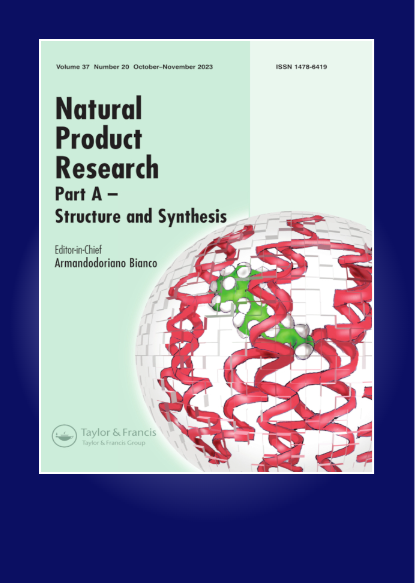
The aim of Natural Product Research is to publish important contributions in the field of natural product chemistry. The journal covers all aspects of research in the chemistry and biochemistry of naturally occurring compounds.
The communications include coverage of work on natural substances of land and sea and of plants, microbes and animals. Discussions of structure elucidation, synthesis and experimental biosynthesis of natural products as well as developments of methods in these areas are welcomed in the journal. Finally, research papers in fields on the chemistry-biology boundary, eg. fermentation chemistry, plant tissue culture investigations etc., are accepted into the journal.
Natural Product Research issues will be subtitled either ""Part A - Synthesis and Structure"" or ""Part B - Bioactive Natural Products"". for details on this , see the forthcoming articles section.
All manuscript submissions are subject to initial appraisal by the Editor, and, if found suitable for further consideration, to peer review by independent, anonymous expert referees. All peer review is single blind and submission is online via ScholarOne Manuscripts.




 京公网安备 11010802042870号
京ICP备2023020795号-1
京公网安备 11010802042870号
京ICP备2023020795号-1

 分享
分享
 求助内容:
求助内容: 应助结果提醒方式:
 扫码关注我们
